

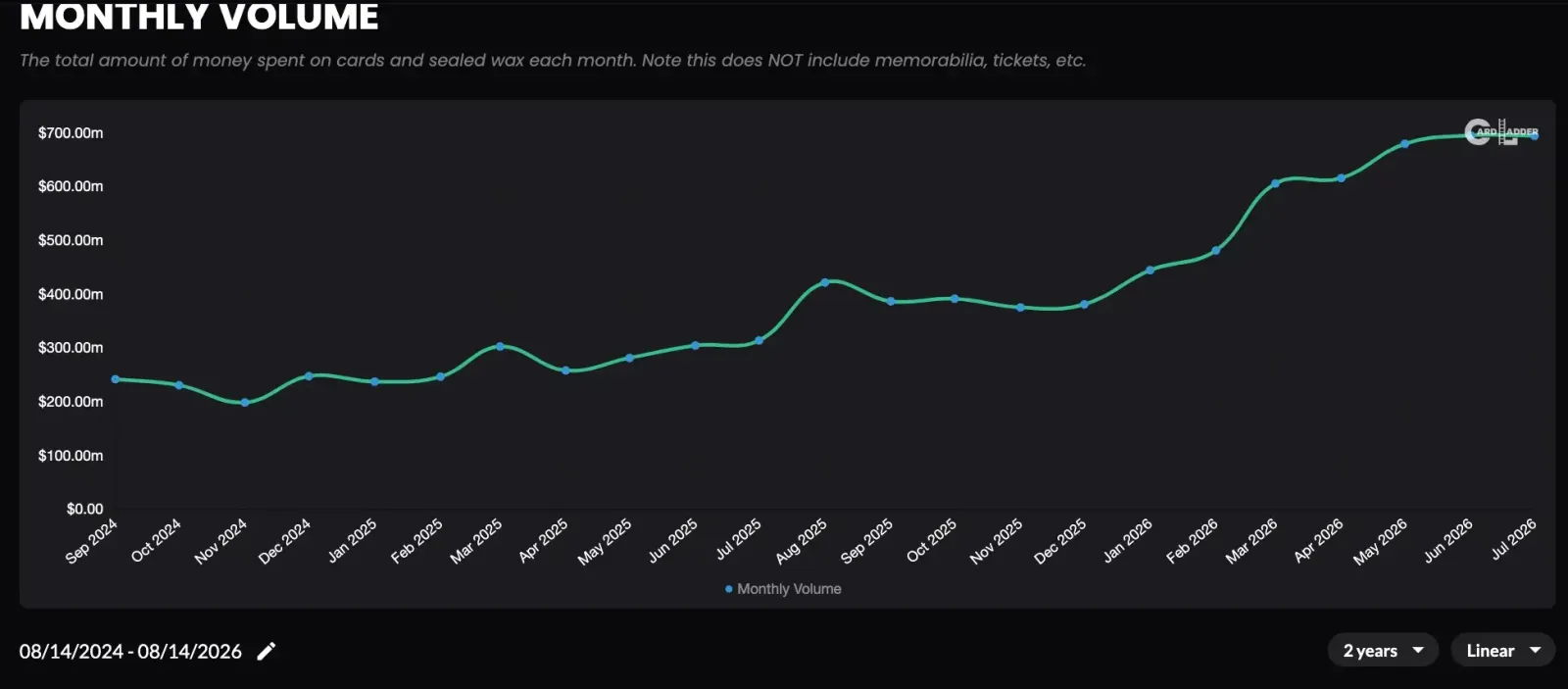
Sports Card Market Strength Raises a Bigger Question
The sports card market has been running hot, with higher prices, stronger sales data, and more outside money flowing into the hobby. That kind of growth has created excitement across the industry, but it has also sparked a familiar concern: how long can it last?
On a recent Sports Cards Nonsense podcast, Mike Giosefii and Jesse Gibson talked through the current state of the market and the impact of new investment entering the hobby. Their discussion centered on a simple but important question for collectors: if values are up across the board, is now the time to sell some cards and lock in gains?
There is no panic in the conversation, but there is a clear sense that prices, costs, and expectations have all moved higher at the same time. For many collectors, that combination is starting to feel less like a hobby and more like a financial balancing act.
Big Money Keeps Entering the Hobby
One of the biggest talking points was the amount of new money entering the sports card space. The podcast referenced CardVault by Tom Brady's new round of funding and the involvement of major names such as Jay-Z, Aaron Judge, Connor McDavid, and Dana White.
That kind of attention does not happen in a vacuum. It reflects a hobby that has become more visible, more commercial, and more attractive to outside investors than it was in years past. Card shops are opening across the country, and large-scale breaking operations continue to grow. Those are signs of a market with real momentum.
At the same time, the influx of money has created pressure points. When more capital enters a hobby that once relied heavily on collectors and enthusiasts, prices can rise quickly. That can be good news for people who already own valuable cards, but it can also make it harder for new collectors to participate at the same level.
Higher Prices Are Changing the Collector Experience
Mike Giosefii made the point that the problem is not limited to one category of cards. In his view, the cost increases are showing up everywhere.
That includes singles, boxes, grading, travel to card shows, and the broader cost of participating in the hobby. Even if product quality has improved, the overall price of entry has become much steeper. For collectors who want to buy cards, rip boxes, grade cards, and attend major events, the total expense can add up fast.
He framed it as a situation where collectors may now need to sell a major card just to keep up with the rest of their hobby spending. That is a meaningful shift. It suggests that even longtime collectors with strong collections may have to make choices about what they keep and what they move in order to stay active.
The issue is not only affordability in the abstract. It is also about access. If too many collectors feel priced out, the hobby risks becoming less welcoming to the very people who helped build it.
Why the Market Feels Strong and Fragile at the Same Time
There is a tension running through the current market. On one hand, values are high and many collections are worth more than they were a few years ago. On the other hand, those same rising values can make the market feel unstable if the pace of growth becomes difficult to sustain.
Mike said he is not predicting doom and gloom. He still sees runway in the market, and he was careful not to suggest that collectors should rush to liquidate everything. But he also said it makes sense to take some money off the table rather than assume prices will keep climbing forever.
That perspective reflects a broader reality in collectibles. Markets can stay strong for long stretches, but they rarely move in a straight line. Corrections are part of the cycle, and collectors who have seen multiple waves of growth and pullback often understand that the best time to sell is not always when everyone feels the most confident.
Jesse Gibson echoed that concern, saying he could not foresee a future where the current level of pricing remains sustainable indefinitely. His point was not that the hobby is in trouble now, but that the structure of the market has changed enough to make long-term continuation at these levels difficult to imagine.
Collectors Are Feeling the Pressure From Every Direction
One reason this conversation resonates is that the pressure is not coming from just one source. It is not only that singles are more expensive. It is also that the entire ecosystem around the hobby has become more costly.
- Higher prices for sealed product
- More expensive grading services
- Travel and setup costs for card shows
- Increased competition for top cards
- More money required to stay active across multiple areas of the hobby
That makes participation harder for collectors who are not operating with large budgets. It also changes how people think about their collections. A card that once felt like a long-term hold may now represent a chance to realize gains and redeploy that money into other parts of the hobby, or simply to reduce exposure if the market cools.
For some collectors, that means selling cards that are not part of their personal collection. For others, it may mean trimming inventory or moving duplicate pieces while demand remains strong. The key idea is not necessarily to exit the market, but to think carefully about where value can be captured.
Is This the Right Time to Take Some Wins?
The central question from the podcast was whether collectors should consider selling at least some cards while prices remain elevated. That question does not have a one-size-fits-all answer, but it is becoming harder to ignore.
If values are up across the board and costs are rising just as quickly, then holding everything indefinitely may not be the best strategy for every collector. Some may prefer to reduce risk by selling cards that are not essential to their personal collections. Others may want to keep riding the market and see how far it can go.
Mike's advice was measured rather than dramatic. He did not argue for a full sell-off. Instead, he suggested taking a little off the table. That approach reflects a practical mindset: if the market has already delivered gains, there is nothing wrong with realizing some of them.
That idea may be especially relevant for collectors who have built strong positions in cards that are no longer central to what they collect. If a card is not a true PC item, and the market is offering a strong return, selling part of a collection can create flexibility without forcing a complete reset.
What the Current Debate Says About the Hobby
The discussion between Mike and Jesse is less about predicting a crash and more about recognizing how much the hobby has changed. Sports cards are no longer just a collector-driven market. They are now influenced by investors, celebrities, major brands, and large-scale business activity.
That shift has brought more attention and more money, but it has also changed the economics of participation. A hobby that once felt accessible to a wide range of collectors now asks more from everyone involved, whether that means paying more for cards, spending more to grade, or investing more to attend major events.
For collectors, the challenge is deciding how to respond. Some will continue buying aggressively. Some will focus only on personal collection items. Others will look at the current market and decide it is a good time to sell select cards and preserve gains.
The market may still have room to run, but the conversation itself is a reminder that strong prices do not eliminate risk. They simply change where the risk sits. For many collectors, that makes now a reasonable time to review holdings, reassess goals, and decide which cards are worth keeping for the long term.
As the hobby continues to evolve, the balance between collecting, investing, and speculating will remain a major part of the conversation. For now, the market is strong, but the question hanging over it is whether collectors should enjoy the run while it lasts and be ready to take some wins along the way.
Join the Sports Card Portal Page thread for this story.
Comments
0You must be signed in to comment.
Sign In