

Put three cards of the same player from the same season on a table. One has the clean portrait you want for your binder. Another captures a game you remember. The third has a finish you love but costs enough to delay filling a missing year. All three may be good cards. The question is whether they’re all doing a different job in your collection.
A focused player collection gives you a way to answer that question before you shop. Choose what you want the cards to show, define what earns a slot, and set aside a little room for surprises. You can collect across several seasons and product lines without turning every new parallel into another item you’re supposed to buy.
Give the collection a finish line
Write a one-sentence brief with the player, the seasons you’ll cover, what earns a main slot, and how many exceptions you’ll allow. For example: “One standard-size solo card per season from 2022 through 2026, plus up to three extras: an event card, an autograph, and a parallel.” That’s a buying rule, not a prediction that all eight targets exist. An unfilled slot is a better outcome than buying a card you don’t want just to close a gap.
Choose the structure by imagining how you’ll look through the finished collection. If you want to watch the player’s career unfold year by year, build a season run. If you want to compare photography, design, or finishes, make a sampler of named product lines within a fixed period. For a career story, give each slot a specific job, such as showing a new team or marking a game that mattered to you. A timeline makes gaps visible; a story collection lets you skip years that add little.
Decide what counts as a different brand
“Across brands” can mean different manufacturers or different product lines from the same manufacturer. Decide which distinction matters before you build the want list. Topps Chrome Baseball and Topps Series 1 Baseball can give a display visual variety, but they don’t satisfy a two-manufacturer rule. If what you really want is a change of pace from page to page, a product-line rule may serve you better than requiring a second manufacturer.
Consider three documented options for Aaron Judge in 2024: Chrome Baseball base card #50, the Series 1 Heavy Lumber insert HL-3, and Topps Now event card #117. They give you three ways to represent the year: a base card, a design-led insert, or a card tied to a particular event. If you allow only one main card per season, compare them as alternatives. If you can’t verify an eligible card from a second manufacturer, leave that slot open or change the rule explicitly rather than stretching your definition.
Identify the exact card before tracking a listing
Start with the checklist for the specific release, then read the heading above the player’s name. Judge’s HL-3 appears under Heavy Lumber in 2024 Topps Series 1, while OTB-4 is in the Super Box–exclusive oversized set. A listing that says only “2024 Topps Judge insert” doesn’t distinguish them. That difference matters if you’re filling standard binder pockets or looking for one particular design. Ask for photos of the actual card when the listing leaves the format unclear.
Sometimes the distinction is a suffix; sometimes even the whole number isn’t enough. Topps Now lists Judge’s #117 and short print #117SP under the same April 24, 2024 event date. In 2024–25 Upper Deck Series 1 Hockey, Lane Hutson’s Young Guns base and Exclusives parallel both use #229. The hockey example isn’t another manufacturer option for Judge; it shows why the same identification habit works across sports. Match the release, subset, number, and variant together rather than relying on any one field.
Keep the season, event date, and rookie rule separate
Use the manufacturer’s issue designation even if you sort your collection another way. Upper Deck calls the hockey release 2024–25, so keep both years in the identity record. If your display groups cards by the year a season began, put that in a separate sorting field. Likewise, the April 24 date beside Judge’s Topps Now #117 is an event date, not evidence of when the card shipped. Your purchase date belongs in a different field again.
Define a rookie slot just as carefully. Upper Deck identifies Hutson’s #229 Young Guns base as a rookie, which is enough if your rule is to choose a card designated as a rookie on its checklist. It doesn’t prove that card is the earliest one featuring him. If what interests you is the earliest issue you can document, treat that as a different target and leave it unresolved while you compare evidence. Don’t let a seller’s use of “rookie” settle either question.
Make extras earn space without expanding the main run
Give each extra a job you can describe without using the word “rare.” A team-color parallel might complement the uniform, an autograph might anchor the display, or a shared card might tell a story the solo run can’t. Topps Now #76 features Judge and Derek Jeter, so it could fit a career-story collection without qualifying for a solo season slot. A fixed allowance lets you enjoy a card like that without having to rewrite the main collection every time you find an exception.
If you want a rainbow, make it a separate project around one exact card and release. Decide in advance whether the hardest variants are required or optional. The Upper Deck checklist lists Hutson’s Exclusives parallel at 100 and identifies Hobby and e-Pack as its distribution formats. That listed quantity is not a pack probability, and the checklist’s Young Guns category odds aren’t the odds of pulling Hutson specifically. If your goal is to fill one exact slot, shop for the single first. Buy packs if you want the experience of opening them, not as a substitute for the want list.
Set a condition standard you’ll actually use
Set the standard by slot rather than requiring the same holder for everything. For a binder run, front and back photos can help you decide whether corner wear, centering, or a surface mark will bother you. A lightly worn copy might be fine if the image is what drew you to the card. For a centerpiece, you might require a numeric grade but still compare copies for the trait you care about most, such as how evenly the image sits within the borders.
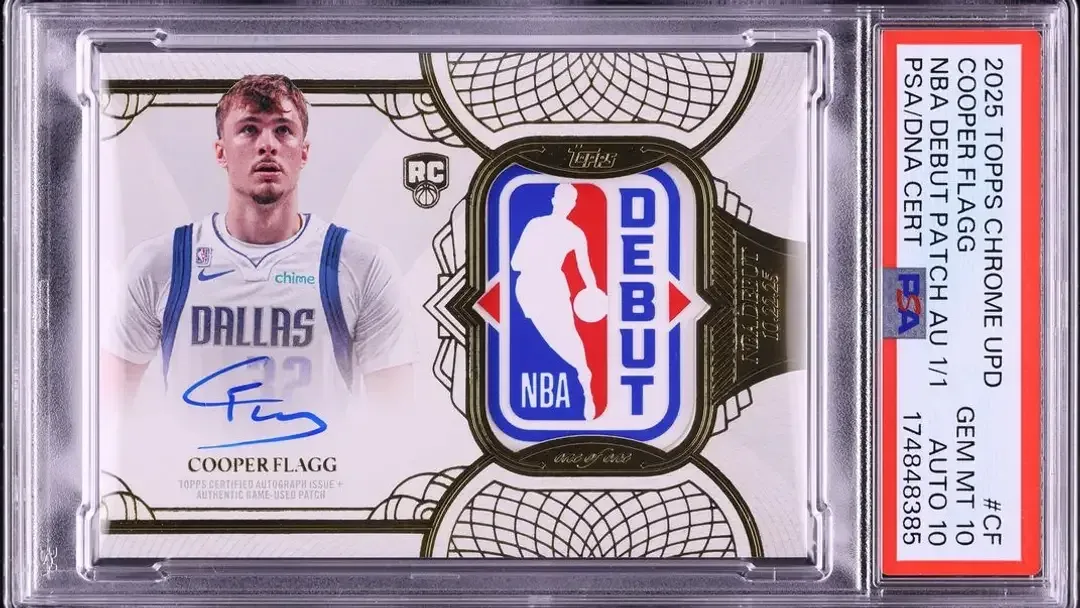
Read the label for what it actually says. PSA distinguishes numeric condition grades from designations such as Authentic and Authentic Altered. Neither designation translates into a numeric grade, and they don’t mean the same thing as each other. Decide whether you’ll accept alteration before comparing prices. On a signed card, check whether a number refers to the autograph or the card itself. If your brief calls for a numeric card grade, an autograph grade doesn’t meet that rule.
Check the item, not just the certification number
When buying a slab, enter the certification number yourself and compare the returned description and grade or designation with the listing. Compare images if the record provides them. A matching lookup tells you what PSA associates with the number; it doesn’t establish that the item in the photos is the one PSA examined. Counterfeit inserts can carry real numbers copied from public sources, so a database match is one check, not a reason to skip the others.
Ask for clear front and back photos of the actual item, especially if the listing crops the label or uses a generic image. A familiar player and matching number won’t resolve a disagreement over the variant, grade, or holder. Give the seller a chance to clarify a mistake, but pass if a material mismatch remains or you can’t get enough information. Confirming that an issue exists, checking what a certification number describes, and evaluating the offered copy are three separate tasks.
Make purchases compete for the same budget
Set a delivered-cost cap for each slot and protect the money you’ve set aside for missing seasons. Imagine you already own a 2024 card you like, but a sharper-looking example turns up while an earlier season is still empty. Compare the upgrade with the best eligible card for the gap, not just with your existing copy. If you still prefer the upgrade, name the card it will replace and decide whether the outgoing copy will stay as an extra, move to another project, or leave the collection.
For the Judge event slot, suppose #117 already captures what you want from that April 24 entry. The existence of #117SP doesn’t make the base card a placeholder. Ask what you’d value about the exact short print if the seller never called it scarce. If you have a clear answer and the purchase fits your cap, it may be a worthwhile replacement. If the only answer is that it’s harder to find, give the next empty slot first claim on the money.
Track what you know and count only what qualifies
Give each slot its own row in a spreadsheet or notebook, even before you’ve settled on a card. Keep identity fields together: issue designation, manufacturer, product, subset, number, variant, and where you confirmed them. Keep seller, delivered cost, observed condition, and certification number in separate purchase fields. This makes it easier to compare two copies without confusing an asking price or a seller’s description with a permanent fact about the issue.
Mark candidates verified, unresolved, or out of scope, and track ownership separately. A verified target can still be unowned; an unresolved target isn’t necessarily nonexistent. Revisit the want list when a gap stops making sense under your rules. You might keep the space open, choose a different eligible product line, or narrow the season range. Write down the change so the next tempting listing doesn’t move the finish line again. When the main slots are filled, you can call the run complete even if the optional slots stay empty.
Frequently Asked Questions
Should a base card or a parallel fill my season slot?
Either can work if your rules allow it. Choose the base if the image and design already represent the year well. Choose the parallel if its finish or color adds something you’d miss and the delivered price fits the slot.
Can a card featuring two players count in a player collection?
Yes, if it fits your brief. A shared card can be ideal for a career milestone or event slot, but it shouldn’t count toward a run you’ve defined as solo cards only.
Do I need all my cards raw or all graded?
No. A raw binder run and a few graded centerpieces can coexist. Choose a consistent format only if it matters to how you store, display, or evaluate the cards.
What if I can’t confirm a card for one season?
Leave the slot unresolved and record what you checked. A missing entry in one release doesn’t rule out every other product, and an unverified listing doesn’t prove an eligible issue exists.
Written with AI assistance. Featured image: AI-generated editorial illustration.

Comments
0You must be signed in to comment.
Sign In