

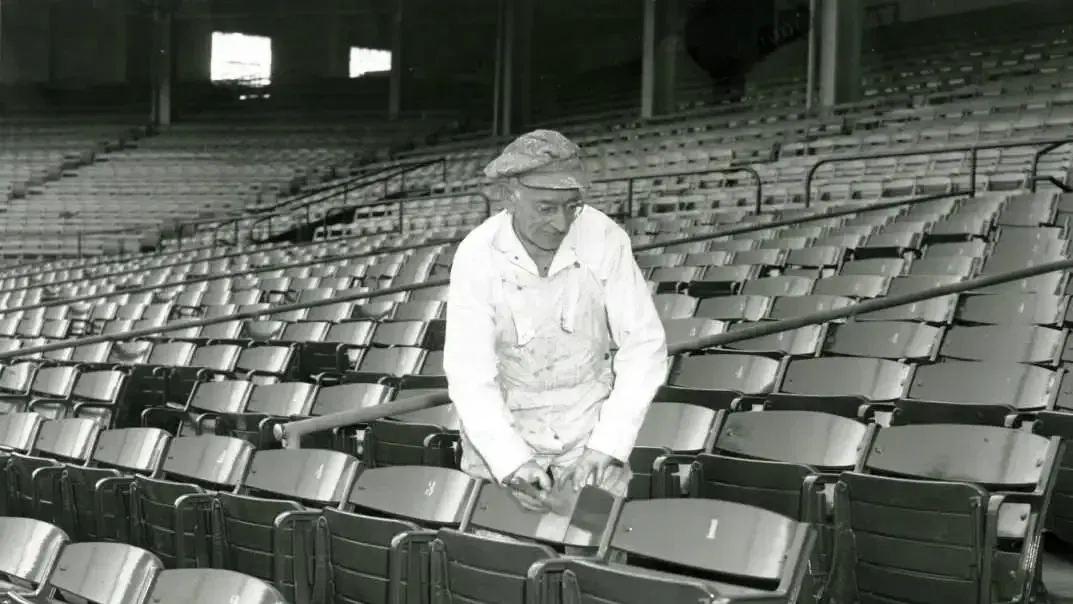
Historic ballpark seats remain a niche collectible
Seats from classic ballparks have long been part of the broader world of sports memorabilia. Along with signs, turnstiles and other fixtures, they offer collectors a tangible connection to venues that hosted generations of fans and countless memorable moments.
For many collectors, the appeal is obvious. These items were used in real stadiums, often for decades, and they bring a piece of sports history into a home, office or man cave. But that same appeal creates a problem: in an online marketplace filled with one-off listings and limited documentation, authenticity is not always easy to confirm.
A recent reminder came from a collector who picked up a Comiskey Park box seat at a Florida tag sale for less than $50. The seat showed the kind of wear expected from decades of use, retained much of its original lime green paint and included a plaque manufactured by Seitz and Company in the early 1990s. Based on prior experience with a similar seat, the buyer felt comfortable that it was genuine and later sold it on eBay for $275 to a White Sox fan buying it for his father.
That kind of clear provenance is not always available. When stadium seats are sold through major auction houses, staff researchers can review the lots before they are cataloged. But when the transaction is between private sellers online, the burden of verification falls heavily on the buyer.
Why authenticating stadium seats is complicated
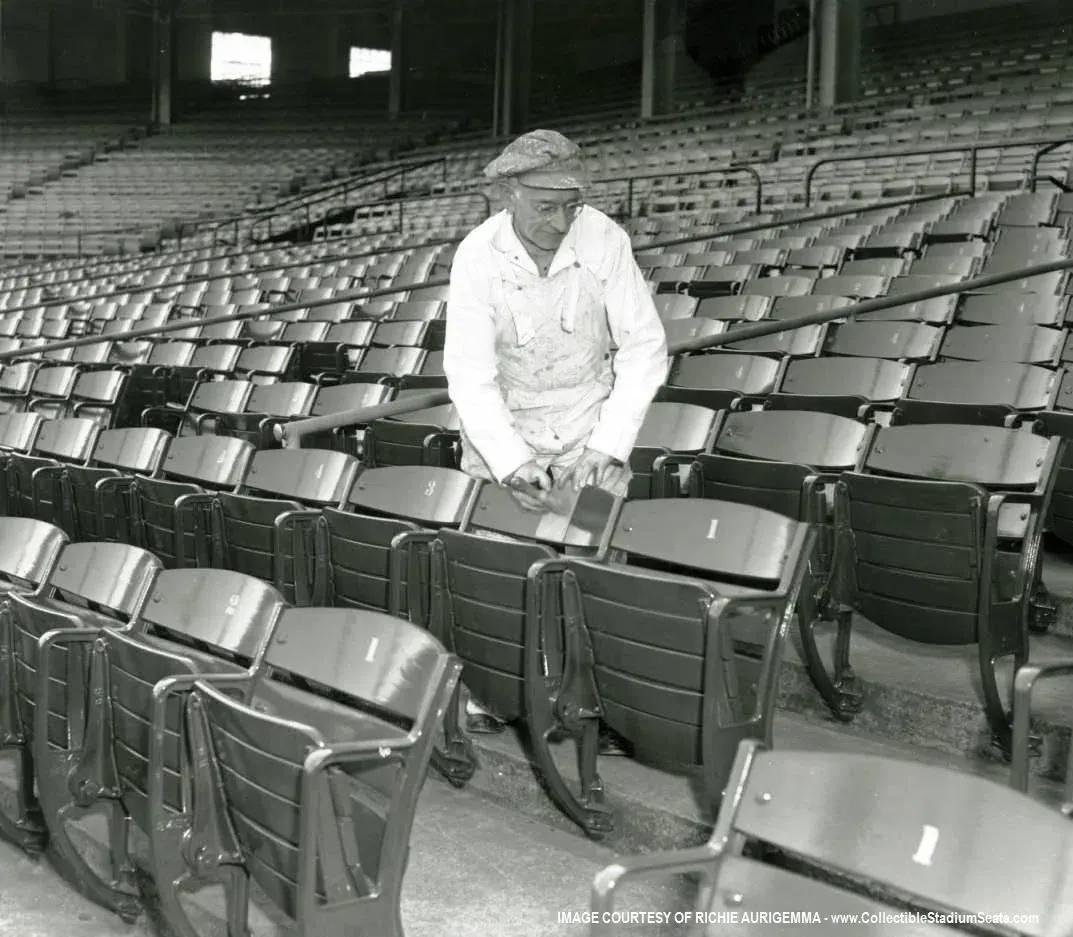
One of the biggest challenges is that a single ballpark may have used several different seat styles over its lifetime, sometimes from multiple manufacturers. A seat claimed to be from a famous stadium may be real, but that does not automatically mean it is the exact style a collector expects.
Shibe Park, later known as Connie Mack Stadium, is a strong example. The Philadelphia ballpark opened in 1909 and operated for more than 60 years, giving rise to a wide range of seating fixtures. Over time, collectors and dealers have had to sort through different models, paint schemes and later reuse at other venues to determine what is truly from the park.
That detective work often depends on photo-matching. Researchers compare seats to period images, newspaper accounts, reference books and archival material to determine whether a specific chair or fixture matches what was installed at the stadium. In the case of Shibe Park, that process has helped identify several distinct seat types.
Shibe Park seats that collectors pursue
Among the most sought-after Shibe Park seats are two styles installed at the ballpark’s opening in 1909 and manufactured by the Royal Metal Manufacturing Company. The company advertised them as unbreakable steel-based ballpark chairs made specifically for Shibe Park, and they do not appear to have been used in any other major league or minor league park.
Related coverage includes Historic Stadium Seats Remain a Popular Collecting Niche, but Authentication Still Demands Caution.
The Slant Arm and Double Ribbon models
The first is the Slant Arm model. The second is the Double Ribbon, also known as the Heart Shape model. Both have the look of early 20th century stadium seating, which is part of what makes them so desirable to collectors.
Of the two, the Double Ribbon is generally considered the more appealing style because of the artwork inside the armrests. Both models were originally painted dark green. Later repaints introduced different color schemes, with Slant Arms often receiving a peach topcoat with yellow numbers and Double Ribbons commonly painted red with yellow numerals. Peach Double Ribbons are also known to exist, including examples that have been displayed at the Baseball Hall of Fame.
Retail values cited for these seats vary by condition. Slant Arm examples are generally placed in the $500 to $1,000 range, while Double Ribbons are typically valued at $600 to $1,500.
One well-known source of Double Ribbon seats came from Greensboro, North Carolina. During a renovation at WWI Memorial Stadium, a large number of these seats were acquired from the facility. Those seats had previously come from Duncan Park in South Carolina, which had received them from the Phillies when Shibe Park closed. That chain of custody helped strengthen their appeal among collectors.
The Heywood Wakefield two-slat seats
Another 1909 Shibe Park style is the Heywood Wakefield free-standing two-slat curved back box and reserve seat. According to the information cited by collector and dealer Richie Aurigemma, the red version was used in upper-level sections, while a peach version is also known to exist.
These seats are considered uncommon, and Shibe Park is believed to have been the only major league park to use the two-slat version. Aurigemma noted that unrestored examples he has encountered have all been red, making a peach example potentially more desirable from a rarity standpoint.
There is also a grey version with green stenciled numbers that traces back to the same 1909 Heywood Wakefield originals. These seats are real Shibe Park fixtures, but they are not fully original in the sense that their paint was changed later. Aurigemma said sections of Shibe Park seats were diverted to the Bloomsburg Fairgrounds in Pennsylvania, where they were repainted grey and renumbered using a stencil style that closely matched Shibe’s own. Because of that, collectors may view these as authentic fixtures with altered paint rather than fully original examples.
Demand for the grey version is more modest than for the better-known 1909 styles, and Aurigemma placed its value in the $400 to $800 range.
The later grey American Seating model
Another grey seat tied to Shibe Park is a light grey curved back free-standing model with three slats and green seat numbers. This version, manufactured by American Seating, dates to the late 1930s or early 1940s.
These seats were also associated with the Bloomsburg Fairgrounds, where they were reportedly installed in the grandstand. Aurigemma pointed to a Feb. 7, 1991 article in the Bloomsburg Press Enterprise that announced the sale of more than 5,000 battleship grey seats and stated that they had been removed from Shibe Park in the 1940s. A photo accompanying the story showed rows of the same seats lying face down in the Bloomsburg grandstand.
Even so, the provenance remains disputed. Aurigemma said he has not found in-service images of this seat model at Shibe Park and has never seen an unrestored example in any color other than grey. Because of those concerns, he said he could not confidently assign a retail value to the model and left the question of authenticity to individual collectors.
Other Shibe Park fixtures collectors still chase
Shibe Park’s seating history did not end with the early fixed chairs. In the 1950s, the park also used field box folding chairs with a silver frame and padded red leather armrests and bottoms. These chairs were used not only as box seats but also as locker room seating.
They are considered extremely difficult to find. Aurigemma said he has only encountered a few over the years, making them a relatively obscure but distinctive Shibe Park variation. Their portability and recognizable design make them attractive to collectors who want a functional piece of stadium history. Estimated retail value for these chairs is $500 to $1,000.
Another rare item is the circa 1940s locker room or ball boy stool. Aurigemma said he has only seen a couple over the years, but noted that the stool takes up very little space and can be a strong complement to a collection that already includes a Shibe Park locker or other fixture. Estimated retail value is $300 to $500.
What collectors should look for before buying
The main lesson from stadium-seat collecting is that authenticity should never be assumed. A seat may be old, may come from a ballpark-related source and may even have the right color or numbering, but that does not automatically make it what the seller claims.
Collectors are advised to look for several signs of legitimacy:
- Photo-matching to period images when possible
- Documentation from a known stadium source or prior owner
- Evidence of original paint beneath later coats
- Manufacturer details that fit the ballpark’s known seating history
- Consistency between the seat style and the era in which the park used it
Even then, some questions may remain. A seat can be authentic to a stadium while still having been altered, repainted or moved to another venue. That distinction matters, especially for collectors who want a piece that is both genuine and as original as possible.
For those who enjoy the hunt, that uncertainty is part of the challenge. Stadium seats are among the most personal forms of sports memorabilia because they connect directly to the fan experience. They are also among the most complicated, because a single chair can have a long and winding history that crosses ballparks, states and decades.
That is why experienced collectors continue to rely on research, comparison and patience. In a hobby where a seat can be both a conversation piece and a historical artifact, knowing exactly what you are buying is as important as owning it in the first place.

Join the Sports Card Portal Page thread for this story.
Comments
0You must be signed in to comment.
Sign In