

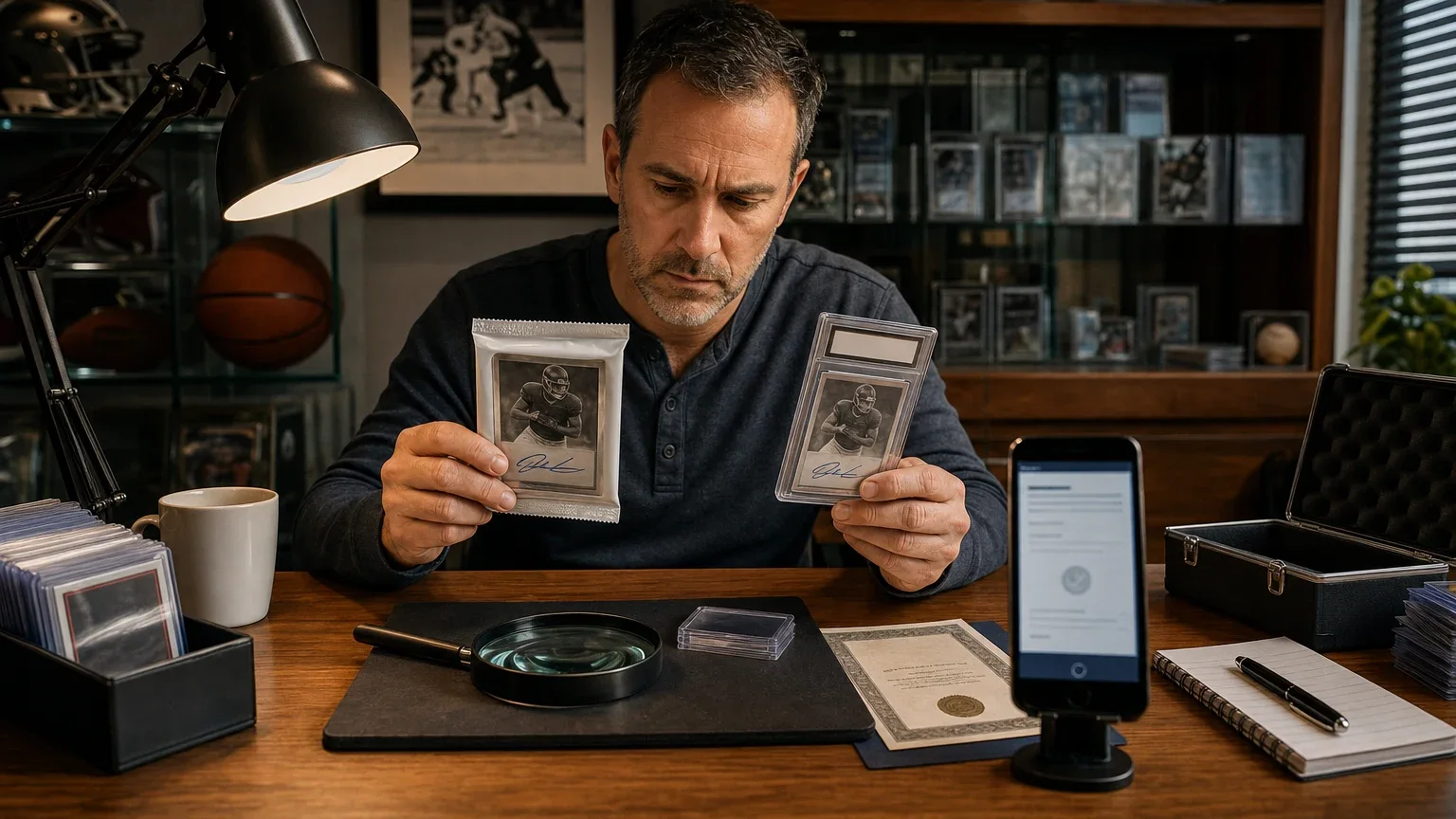
Autograph cards sit at the intersection of product design, player access, and collector trust. Some signatures were built into a card set before the packs ever left the factory. Others were added later and then reviewed by a third-party authenticator. Those two paths can look similar once a card is slabbed, but they do not mean the same thing.
That difference matters because authentication, grading, and provenance are separate questions. A signature can be real without the card being high grade. A label can confirm a certification number without telling you everything about the item’s condition. And a manufacturer’s promise about a certified autograph issue is not always the same as a third-party opinion on a later-signed card.
If you collect modern pack-pulled autos, vintage signed cards, custom items, or mixed lots from a show case, understanding how each pathway works can save you from overpaying or misreading a label. The key is to identify where the autograph came from, who verified it, and what exactly was verified.
What does pack-certified autograph actually mean?
A pack-certified autograph is one that was integrated into the original trading card product before the packs were sealed. In practical terms, the manufacturer planned the autograph as part of the release, whether the signer wrote directly on the card surface or on a sticker that was later affixed during production. The signature belongs to the product checklist, not to a later add-on process.
That is why pack-certified autos often feel cleaner from a provenance standpoint. The autograph is tied to the issue itself, and the card’s path can usually be traced back to the manufacturer’s production and release framework. For collectors, that does not automatically make the card more valuable, but it does make the origin story more straightforward to understand.
Different brands describe this process in slightly different language, but the underlying idea is consistent: the autograph is part of the product design rather than a later embellishment. That distinction becomes important when you compare a factory-issued card to a signed card that entered the market later through a dealer, athlete signing session, or private sale.
- Signed before sealing, not added after release.
- Usually appears on an insert or parallel built for autographs.
- Provenance starts with the manufacturer’s product run, not a later signing event.
How do aftermarket signatures differ from pack-pulled ones?
Aftermarket signatures are autographs obtained outside the original pack-out process. The item may have been unsigned when released and later signed by the athlete, celebrity, or other signer. In those cases, the collecting question shifts from product-origin provenance to signature authentication. The item may be a card, a ticket, a photo, a magazine page, or almost any other surface that can carry a signature.
Because the autograph was not part of the original sealed product, collectors usually rely on a third party to evaluate it. PSA and Beckett both offer authentication services for signatures on items submitted after the fact, and Beckett describes its service as able to authenticate autographs on any item. That does not make every after-the-fact autograph risky, but it does mean the collector is depending on a verification process rather than on the pack-pulled origin story.
This is why two signed cards can look similar while representing very different collecting experiences. A pack-certified autograph comes from the manufacturer’s controlled production flow. An aftermarket signature depends on a later evaluation of authenticity, which may be solid, but is still a separate layer of trust.
- Signed after the original product run.
- Common for vintage cards, custom items, and non-pack memorabilia.
- Authentication depends on a third-party review and holder system.
Why authentication is not the same as grading
Collectors often use authentication and grading as if they were one service, but they answer different questions. Authentication asks whether the signature is genuine. Grading asks how the autograph, the card, or both were judged for condition and presentation. A card can be authentic and still show wear, poor centering, or ink that receives a modest grade.
PSA separates autograph authentication from autograph grading, and notes that some services grade only the autograph while others can grade both the autograph and the base item. Beckett makes a similar distinction by offering autograph authentication and an autograph grading add-on. That means the slab or label may tell you that the signature is genuine without saying much about the underlying card’s physical quality.
For buyers, that distinction matters most when comparing prices. A sharp-looking label can create the impression that everything about the item was graded equally, but that is not always the case. You may be looking at a genuine autograph on a heavily handled card, or at a high-condition card with an autograph that received only authentication and no numeric grade.
- Authentication = is the autograph genuine?
- Grading = how does the autograph or item rate for condition?
- A card may be authentic without being high grade.
What do PSA and Beckett labels tell you—and what don’t they?
A certification label is useful, but it is not a complete biography of the item. PSA ties its authentication to a unique certification number and says its holders use tamper-evident labels. PSA also provides public verification tools, which let collectors confirm that a certification number matches the authenticated item on record. Beckett offers similar verification through a certificate number lookup and QR-based confirmation, along with label and LOA features designed to help identify the item as certified.
That said, a lookup result alone should not be treated as the whole story. A cert number can confirm that a record exists, but the buyer still needs to examine whether the holder looks intact, the label matches the stated service, and the item inside matches the description. In other words, verification is necessary, but not always sufficient, especially when paperwork has been moved, altered, or paired with an item that does not belong to it.
This is where careful inspection becomes part of the hobby skill set. If you are buying online, ask for clear photos of the front, back, label, and cert number. If you are buying in person, compare the printed information with the card itself before focusing on the autograph image alone. The label should support the item, not replace your own check of what is actually in the holder.
- Look for a matching cert number and intact holder.
- Use lookup tools, but still inspect the physical item.
- A label confirms a record; it does not replace due diligence.
How do manufacturer-authenticated autograph programs work?
Manufacturer programs are not all identical, but they usually start with controlled signing and quality checks. Topps says autograph cards are signed before packs are sealed, and its authenticity program explains that it stands behind unaltered certified autograph issues. Upper Deck describes a witnessed-signing model for its high-profile athletes and says it uses a five-step process for authenticity and fraud prevention. Those approaches show how brand-level control can reduce uncertainty before a card ever reaches the market.
Panini’s FAQ language also reinforces the basic category: autograph cards are insert cards that include an actual signature from an athlete or entertainer. The key point for collectors is that the autograph is part of the original product definition, not a later aftermarket add-on. That matters when you are weighing whether a card’s value comes from the chase mechanics of the product, the signer’s profile, or the clarity of the production path.
If you want a broader overview of how set design and chase structure shape autograph demand, the Sports Card Portal guide on Topps NOW Adds Victor Wembanyama Autographed Relic Chase is a useful companion read. It illustrates how modern releases frame autograph scarcity and product appeal without confusing those features with later authentication services.
- Brand programs emphasize controlled signing and production checks.
- Some brands use witnessed signings; others rely on other documented processes.
- Manufacturer-certified autos are built into the product, not added later.
What should you ask before buying a pack-certified autograph?
Start with the simplest question: is it actually a manufacturer-certified autograph issue? If the answer is yes, then the next question is whether the card still matches the product language and condition you expect. Pack-certified does not automatically mean pristine, and sticker autos can still be genuine even if they are not on-card. The important point is that you know what was promised by the set and what you are looking at now.
You should also ask whether the card’s condition matters as much to you as the autograph itself. A pack-pulled auto with a soft corner or surface issue can still be authentic, but the visual appeal may be different from a gem-grade example. If you are buying a sealed product hit or a graded card, make sure you understand whether the holder or description is emphasizing autograph authenticity, card condition, or both.
One useful habit is to compare the item against the product checklist or description from the original release, if available. That can help you spot cases where a seller has described a card in broad terms but not clarified whether it is a true pack-pulled hit, a redemption replacement, or a card that was later signed and authenticated separately.
- Confirm the card is from a certified autograph issue.
- Decide whether condition, autograph, or both matter most.
- Compare the item to the original product description when possible.
What should you ask before buying an aftermarket signature?
With an aftermarket signature, the first question is who authenticated it and how. PSA and Beckett both offer authentication services, and each provides a way to verify the certification after the fact. If you are considering a signed card, postcard, photo, or other memorabilia item, ask for the cert number, the holder details, and any letter of authenticity that accompanies the piece.
Then ask whether the item is being sold as authentication only or as a graded autograph. That distinction can affect both pricing and your expectations. A genuine signature may still sit inside a holder that says little about the base item’s condition. Conversely, a nice-looking card can still have an autograph that is merely authenticated, not numerically graded.
Finally, be realistic about provenance. A third-party authentication service can be very helpful, but it is not the same thing as a witnessed manufacturer signing. Aftermarket signatures can be excellent collectibles, especially on vintage or otherwise important items, but the burden is on the buyer to understand the route the autograph took before it reached the holder.
- Request the cert number and any LOA.
- Check whether the item is authenticated only or also graded.
- Understand that third-party authentication is different from a witnessed factory signing.
When does authenticity matter more than condition?
For many collectors, authenticity is the first gate and condition comes second. That is especially true with scarce signers, vintage pieces, or items where the autograph itself is the main attraction. In those cases, a lower-condition card with a confirmed genuine signature may be more desirable than a cleaner example whose signature cannot be verified as confidently.
At the same time, condition can matter a great deal on modern pack-pulled cards, especially when surface quality, centering, or edge wear influence how the card presents in a slab. PSA’s separation of autograph authentication from grading reflects that reality. The holder may authenticate the signature while the card’s physical grade still shapes how the market views the item.
The practical lesson is not to choose one factor and ignore the other. Instead, decide which feature is doing the heavy lifting in the value proposition. If you are buying a pack-pulled auto for display, authenticity and visual appeal may be enough. If you are buying a premium modern card, both the autograph and the condition may influence your comfort level with the purchase.
- Vintage and scarce items often put authenticity first.
- Modern pack-pulled cards may be influenced by both autograph and card grade.
- Ask which feature is driving the asking price.
How do product-era changes affect what you see in the hobby now?
One of the easiest mistakes is assuming every holder, label, or authentication note looks the same across years and brands. PSA notes that its blue autograph-only label began on June 19, 2024, which means older PSA items may use different visual language even when the underlying service is similar. That can confuse buyers who are comparing labels without realizing the format changed.
Brand policies can also evolve. Topps explains its current authenticity and redemption approach in terms that may differ from older product eras, and it notes that it may offer replacements or remakes when authenticity questions arise on unaltered certified autograph issues. That creates a useful safety net, but it also means buyers should pay attention to the wording that applies to the specific card they are considering.
The best habit is to read the item in context rather than by label color alone. A modern slab may communicate authentication differently from an older one, and a card from one manufacturer may be backed by a different policy than a card from another. Those differences are normal, but they matter when you are comparing similar-looking signed cards from different eras.
- Label formats can change over time.
- Manufacturer guarantees may differ by era and product line.
- Always read the specific card in context, not just the holder color.
A simple buyer checklist for choosing between the two
If you want the cleanest product-origin story, choose a pack-certified autograph issue. You are buying a signature that was part of the original release, with provenance anchored to the manufacturer’s controlled production process. That is often the clearest route when you want a modern chase card and do not want any ambiguity about when the autograph was obtained.
If you want an autograph on a vintage card, custom piece, or memorabilia item, aftermarket authentication may be the right path. In that case, the quality of the cert, the integrity of the holder, and the clarity of the seller’s description matter more than whether the item came from a sealed pack. The card can still be highly collectible, but the trust model is different.
And if you care about resale presentation, remember that a numeric grade is optional, not automatic. Authentication answers a different question from condition grading. The smartest purchases start by identifying which question you are actually trying to answer, then matching the item and the service to that goal.
- Choose pack-certified for original product provenance.
- Choose aftermarket when the autograph was added later.
- Choose a grade only when condition is part of the buying decision.
Frequently Asked Questions
Is a pack-certified autograph always better than an aftermarket signature?
Not always. Pack-certified autos offer cleaner product-origin provenance, while aftermarket signatures can be the right choice for vintage cards, memorabilia, or items signed after release. The better option depends on the item and your collecting goal.
Does authentication mean the card is also graded?
No. Authentication verifies the signature, while grading evaluates the autograph, the card, or both for condition. A card can be authentic without carrying a strong numeric grade.
Can I verify a certified autograph online?
Yes. PSA and Beckett both provide verification systems tied to certification numbers, and Beckett also uses QR-based confirmation. Still, it is wise to inspect the holder and label as well as the lookup result.
What is the biggest mistake collectors make with signed cards?
The most common mistake is confusing authentication with grading, or assuming every certified autograph was handled the same way. The autograph’s origin, the verifier, and the condition grade are separate issues.
Written with AI assistance. Featured image: AI-generated editorial illustration.
Comments
0You must be signed in to comment.
Sign In