

Anfernee Hardaway’s Card Legacy Still Resonates
In the short span when Anfernee Hardaway was at his peak, he looked like one of the NBA’s most captivating young stars. At 6-foot-7, he combined size, pace, creativity, and rare court vision in a way that made him a must-watch player every time he stepped on the floor. He could change direction in an instant, glide to the basket with long strides, dish a no-look pass, or rise for a highlight dunk.
Before knee injuries changed the course of his career, Hardaway made two All-NBA First Teams before turning 25 and teamed with Shaquille O’Neal to form one of the league’s most dynamic duos. While his career never reached the heights many expected during those early Orlando years, the memory of that stretch continues to drive strong interest in his cards.
For collectors who came up in the 1990s, Hardaway’s appeal is tied to both production and style. He was one of the era’s most exciting young players, and his cardboard remains a reflection of that brief but electric run.
1993 Finest Rookie Cards Remain the Foundation
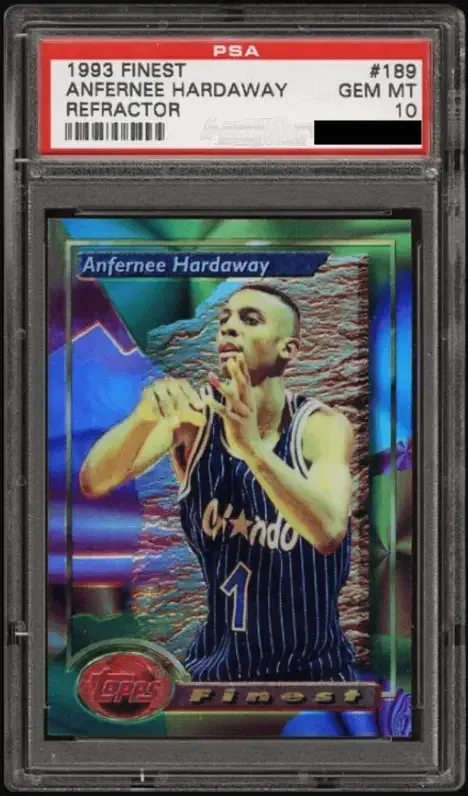
Hardaway’s 1993 Finest rookie card remains one of the key pieces in his market. When the Magic made the surprising draft-night move to acquire him, it marked a major shift from the conventional expectation that Orlando would pair O’Neal with a big man such as Chris Webber. Hardaway impressed team executives in a second workout, which helped lead to the trade that sent the No. 1 pick to Golden State in exchange for the Memphis State guard and future picks.
For more collecting context, read 6 Iconic 1963 Topps Baseball Cards Collectors Still Chase.
Shortly after release, Hardaway’s 1993 Finest #189 rookie card sold for $20, while the short-printed Refractor was listed at $200 to $250 in Beckett’s price guide. Two years later, the base card had risen to $24 and the rainbow-foil parallel had climbed to $225. By 1998, those figures were listed at $35 and $250, respectively.
Today, the card remains a steady performer. Card Ladder values a PSA 10 base rookie at around $400, up 55.63% over the past year. A PSA 9 has more than doubled, moving from $25 to $58. The PSA 10 Refractor, with a population of just 33, last sold for $4,440, an 83.09% year-over-year increase.
That combination of early star power, limited high-grade supply, and strong nostalgia has kept the card firmly on the radar for basketball collectors.
Related coverage includes Anfernee Hardaway Card Market Still Thrives on the Strength of Penny’s 1990s Peak.
1995 Skybox E-XL Natural Born Thrillers Highlights His Rise
By his second season, Hardaway had already become a full-fledged superstar. He was an All-Star Game starter, a fringe MVP candidate, and the centerpiece of an Orlando team that won a then-franchise-record 57 games and beat Michael Jordan and the Bulls in the playoffs on the way to the NBA Finals.
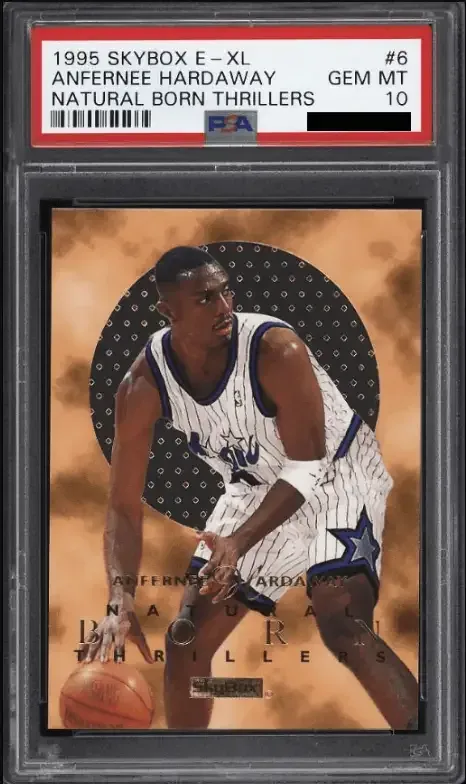
One of the more memorable cards from that stretch is his 1995 Skybox E-XL Natural Born Thrillers insert. The die-cut, gold-foil set includes 10 players and was designed to showcase the league’s biggest attractions. Hardaway’s card fits the theme perfectly, capturing the excitement he brought to the sport during his peak years.
Card Ladder shows strong recent movement for the card. A PSA 9 of Hardaway’s No. 6 has risen 236.62% over the past 12 months, and the last sale of $225 set a new high for the grade in the database.
The set’s title is also a reminder of how inventive 1990s basketball card design could be, with manufacturers regularly leaning into bold concepts and dramatic finishes.
1996 E-X2000 A Cut Above Stands Out for Design
Hardaway’s popularity extended well beyond the court. Around that same period, his off-court profile was boosted by the Lil’ Penny campaign, the wisecracking puppet voiced by Chris Rock in a series of Nike commercials that became a pop culture hit.
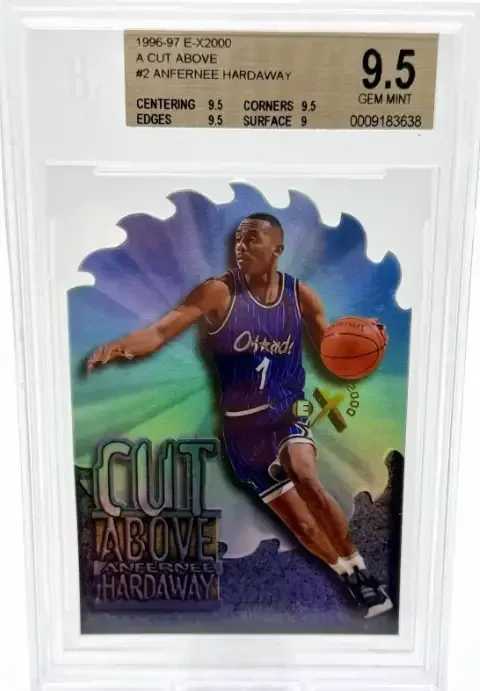
On the card side, one of the most distinctive issues from his career is the 1996 E-X2000 A Cut Above insert. Skybox took the concept literally, using a circular saw-blade die-cut across the top and silver reflective holographic foil. The card shows Hardaway driving in his blue Magic pinstripes and signature Air Penny 1s.
Hardaway’s market for the card remains healthy. The last raw copy sold for $609, a 35.89% year-over-year increase. Because the shape makes high-grade examples difficult to find, a BGS 9.5 brought $2,500 on September 21.
The card is a strong example of why Hardaway remains such a favorite among collectors. It combines a memorable image, a distinctive design, and a player who was still at the center of the league’s conversation when the card was issued.
Precious Metal Gems Cards Bring the Biggest Prices
Hardaway’s most valuable cards were produced during the years when injuries began to derail his career. After his first major knee surgery, he missed most of the 1997-98 season and was no longer the same explosive player who had once seemed destined for an all-time career arc.
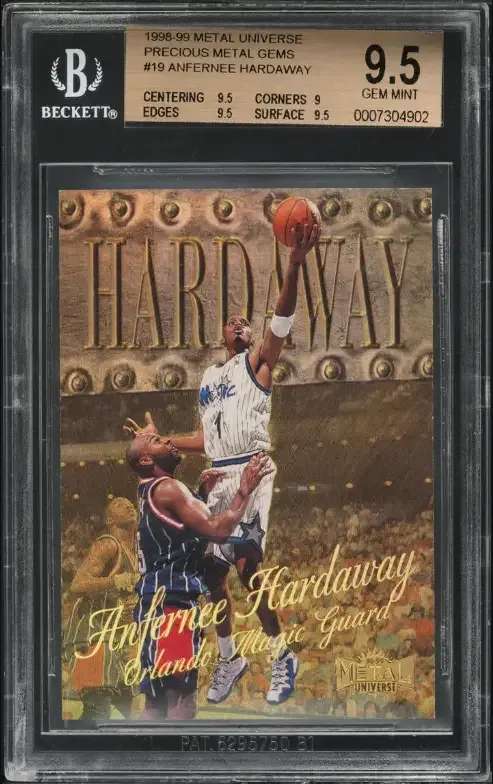
Even so, his name remained highly recognizable, and that helped fuel demand for his short-printed parallels and inserts. Among the most coveted are the Metal Universe Precious Metal Gems cards, which were largely overlooked when they first appeared but now command major prices.
Card Ladder shows a PSA 7.5 1998 PMG selling for $15,600 on September 25. A BGS 9.5 copy brought $43,200 last February, the second-highest sale for any Hardaway card tracked by the database.
His 1997 PMGs have also sold in similar ranges. A Red /100 in PSA 6 sold for just under $27,000 last October, while the /50 Metal Universe Championship version has sold between $13,000 and $15,000 depending on grade.
Those results underscore how much value collectors place on Hardaway’s rarest cards, especially from the period when his talent was still fresh in the hobby’s memory and his career was still unfolding.
1999 Topps Chrome Instant Impact Reflects a New Chapter
Hardaway played all 50 games during the lockout-shortened 1998-99 season, but he was no longer the same player who had dominated earlier in the decade. His move to Phoenix in the offseason was one of the more notable player changes of the era, and it led to one productive season alongside Jason Kidd before injuries and microfracture surgery further reduced his role.
That transition was reflected in the 1999-00 Topps Chrome Instant Impact insert set, which featured 10 players who had joined new teams. Hardaway’s card serves as a time capsule from the period, capturing the hope that his next chapter might still deliver a revival.
Prices remain accessible compared with his top rookie and PMG cards. A PSA 10 last sold for $150 on September 9, while a PSA 9 can be found for under $40.
For collectors, the card marks an important point in his career, when the promise of a fresh start still lingered even as injuries continued to mount.
Late-Career Memorabilia Cards Add Another Layer
Hardaway’s final playing years were spent in New York and Miami, where his production declined further. The Knicks later traded him back to Orlando in 2006, but he was waived before he could return to the court in a Magic uniform. His career ended 22 months later when the Heat released him after he appeared in only 16 games.
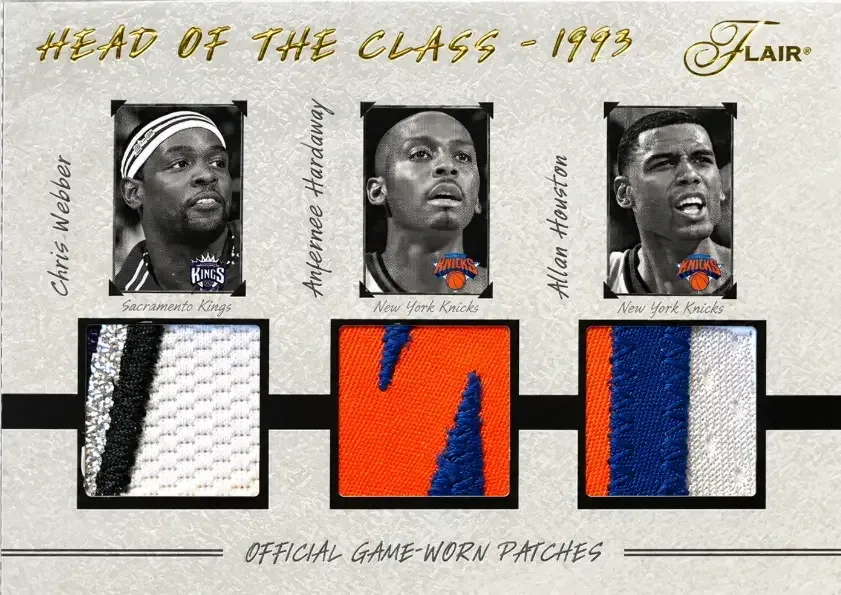
Even those late-career seasons produced cards that remain of interest to collectors, especially memorabilia issues tied to the 1993 draft class. One example is the 2004 Flair Head of the Class Patches card, numbered to 33, which features a swatch from Hardaway’s Knicks jersey alongside pieces from Chris Webber’s and Allan Houston’s jerseys.
Card Ladder shows only two sales of the card in the past five years. The most recent was a jersey-number match, serial-numbered 1/33, that sold for $160 in October 2023.
It is a fitting card for a player whose career was defined by both early brilliance and what might have been. Hardaway’s legacy in the hobby remains strong because collectors still remember the version of Penny who looked like one of the sport’s next all-time greats, and the market continues to reward the cards that capture that moment.
Why Hardaway Still Matters to Basketball Collectors
Hardaway’s card market stands out because it is driven by more than just career totals. His appeal comes from the combination of elite early performance, unforgettable style, and a career arc that left collectors wondering how much more he could have accomplished without the injuries.
That combination has helped keep demand high for his best cards across multiple eras and brands. From his 1993 Finest rookie to his 1995 Skybox E-XL insert, his 1996 E-X2000 die-cut, his Precious Metal Gems parallels, and his late-career memorabilia cards, Hardaway remains one of the clearest examples of a player whose hobby legacy was built as much on potential and memory as on statistics.
For many collectors, that is exactly why his cards still feel worth chasing.
Join the Sports Card Portal Page thread for this story.
Comments
0You must be signed in to comment.
Sign In