

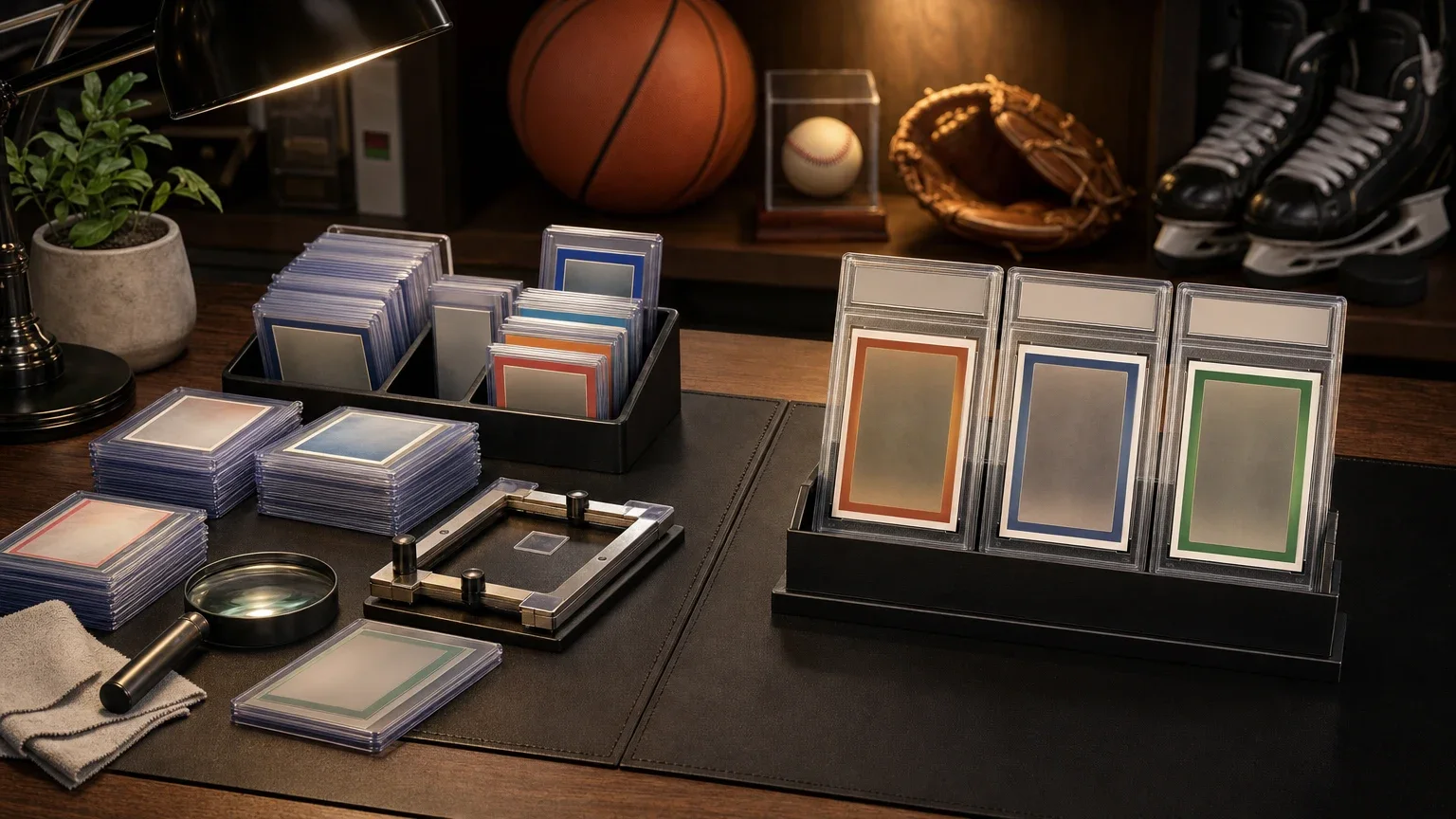
The graded-versus-raw debate is one of the hobby's simplest questions on the surface and one of its most personal in practice. A raw card is a card outside a third-party grading holder, often protected in a sleeve, top loader, binder, or magnetic holder. A numerically graded card has been authenticated, assigned a condition grade, and encapsulated by a grading company. Authenticity-only holders are a separate option: they should not be mistaken for a numerical condition grade.
For many collectors, grading is less about making a card look more important and more about outsourcing a few difficult judgments: Is the card genuine? Has it been altered? How strong is the condition relative to the issue? PSA, Beckett, and CGC all describe grading as a combination of authentication, evaluation, and encapsulation. That is why graded cards often appeal most when the card is expensive, counterfeits are a concern, or the issue is especially condition-sensitive.
Raw cards still have a very strong place in the hobby. Some collectors prefer the direct, tactile experience of handling cards, sorting them, and making their own condition judgments. Others want the flexibility to buy raw now and decide later whether a card deserves submission. The best choice is usually not about which format is universally superior, but about which format better matches the card in front of you and the way you collect.
What Graded and Raw Actually Mean
The basic distinction is straightforward, but holder labels deserve a careful read. Raw describes the absence of third-party grading encapsulation, not the absence of protective storage. A grading holder may carry a numerical condition grade, while an authenticity-only result answers a different question. PSA describes authentication as verification of originality or genuineness and grading as an assessment of quality and condition. CGC Cards describes a process ending with a holder, label, certification number, and QR code.
That packaging matters because it changes the card from a card without that particular third-party assessment into a certified object with a documented opinion attached. Beckett says its graded cards are preserved in a protective holder, and that grading includes authenticity. So “graded” is not just a cosmetic label; it is a formal third-party judgment about the card itself.
A useful way to think about it is this: raw cards place the burden of trust on the buyer and seller, while graded cards shift part of that trust to the grading company. That does not mean raw cards are bad or suspicious. It simply means the card’s condition and authenticity remain open questions until the collector or dealer evaluates them.
- Raw: outside a grading slab, with condition evaluated by the buyer or seller; protective sleeves and holders are still important.
- Numerically graded: authenticated, assigned a condition grade, and sealed in a protective holder; an authenticity-only label is different.
- The main value-add is not just appearance; it is third-party opinion plus encapsulation.
Why Authentication Is the Biggest Reason Collectors Grade
Authentication is where grading helps most. PSA says it will not grade cards with evidence of trimming, recoloring, restoration, or other tampering, and it may reject questionable items entirely. CGC Cards likewise presents authentication as a formal step before the card is encapsulated. Beckett also includes authenticity within its grading process.
That matters because many collectors are not only asking, “What condition is this card in?” They are also asking, “Is this card what it claims to be?” A slab cannot solve every problem, but it can reduce uncertainty when buying a card that is expensive, widely collected, or easy to fake.
Upper Deck’s authenticity and fraud-prevention page is a useful reminder that the hobby’s anti-counterfeit culture did not appear by accident. Upper Deck says it introduced holograms and other security measures to combat counterfeiting. Grading fits into that larger ecosystem as one more layer of verification, not as the only protection available.
- Grading can help when authenticity is the main concern.
- PSA, Beckett, and CGC all describe authentication as part of the process.
- Security features and third-party grading work together, but neither eliminates all risk.
How Graded Cards Change the Visibility Question
Collectors often talk about “visibility” as though it only means whether a card is easy to see. In practice, visibility includes display quality, ease of inspection, and how much of the card’s condition the eye can assess at a glance. Beckett says its holder allows cards to be viewed from all angles and includes a sealed inner sleeve to limit movement. CGC describes a crystal-clear holder with a label, certification number, and QR code.
If you want a card protected while still being easy to display, graded can make a lot of sense. A slab gives a clean, standardized presentation and can help preserve the card’s condition during storage and handling. The tradeoff is that the card is no longer “bare” in the hand, and some collectors feel the holder changes the experience from owning a card to viewing a certified object. That is subjective, but it is a real hobby preference.
Raw collecting can feel more immediate because you choose the sleeve, binder page, or other storage format rather than accepting a grading company's holder. That flexibility is useful when organizing a set or inspecting a card before deciding whether to submit it. It is not a reason to handle cards carelessly or leave them unprotected. For either format, consider glare and viewing angles when displaying the card. These are personal presentation preferences, separate from the condition or authenticity opinion that comes with grading.
- Graded cards usually improve display consistency and protection.
- Raw cards usually feel more direct and tactile.
- Visibility is not just sight; it is also how easy the card is to inspect and enjoy.
The Main Reasons Collectors Prefer Graded Cards
One of the strongest reasons to grade is confidence. When the card is in a slab, the collector knows a third party has looked at its authenticity and condition. That standardization helps buyers and sellers speak the same language, especially in markets where subtle differences in centering, corners, edges, and surface matter. PSA explicitly uses a 10-point scale, and Beckett includes numerical grading and subgrades in its service structure.
Protection is another major reason. Beckett describes its slab as protective and tamper-evident, while CGC emphasizes long-term protection in a clear holder. For a card that will be stored, transported, or displayed frequently, that added protection can matter more than whether the card looks a little more “premium.”
Collectors also like the way grading organizes the hobby. A raw card may be perfectly collectible, but a grade creates a common reference point. That can be especially helpful when comparing similar copies, deciding whether to sell now or hold, or narrowing a collection to only the best-condition examples.
- Third-party authentication can reduce uncertainty.
- Slabs add protection against handling and tampering.
- A numeric grade creates a shared language for comparison.
Why Many Collectors Still Prefer Raw
Raw cards remain popular because they keep the hobby flexible. There is no grading fee, no submission wait, and no decision locked in by an outside company. That flexibility is especially useful when a collector wants to buy several cards, inspect them personally, and only submit the strongest candidates later. The existence of grading services implies cost and process, even if those costs differ by service level.
Raw also leaves room for judgment. Some collectors like to live with a card for a while before deciding whether it deserves grading. That can be a smart strategy when a card is borderline and the likely result depends on small details like centering, corners, borders, or tiny surface flaws. PSA’s standards make clear that those details can materially affect the outcome.
There is also the hands-on side of the hobby: comparing cards under good light, arranging a binder, and sorting by set and player. Raw cards make it easier to choose and change those storage arrangements. A collector can enjoy that flexibility while keeping cards sleeved and minimizing direct handling. Someone who prefers a uniform row of labeled slabs may reasonably reach the opposite conclusion. Neither preference proves that one format is inherently better for every card.
- Raw avoids grading fees and waiting time.
- Raw lets the collector keep options open before submitting.
- Many collectors simply prefer the hands-on experience.
Company Rules Matter More Than Many Collectors Realize
One mistake collectors make is assuming all grading companies follow the same rules. PSA’s standards vary by issue type and by how a card was originally produced. It distinguishes between defined borders, virtually full borders, and hand-cut issues, and it notes that some cards may receive an “Authentic” result only if the cut exceeds the visible border.
Beckett has its own service structure as well. Its page notes that cards produced prior to 1980 do not receive its report card, even though they can still be graded. That means a collector who wants subgrades, a report card, or a particular presentation style needs to check the company’s rules before submitting.
CGC’s process page is especially helpful for understanding the modern grading workflow, but it is not the best source for every edge-case rule. The broader lesson is that “grading” is not one universal system. Each company has its own standards, holder design, and limits, so the same raw card may have different outcomes depending on where it is sent.
- PSA and Beckett do not apply identical standards.
- Issue type and original production format can affect grading outcomes.
- Always check the company-specific rules before submitting.
A Simple Decision Framework for Collectors
If authenticity is your biggest concern, graded usually makes the most sense. If the card is expensive, easy to counterfeit, or likely to be resold, the confidence added by third-party review can be valuable. PSA, Beckett, and CGC all support that basic logic through their descriptions of authentication and encapsulation.
If you care most about hands-on collecting, raw is often the better fit. It avoids submission friction and lets you keep full control over the card until you decide otherwise. That can be especially appealing for collectors who like to hunt for high-grade candidates, but it also works for collectors who simply prefer the feel of loose cards in sleeves or binders.
If you want the most balanced approach, many collectors use both. They keep common or lower-risk cards raw, then send only the best or most important ones for grading. That approach fits the evidence well: grading adds certainty and protection, but raw keeps the hobby accessible, flexible, and personal.
Before deciding, write down the purpose of this particular purchase. Is it a display copy you want to enjoy immediately, a missing card for a binder set, or a candidate you intend to inspect and perhaps submit? Next, compare the exact card and condition rather than treating every copy with the same player name as interchangeable. Finally, ask whether the holder's information answers your actual concern. A numerical grade helps describe condition; it does not replace reading the card's identity, checking the seller's description, and understanding what the grading result does and does not establish.
- Choose graded when authenticity and protection are top priorities.
- Choose raw when flexibility and tactile collecting matter most.
- Using both formats is often the most practical long-term approach.
Frequently Asked Questions
What is the biggest advantage of graded cards?
The biggest advantage is third-party authentication combined with condition assessment and protective encapsulation. That matters most for valuable, counterfeit-prone, or condition-sensitive cards.
Why do some collectors still buy raw cards?
Raw cards are more flexible, avoid grading fees and waiting time, and preserve the direct hands-on collecting experience. They also let collectors decide later whether a card is worth submitting.
Does a slab guarantee a card is perfect?
No. Grading helps with authentication and condition review, but it is not a universal guarantee that every issue has been detected or that the card has no problems. PSA’s standards and guarantee language show that protections are procedural, not absolute.
Can the same raw card grade differently at different companies?
Yes. PSA, Beckett, and CGC each have their own standards and presentation methods, so outcomes and formats can differ.
Is graded always better for value?
No. The available official information supports differences in authentication, protection, and presentation, but it does not prove one format is always better for value. That depends on the card, the issue, the player, and buyer preferences.
Written with AI assistance. Featured image: AI-generated editorial illustration.


Comments
0You must be signed in to comment.
Sign In