

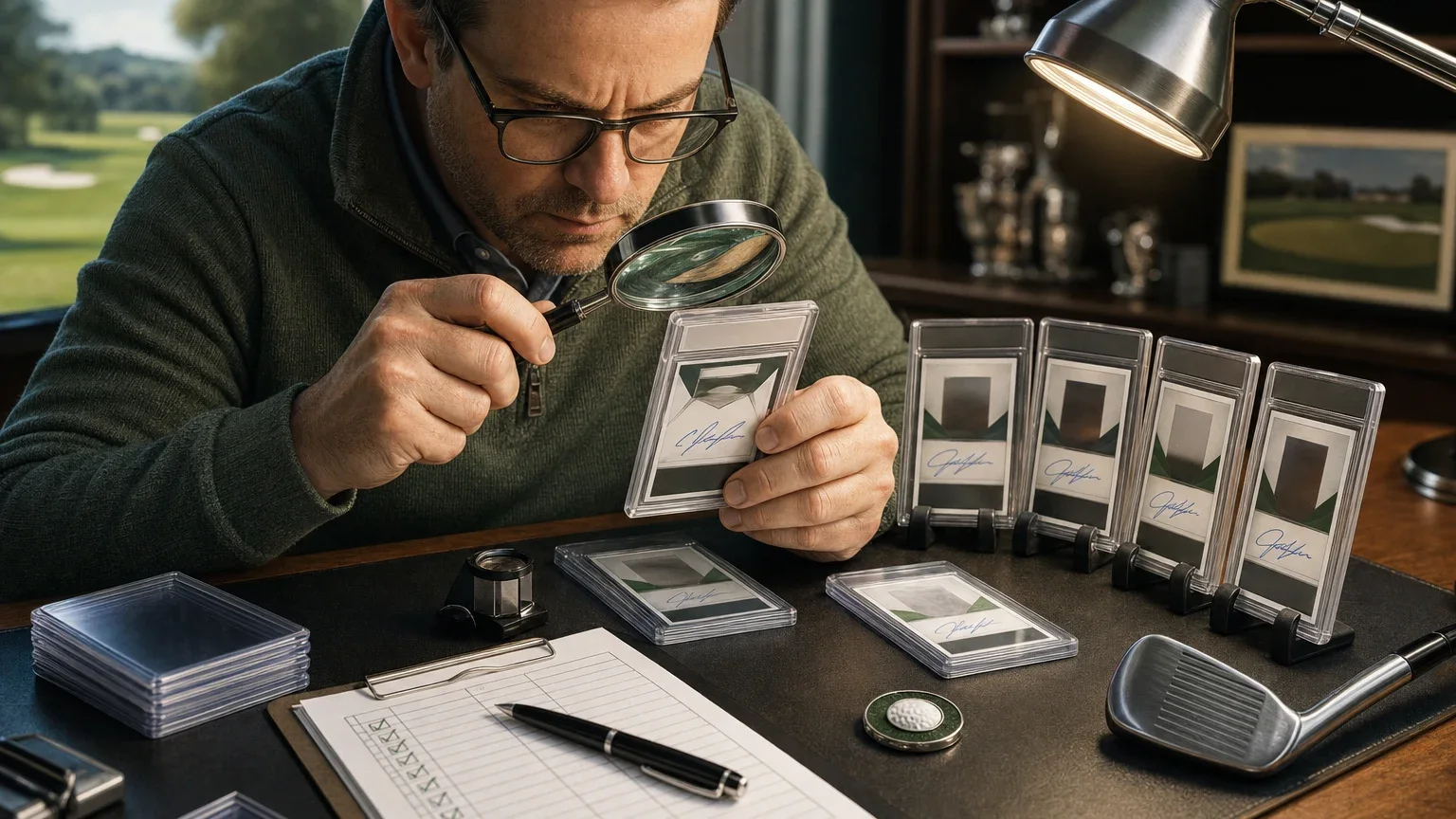
Golf autograph cards can be deceptively simple at first glance. A signed card looks like a signed card, but the real collecting question is usually more specific: is the autograph authentic, is the card itself authentic or properly attributed, and is the holder telling you exactly what service was performed? PSA and Beckett both structure their autograph services around those distinctions, while Upper Deck’s golf checklists show how quickly autograph products can branch into parallels, relic-autos, and buybacks.
That means the smartest collector is not just looking for a famous golfer’s signature. The smarter approach is to identify the exact card type, confirm the certification through the issuer, and compare the slab or holder against the checklist for the product. In golf, where some modern releases include unnumbered autograph inserts, serial-numbered parallels, autograph-relic combinations, and buyback chases, the difference between similar-looking cards can be meaningful.
This guide focuses on practical buying decisions: how to verify an autograph, what the different label types can indicate, where checklists help most, and which product-specific caveats deserve extra attention. It is designed for collectors who want to reduce avoidable mistakes without assuming that every authenticated card is automatically the right card for their collection.
What are you actually trying to authenticate?
The first step in any golf autograph purchase is to separate three questions that are often blurred together in marketplace listings. You want to know whether the autograph is authentic, whether the card or item is authentic as a collectible object, and whether the autograph has been given a numerical grade. PSA’s current autograph services make those distinctions explicit by separating autograph-only authentication from item authentication and grading, with autograph grading available as a separate numeric service.
That matters because two cards can look nearly identical in photos and still represent different levels of service. One may be authenticated only for the signature. Another may be graded for the item and also include autograph authentication. A third may include a numeric autograph grade that says something about presentation or quality, not just authenticity. If you do not read the label carefully, you can easily compare cards that are not actually equivalent.
A good rule is to slow down whenever a listing uses vague language like “PSA certified” or “authenticated autograph.” Those phrases are useful, but they do not tell the whole story. The slab or holder should tell you whether the item itself was graded, whether the autograph was authenticated, and whether a numeric autograph grade is present. That small distinction can change how you evaluate condition, desirability, and price.
- Ask whether the service is autograph-only or item plus autograph.
- Check whether there is a numeric autograph grade or only authenticity.
- Do not assume a clean-looking slab means the card was graded in the way you expected.
How do PSA and Beckett verification systems help buyers?
PSA says its authenticators use tools such as ink analysis, structure analysis, object evaluation, side-by-side comparisons, and, when needed, a video spectral comparator. Beckett likewise offers certification verification through a QR code or online database lookup, and it emphasizes label and holder security features meant to make tampering more difficult. For a buyer, those tools are useful because they make the certification testable rather than purely visual.
Still, verification is not the same thing as blind trust. A database match tells you that a certification number exists and that the number corresponds to an item in the system. It does not eliminate the need to inspect the actual holder, label, and card. That is why the best practice is to treat lookup verification as one layer of due diligence, not the entire process. A copied image of a slab can still look convincing in a listing.
The practical workflow is straightforward. Check the certification number, confirm the item details, and compare the image to the expected label style and holder format. If any of those elements seem off, assume the purchase carries more risk. For expensive golf autographs, especially high-demand names or limited inserts, the combination of database verification plus physical inspection is the most sensible baseline.
- Use issuer lookup tools before paying.
- Compare the certification details against the physical item shown in the listing.
- Treat a database result as confirmation of the record, not a substitute for inspection.
How should you read PSA label types and service differences?
PSA’s label system matters because it signals what kind of service was performed. Collectors can encounter autograph-only authentication, item authentication with grading, and autograph grading as a separate numeric result. Those are not interchangeable. If you are looking for a card that was graded as a collectible object, a blue-label style autograph authentication service may not be what you intended to buy.
That distinction is especially important for modern golf cards because many are bought for different reasons. One collector wants the signed card itself. Another wants the highest-presented example. A third wants a graded card with autograph authentication and a strong slab appearance. Those buyers may all look at the same player and card line, but they are not shopping for the same thing.
A useful habit is to translate the label into plain language before you decide. Ask yourself: what exactly is this slab certifying, and what is it not certifying? If the answer is unclear, the card may still be desirable, but you should price it and compare it as the specific service type it is, not as the service type you hoped it was.
- Identify whether the service is autograph-only, item grading, or autograph grading.
- Do not assume all PSA-encapsulated autographs were serviced the same way.
- Match your purchase goal to the label type, not just the player name.
What should you look for on Beckett-certified autograph cards?
Beckett’s autograph program is built around quick verification and holder security. The company says collectors can confirm authenticity by scanning a QR code or entering the certification number in its database, and it highlights anti-counterfeit features in the label, sticker, and letter of authenticity. For buyers, that means the Beckett ecosystem is intended to make both the certification and the holder easier to inspect.
But the same caution applies here: anti-counterfeit features help, they do not replace due diligence. If you are buying through a marketplace, ask whether the listing includes a clear image of the full holder, the certification area, and any accompanying documentation. If the image is cropped so tightly that you cannot compare the label style or holder condition, you are taking on avoidable uncertainty.
Beckett’s approach is especially useful when you are comparing multiple autograph cards from the same golfer and product. The QR and database tools give you a fast way to confirm the record, but the physical holder still tells you whether the item is in the expected format. In a hobby where altered or mismatched items can create confusion, that extra second look is worthwhile.
- Verify by QR code or database number, not by photo alone.
- Inspect the holder and label style in addition to the record.
- If the listing hides key details, treat the risk as higher than it appears.
How do Upper Deck golf checklists change the way you buy?
Upper Deck’s golf checklists are valuable because they show the structure of a product, not just the names inside it. The 2026 Upper Deck Golf checklist identifies autograph subsets, parallel tiers, and cases where print runs for unnumbered cards have not been announced. That kind of information helps you understand whether a card is a straightforward autograph insert, a parallel, or part of a broader chase that may not be fully transparent from the pack or box alone.
This matters most when you are choosing between sealed product and singles. If a checklist shows that a set contains several autograph groups, then two cards with the same golfer can occupy very different places in the product hierarchy. One may be a standard autograph insert. Another may be a rarer parallel or a different subset entirely. Without the checklist, those cards can look similar in a listing even when their roles inside the set are not the same.
Collectors who use checklists well are usually not trying to forecast exact market behavior. They are trying to answer a narrower, more useful question: what card am I actually buying? In golf, that question matters because modern releases often mix multiple autograph structures in one product, and the checklist is what tells you how those structures fit together.
- Use the checklist to identify the exact autograph subset.
- Check whether the card is numbered, parallelled, or unnumbered.
- Do not assume checklist appearance equals known final supply when print runs are not published.
Why do buybacks and relic-autographs need extra caution?
Buybacks are one of the clearest examples of why golf autograph cards cannot all be judged by the same standard. Upper Deck’s 2026 golf coverage highlights autographed buybacks of the 2001 Upper Deck Tiger Woods rookie card, which is a very different category from a live-sign autograph inserted directly into a modern product. A buyback starts with a pre-existing card and then adds an autograph treatment, so you are evaluating a different chain of origin and a different set of condition issues.
Relic-autographs create their own layer of complexity. Upper Deck’s Artifacts Golf checklist includes pieces such as ball marker relic autographs and other memorabilia-based autograph combinations. In those cards, the collector is not only assessing the signature, but also the memorabilia component, the serial numbering, and the overall construction. That means a card can be attractive on several fronts while still being more complicated to buy well than a standard autograph insert.
The main takeaway is not that buybacks or relic-autos are bad choices. It is that they ask more of the buyer. When an item combines old-card history, a new autograph, and a memorabilia component, you should slow down and read the product structure carefully. The more elements a card combines, the more important it becomes to verify exactly what you are looking at.
- Treat buybacks as a different category from modern pack-pulled autographs.
- Check relic-autographs for both signature and memorabilia structure.
- Expect more complexity when one card combines multiple collectible elements.
What is the safest way to compare numbered and unnumbered golf autographs?
Serial numbering is helpful, but it is not a complete answer. A numbered card can feel easier to evaluate because the checklist and label often communicate scarcity more directly. Yet a low number does not guarantee better autograph quality, stronger centering, or a cleaner holder. It also does not prevent a mislabeled or tampered item from circulating if the buyer skips verification.
Unnumbered cards are trickier because the checklist may not give you a final print run. That does not mean they are common. It means the product has not published enough information for you to rely on the number alone. In practice, that creates a different kind of risk: you may know the card exists, but not the full size of the pool from which it came. Buyers should resist the temptation to assume “unnumbered” equals “mass-produced.”
A practical comparison method is to evaluate four things together: the card type, the exact subset, the numbering or lack of numbering, and the holder certification. If one of those pieces is missing, your comparison is incomplete. For golf autograph collecting, that is usually the point where a promising card becomes a better research candidate than a purchase.
- Numbered does not automatically mean safer or better.
- Unnumbered does not automatically mean abundant.
- Compare numbering, subset, card type, and certification as one package.
What buying workflow helps reduce avoidable mistakes?
A simple workflow keeps golf autograph buying organized. First, identify the card type: autograph-only, graded autograph, autograph-relic, buyback, or sealed-pack autograph. Then verify the certification through the issuer’s system. After that, inspect the holder and label details, including format, numbering, and whether the item description matches the card in front of you. Only then should you compare the card against the checklist and decide whether the price makes sense for that specific structure.
This sequence is useful because it separates identity from appearance. A clean image can make a card seem trustworthy, but a mismatch between the checklist and the slab tells you more than the photograph does. Likewise, a database result can confirm the cert number while still leaving open questions about the physical holder or whether the item type is exactly what the seller claims. The workflow reduces those blind spots one by one.
For higher-end cards, the biggest error is usually moving too fast on the assumption that a famous golfer or a low-numbered serial stamp settles everything. It does not. The smarter move is to ask whether the exact product structure, certification type, and checklist entry all line up. If they do, you have a much stronger basis for comparing value and condition. If they do not, the card may still be interesting, but it deserves more scrutiny before it becomes a purchase.
- Identify the card type first, then verify the certification.
- Match the slab or holder to the checklist entry before paying.
- Use the full workflow on expensive or structurally complex cards.
What mistakes do golf autograph collectors make most often?
The most common mistake is assuming that all authenticated autographs carry the same meaning. PSA’s service structure shows that autograph-only authentication, item grading, and autograph grading are different outcomes, and buying as if they are the same can lead to disappointment. A second mistake is trusting the slab image in a listing without checking the issuer’s lookup and the physical holder details.
A third error is ignoring checklist structure. Golf products often combine autograph subsets, relics, parallels, and buybacks, so the card title alone may not tell you enough. That is especially true when the same golfer appears across multiple construction types in one product. Another mistake is overvaluing a number stamp without checking whether the card is actually the autograph version or simply a parallel from a different subset.
The best collectors usually do one thing well: they slow down long enough to identify what category a card actually belongs to. That discipline does not make the hobby less exciting. It makes it more coherent. Once you know whether the card is a live autograph, a buyback, a relic-autograph, or an authenticated signature card, the rest of the buying decision becomes much easier to reason through.
- Do not confuse authentication with grading.
- Do not rely on slab photos alone.
- Do not assume numbering tells the whole story.
- Do not skip the checklist when a product has multiple autograph structures.
Frequently Asked Questions
Is a certified golf autograph automatically a graded card?
No. PSA separates autograph-only authentication from item grading and autograph grading. A certified autograph may be authenticated without being graded as a card in the way you expect.
What is the safest way to verify a golf autograph card online?
Use the issuer’s verification tool first, then compare the holder, label, certification number, and item description against the listing photo and the product checklist.
Why do golf checklists matter so much?
Golf checklists tell you the exact autograph subset, whether the card is numbered, whether it is a parallel, and whether the product publishes print-run information for that card type.
Are buybacks riskier than regular autograph inserts?
They are not automatically worse, but they are different. Buybacks involve an older card receiving a later autograph treatment, so condition, provenance, and formatting need extra attention.
Written with AI assistance. Featured image: AI-generated editorial illustration.


Comments
0You must be signed in to comment.
Sign In