

The Most Valuable Mew Cards in Pokémon TCG
Mew has always carried a special place in the Pokémon franchise. The hidden 151st Pokémon became part of the series' mystique long before it appeared on cardboard, and that history has translated into one of the most interesting markets in the hobby.
When it comes to Mew, the biggest prices are not always tied to the newest sets or the strongest attacks. Some of the most valuable cards are promos, special distribution cards, and unusual printings that collectors have chased for years. Based on current market activity, these are the three most valuable Mew cards in Pokémon TCG right now.
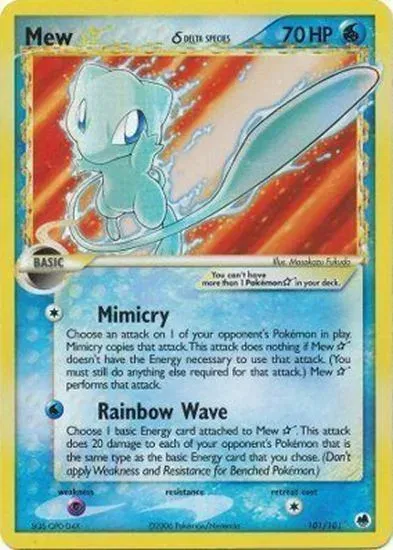
1. Mew 101/101 - EX Dragon Frontiers Gold Star
Mew's Gold Star from EX Dragon Frontiers sits at the top of the list. Card 101 of 101 closes out the set and was illustrated by Masakazu Fukuda. Like other Gold Stars, it represents a Shiny variant, which makes this version of Mew especially distinctive compared with the familiar pink design most collectors know.
The card is also tied to the Delta Species mechanic, which reclassified it as a Water type. That detail adds to its appeal, since it gives the card a look and identity that stand apart from standard Mew releases.
Community estimates place Gold Star pull rates at roughly one per 72 packs across the era, though that figure applies to any Gold Star in a set rather than this specific card. Even so, the rarity and status of the Gold Star line have made this one of the hardest Mew cards to acquire in high grade.
Current market data shows the ungraded market price near $1,940, while clean examples have reached $3,850 and marketplace listings can climb around $3,500. Graded 9 sales have ranged from roughly $6,500 to $17,000 depending on the service. Graded 10 copies remain the ceiling of the Mew catalog, with the last two public sales landing at $86,620 in April and $192,000 in July.
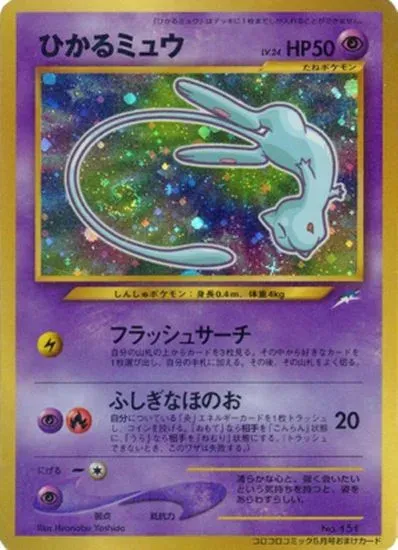
2. Shining Mew 151 - CoroCoro Promo
Shining Mew was distributed on April 15, 2001, with the May issue of CoroCoro Comic. It carries a Cosmos Holofoil treatment rather than the embossed foil used on the Shining Pokémon in the expansion it promoted, and the holo pattern extends across the entire card instead of staying inside the artwork frame.
That unusual presentation helps make the card one of the most recognizable Mew releases in the hobby. The magenta printing also shifts toward blue under sunlight, a detail that makes condition and preservation especially important for collectors trying to find strong examples.
Raw copies have been closing between $770 and $1,500, with the ungraded market price near $950. Most graded 9 sales fall between $5,200 and $6,800. Graded 10 copies have sold between $35,700 and $61,000 over the past three months, showing how much premium the market places on top-condition examples of this promo.
For collectors focused on Japanese promo history, Shining Mew remains one of the most important cards in the character's run. Its combination of limited distribution, unique foil treatment, and strong demand has kept it near the top of the market for years.
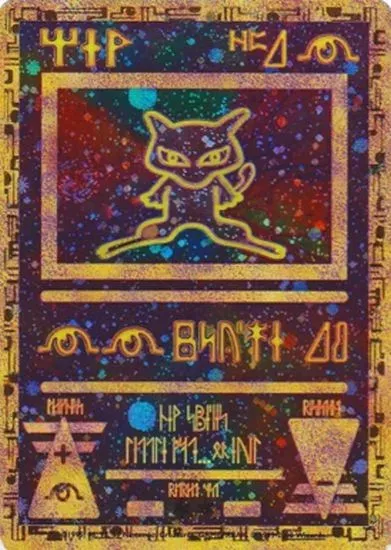
3. Ancient Mew - The Power of One Promo
Ancient Mew is one of the most unusual cards Wizards of the Coast ever printed. It was handed out with ticket purchases during the first week of The Power of One's theatrical run in 2000 and came sealed in a plastic wrapper alongside a Pokémon League teaser card.
The card stands out immediately because of its design. Its text is written in a cipher that mixes Germanic runes with Mayan glyphs, giving it a look unlike any other Pokémon card from the era. That uniqueness helped make it one of only two cards ever banned from the Unlimited format as well as Standard.
Market prices reflect both the nostalgia and the oddity surrounding the card. Sealed copies have closed between $130 and $165, while opened Near Mint copies run closer to $85 to $120. Graded 10 examples sit near $2,900.
Collectors should also pay close attention to the version they are buying. Six distinct versions exist across the international, Japanese, and Korean releases, separated by copyright text, foil treatment, and border detail. Those differences can affect both value and identification, especially for buyers comparing listings across marketplaces.
Why Mew Cards Keep Drawing Strong Demand
Mew cards do not need to be the strongest competitive play to command major attention in the hobby. The cards that lead the market are often tied to special distribution methods, limited print runs, or distinctive artwork and foil treatments that make them stand out from standard releases.
That is part of what makes Mew such a compelling character for collectors. The card history stretches across multiple eras of the Pokémon TCG, from early promos to high-end chase cards, and the best examples continue to attract serious interest whenever they surface in strong condition.
For collectors tracking the market, the key details are often the ones that separate one version from another. Ancient Mew has multiple international print variations. Shining Mew carries a foil treatment that behaves differently from the card it promoted. Mew's Gold Star version is tied to a specific set number and a Shiny interpretation that sets it apart from the classic design. In a market this detailed, those distinctions matter.
As prices continue to move, these three cards remain the clearest snapshot of Mew's long-term appeal in Pokémon TCG collecting.

Comments
0You must be signed in to comment.
Sign In