

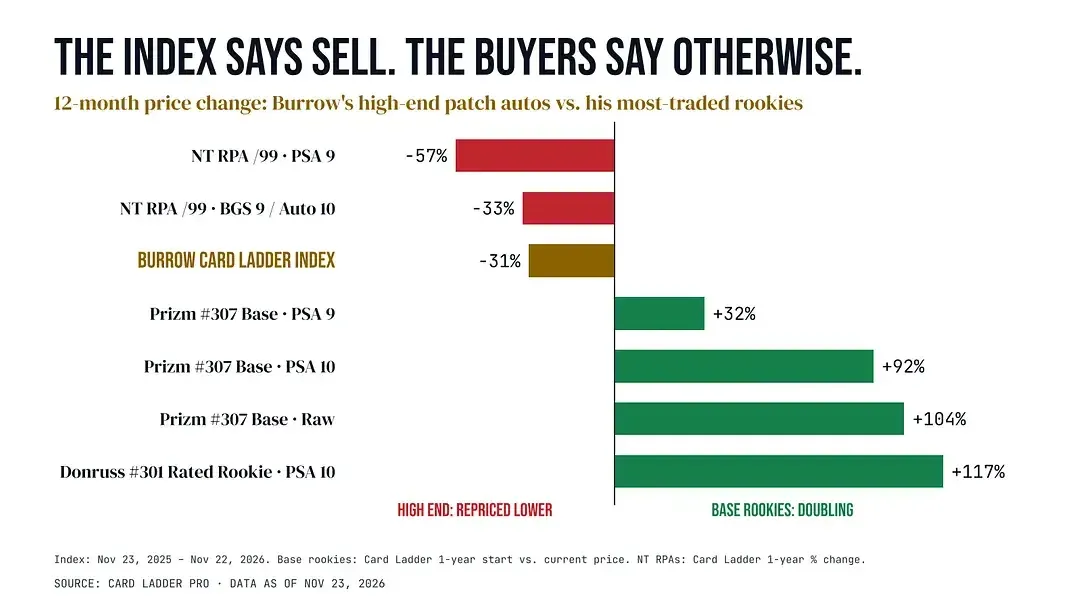
Joe Burrow is putting together an MVP case, but the market for his football cards is moving in two directions. His Card Ladder index hit a two-year low in November 2026, while all five of his most-traded cards gained value over the preceding year. Those five cards are all 2020 base rookies, and together they accounted for 1,574 recorded sales.
The split is especially clear in the numbers for Prizm and National Treasures. A PSA 10 copy of Burrow's flagship Prizm base rookie climbed from $85 to $163.60, while the National Treasures rookie patch autographs tracked in the comparison were down 33% to 57% year over year. The index and the busiest part of the market tell different stories because the cards behind those numbers are different.
Burrow's MVP case starts with staying on the field
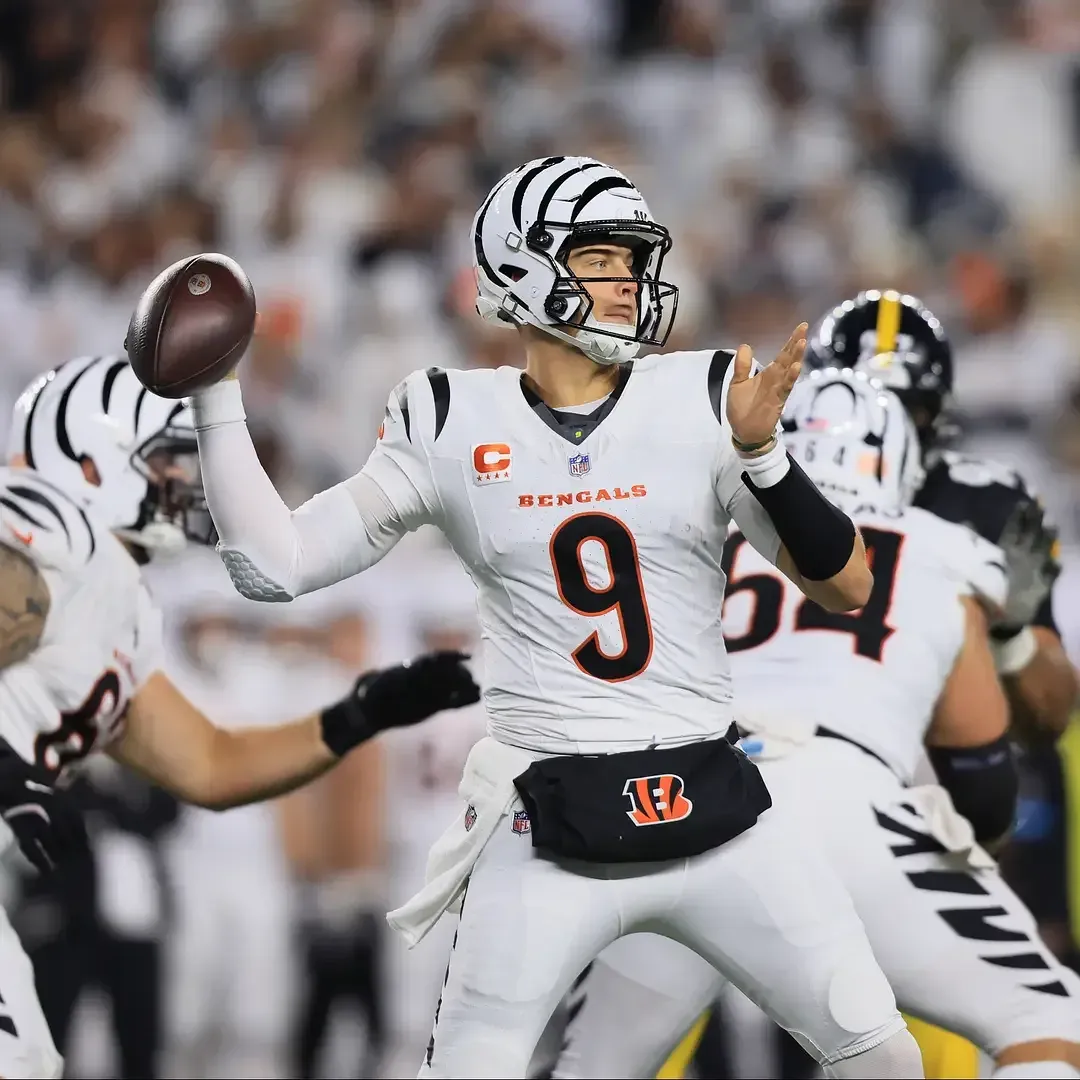
Cincinnati moved to 7-2 and took sole possession of first place in the AFC North after beating the Pittsburgh Steelers in Week 10. The Bengals had won five straight at that point and were off to their best start since 2015. For collectors following Burrow, the nine games mattered for another reason: He had stayed on the field for all of them.
Turf toe cost Burrow nine games the previous season, and the Bengals won just once during his absence. It was the third time in six years that injuries had taken a substantial chunk out of his regular season. He finished strongly after returning, but whether he could stay healthy remained a question entering 2026. An early back issue put him on the injury report as questionable, but he played through it.
Burrow threw for 400 yards in three of his first nine games and put up 16 touchdown passes in a four-game stretch. The difference from his productive 2024 season is that Cincinnati is pairing those numbers with wins. Ja’Marr Chase and Tee Higgins give him two established targets, and a healthier offensive line has helped give him time to throw. After the Steelers win, Burrow's message was that the team wasn't satisfied with what it had accomplished so far.
Why Joe Burrow's Card Ladder index fell
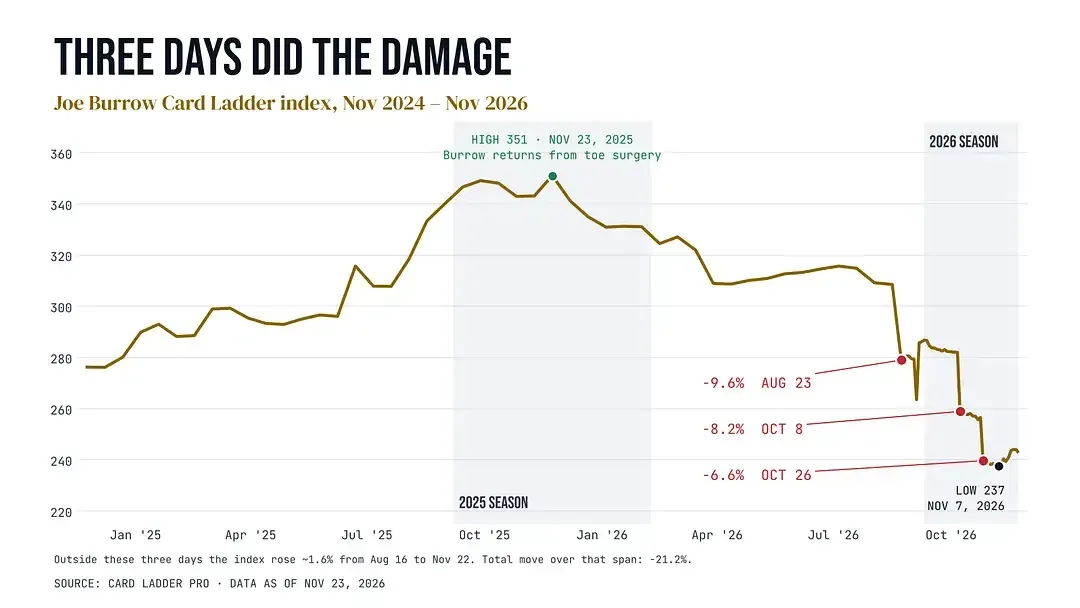
Card Ladder Pro data showed Burrow's index down about 31% over the year. It reached 351 on Nov. 23, 2025, and fell to a two-year low of 237 on Nov. 7, 2026. The low came one day before Cincinnati beat Atlanta 34-17 in Madrid, where Burrow ran for a second-quarter touchdown.
Three days accounted for much of the late-season weakness in the index: Aug. 23, when it fell 9.6%; Oct. 8, when it dropped 8.2%; and Oct. 26, when it lost 6.6%. Excluding those three days, the index rose about 1.6% from Aug. 16 to Nov. 22. The decline was concentrated rather than a steady slide across that stretch.
Lower prices for a handful of National Treasures rookie patch autographs weighed on the index. Meanwhile, the cards that changed hands most often were neither patch autographs nor numbered parallels. They were base rookies from Prizm, Donruss and Mosaic, ranging from a raw card that averaged less than $3 per sale to a PSA 10 Prizm that reached $163.60.
Related coverage includes Joe Burrow’s Card Ladder Index Hit a Two-Year Low as His Busiest Rookie Cards Rose.
Joe Burrow's five most-traded rookie cards
Card Ladder recorded 1,574 sales across the five cards below from Nov. 23, 2025, to Nov. 23, 2026. Prizm #307 appears three times because the PSA 10, PSA 9 and raw versions were tracked separately. Each version rose in price, but the differences in sales counts and prices show how much the grade matters even when the underlying card is the same.
2020 Panini Prizm #307 Base, PSA 10
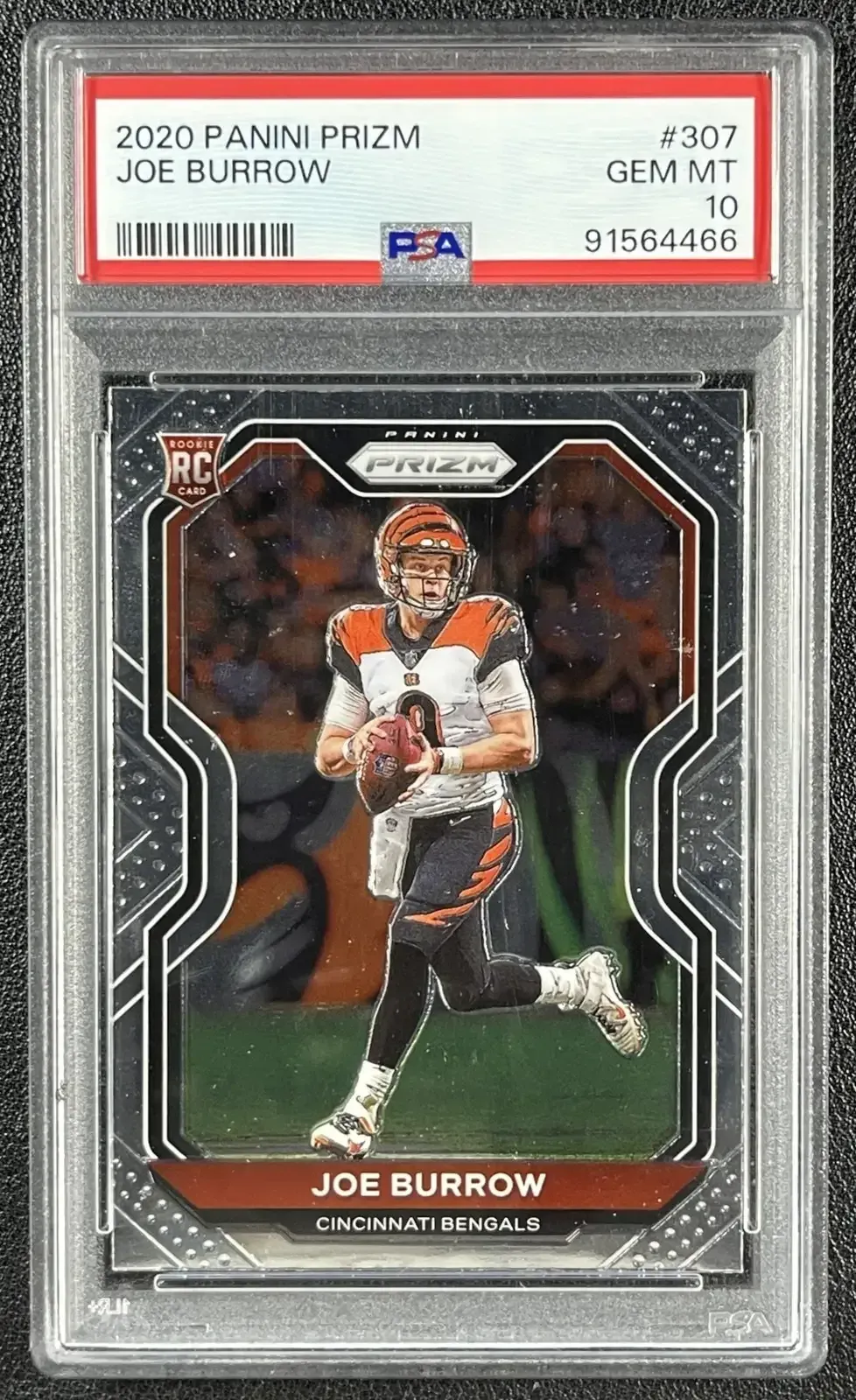
Burrow's PSA 10 Prizm rookie led the list with 619 sales, or roughly 1.7 per day. It accounted for nearly 40% of the five cards' combined sales. Its price rose 92%, from $85 to $163.60, and it averaged $100.60 per sale over the year.
With a PSA 10 population of 7,820, scarcity isn't what distinguishes this card. The sales count is more telling: No other card on the list came close to changing hands as often. That also provides more sale prices for comparing copies in the same grade.
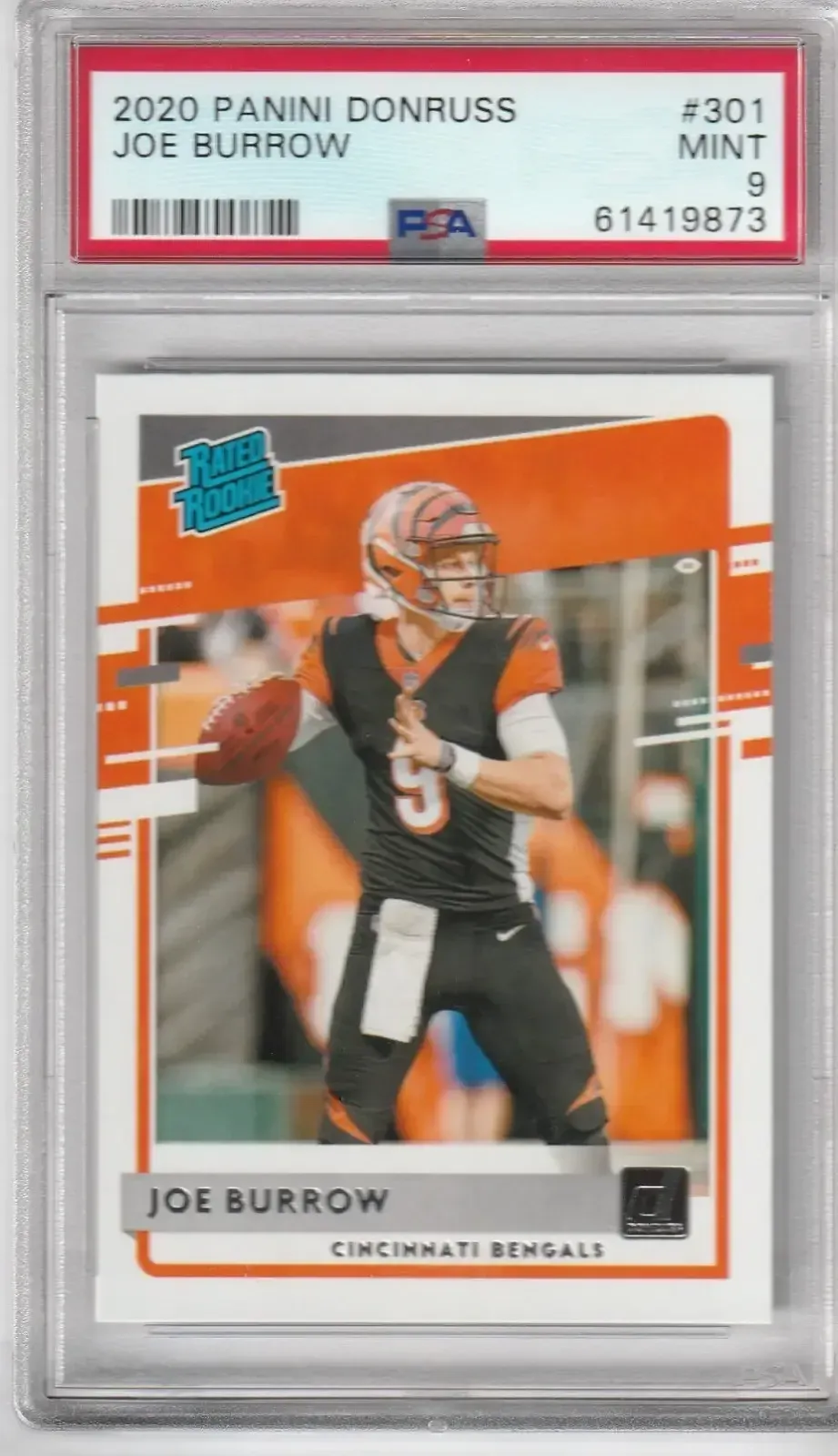
2020 Donruss #301 Rated Rookie, PSA 10
The Donruss Rated Rookie finished second with 328 sales and posted the largest price gain among the three graded cards on the list. It rose from $46 to $100, an increase of 117%. Its PSA 10 population was 6,367.
The Donruss started and ended the period at a lower price than the PSA 10 Prizm, even though it gained more in percentage terms. In dollars, the Donruss gained $54, while the Prizm rose $78.60. The two cards illustrate how the starting price changes the way those gains look.
2020 Panini Prizm #307 Base, PSA 9
The PSA 9 Prizm generated 302 sales and rose 32% to $41.57. Its population of 8,049 was only slightly larger than the PSA 10 population of 7,820, but the price gap was substantial. At the end of the period, the PSA 10 was priced at about 3.9 times the PSA 9.
The PSA 9 trailed the PSA 10 in both volume and price growth. It also finished well below the $100 PSA 10 Donruss, giving the Prizm card a frequently traded graded version at a lower price than either of the gem-mint entries on the list.
2020 Panini Prizm #307 Base, Raw
Ungraded Prizm copies logged 184 sales and more than doubled from $11.67 to $23.75, a gain of 103%. That was a larger percentage increase than either graded version of Prizm #307 recorded, although the raw card changed hands less often and finished at a lower price.
The raw and graded figures aren't interchangeable. The $23.75 figure is for an ungraded copy, while $41.57 and $163.60 reflect cards that had already received specific PSA grades. The premium for a PSA 10 is not a premium that applies to every raw copy.
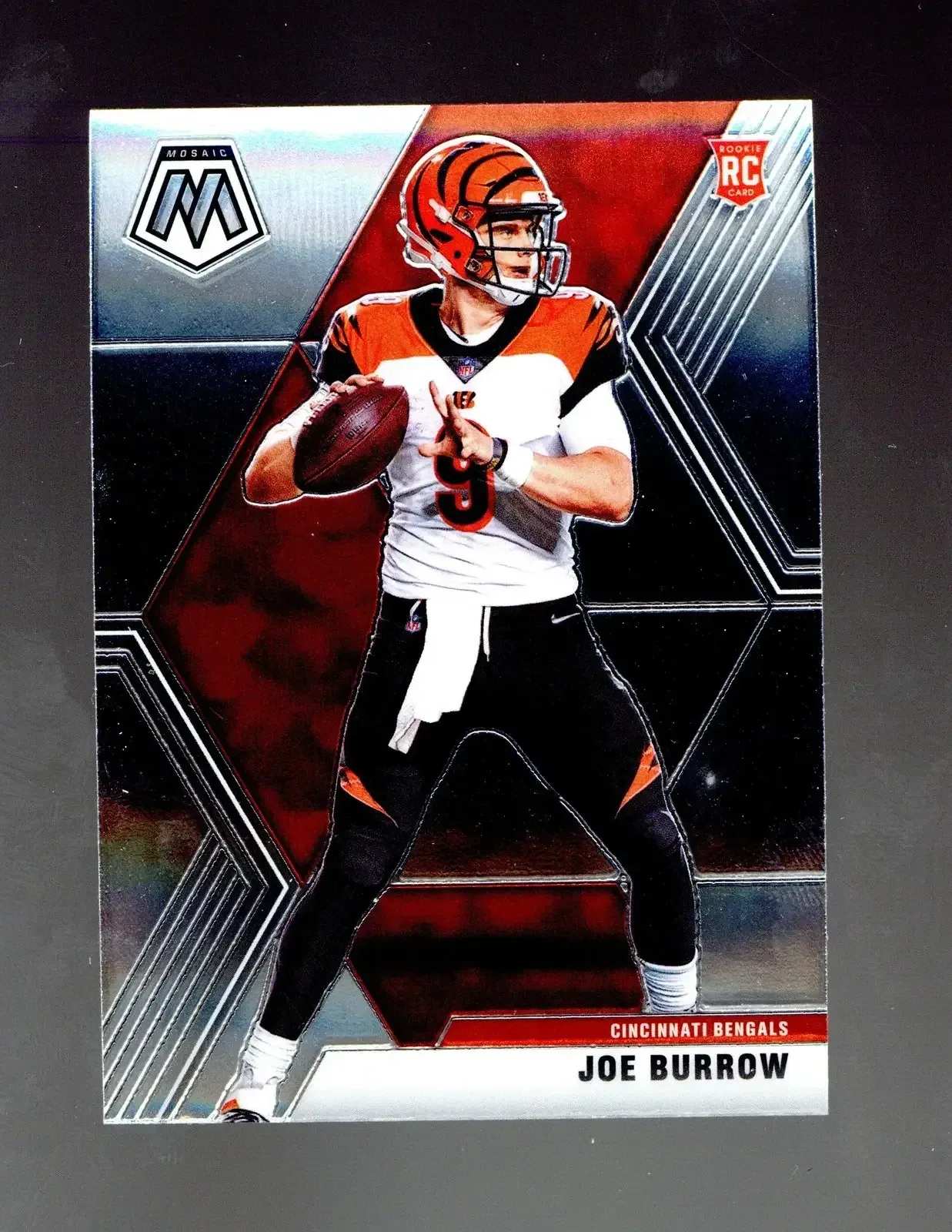
2020 Panini Mosaic #201 Base, Raw
The raw Mosaic rookie rounded out the top five with 141 sales. It moved from $0.99 to $3.25, a 228% increase, and averaged $2.82 per sale. That made it the least expensive card on the list and the biggest percentage gainer.
In absolute terms, the Mosaic gained $2.26. That puts its triple-digit increase in perspective alongside the much larger dollar gains for the two PSA 10 rookies. It also shows that sales activity wasn't limited to graded cards or to one set.
National Treasures and base rookies tell different market stories
The National Treasures rookie patch autograph declines of 33% to 57% are a separate measure from what happened to the five base rookies. An MVP award could draw fresh attention to the high end, but it would not establish what the next copy of a particular patch autograph will sell for. As of the November comparison, the tracked National Treasures cards remained below their prices a year earlier.
Among the base cards, the most direct comparison is within Prizm #307 itself. Its three versions accounted for 1,105 sales, about 70% of the top five's total. Despite sharing the same set and card number, they ended the period at $23.75 raw, $41.57 in PSA 9 and $163.60 in PSA 10. The 619 sales in PSA 10 made that version Burrow's most-traded card in the comparison, but that volume and price belong to that grade, not to every copy of the rookie.
Join the Sports Card Portal Page thread for this story.
Comments
0You must be signed in to comment.
Sign In