

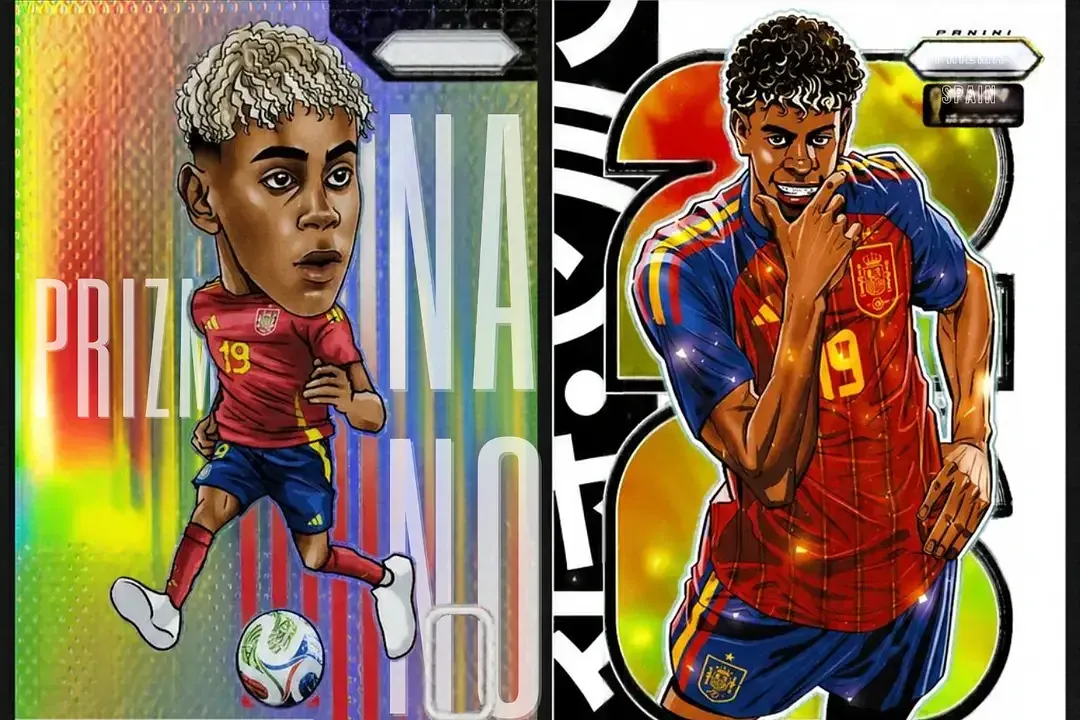
2026 World Cup Prizm Adds Two Popular Case Hits
Panini’s 2026 World Cup Prizm release has already become one of the most closely watched soccer products of the summer, and the set’s case-hit lineup has fueled much of the conversation. Alongside returning chase cards such as National Landmarks, World Cup Posters, National Pride, Color Blast, Dual Color Blast, Color Wheel, Alter Ego, Manga, and Prizmania, collectors have been tracking how the market has responded to the different inserts.
Among those case hits, Manga has drawn major attention. But when the completed sales are compared with Prizmania, the two inserts are not performing in the same market at all. Using Card Ladder Pro completed sales from June 16 through October 11, the gap between the two is clear in both volume and dollar value.
Manga Sold Far More Often Than Prizmania
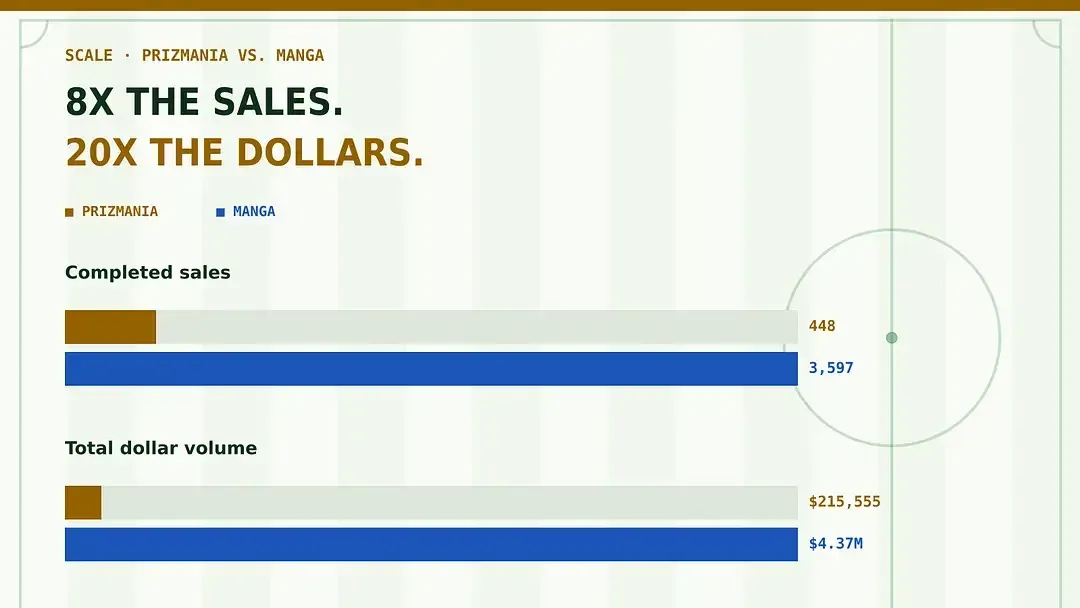
During the measured window, Manga recorded 3,597 completed sales for a total of $4.37 million. Prizmania posted 448 completed sales totaling $215,555.
That means Manga generated roughly eight times as many sales and about 20 times as much money as Prizmania. The difference is not just about how often the cards changed hands. It is also about how much buyers were willing to pay for individual Manga cards.
For more collecting context, read Cresselia Tops Another Pokémon Sweep of Weekly TCG Sales.
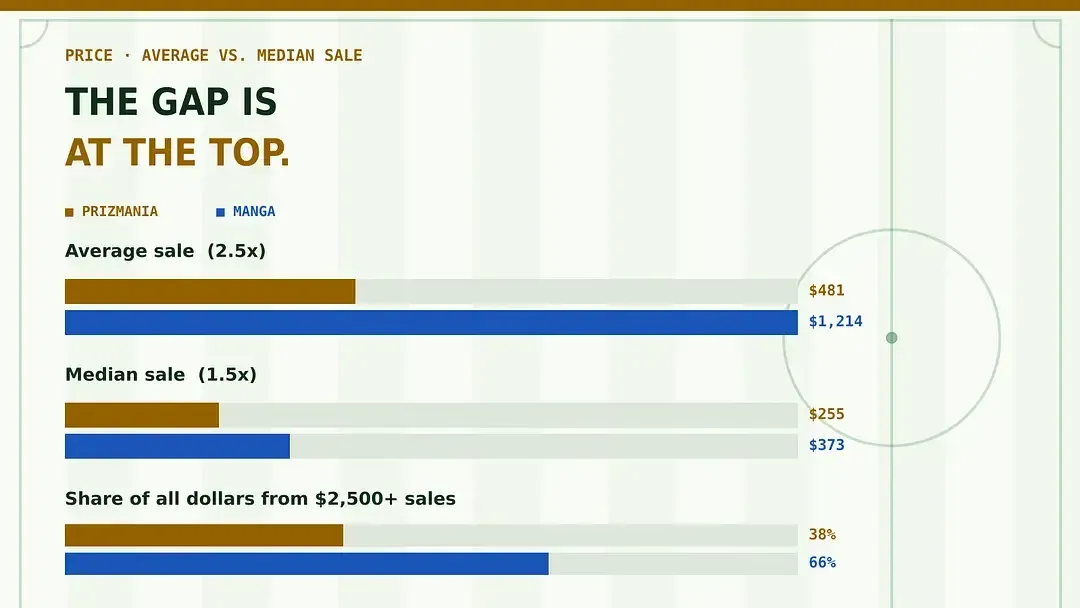
The average Manga sale came in at $1,214, compared with $481 for Prizmania. That is a 2.5x gap on average sale price. The median sale tells a slightly different story, with Manga at $373 and Prizmania at $255. That is still a premium for Manga, but the spread is narrower at 1.5x, suggesting that higher-end transactions are pushing the average up more aggressively.
The Top-End Sales Drive Much of Manga’s Value
The sales distribution helps explain why Manga’s total dollar volume is so much larger. According to the data, sales of $2,500 or more account for 66% of Manga’s dollars. For Prizmania, that figure is 38%.
That kind of split indicates that Manga is not only moving more cards, but also attracting a stronger concentration of premium sales at the top of the market. Prizmania still has meaningful demand, but its sales profile is less heavily weighted toward the highest-priced transactions.
Related coverage includes Manga Commands a Huge Premium Over Prizmania in 2026 World Cup Prizm Sales.
For collectors and market watchers, that distinction matters. A chase insert can be popular without producing the same level of high-end activity, and the Manga data shows a market with both broad participation and significant premium demand.
Same Players, Different Prices
The comparison becomes even more interesting when looking at players who appear in both inserts. The source data highlights four of the biggest names in world football who are included in both case-hit offerings: Lionel Messi, Lamine Yamal, Cristiano Ronaldo, and Diego Maradona.
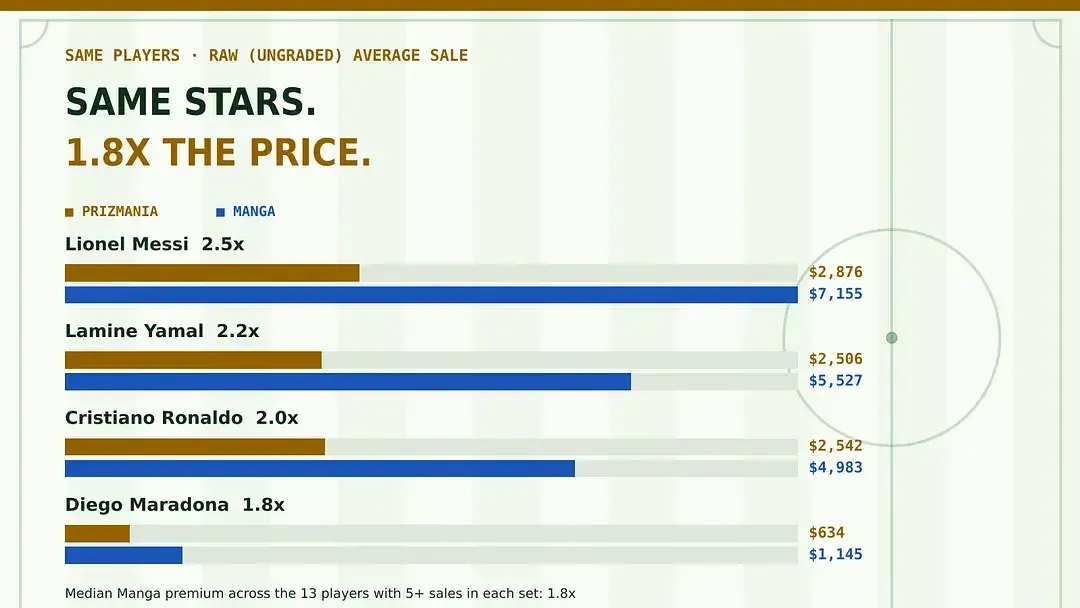
For those players, Manga consistently brought stronger prices in ungraded sales:
- Lionel Messi: $2,876 in Prizmania vs. $7,155 in Manga
- Lamine Yamal: $2,506 in Prizmania vs. $5,527 in Manga
- Cristiano Ronaldo: $2,542 in Prizmania vs. $4,983 in Manga
- Diego Maradona: $634 in Prizmania vs. $1,145 in Manga
Those comparisons show that the same player can command very different prices depending on the insert. Messi’s Manga sales averaged 2.5 times Prizmania’s ungraded average. Yamal’s Manga average was 2.2 times higher. Ronaldo’s was 2.0 times higher, and Maradona’s was 1.8 times higher.
Across the 13 players with at least five sales in each set, the median Manga premium was 1.8x. That suggests the pricing gap is not limited to one or two superstar names. It extends across a broader sample of players who appear in both inserts.
Graded Sales Show a Different Mix
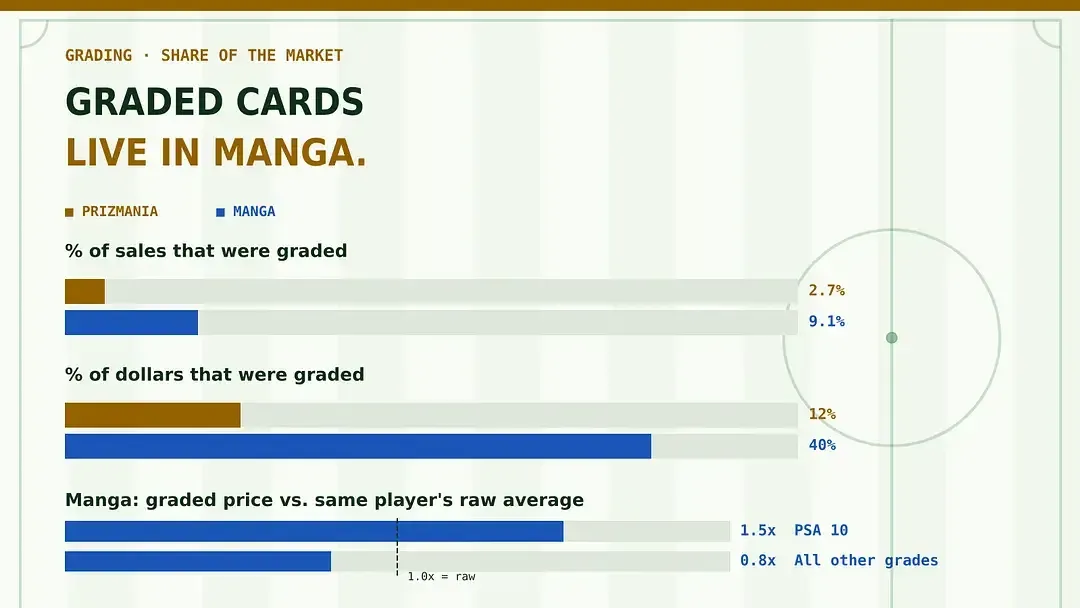
Graded cards make up a larger share of Manga activity than they do for Prizmania. In the measured period, 9.1% of Manga sales were graded, compared with 2.7% of Prizmania sales.
Those graded Manga cards accounted for 40% of Manga’s total dollar volume, while graded Prizmania cards represented 12% of Prizmania’s dollars. That is a significant difference in how value is distributed across the two inserts.
The data also shows that a Manga PSA 10 sold for 1.5 times the same player’s raw average, while other grades sold for 0.8x. That kind of split reinforces the idea that the highest-grade copies are helping support Manga’s premium market position.
What the Sales Data Suggests About Scarcity and Demand
Sales counts are not the same as population data, so completed transactions cannot tell collectors exactly how many copies exist. Even so, the market activity offers a useful signal.
Manga is clearly being treated as a major chase insert. It sold far more often than Prizmania in the same time frame, and it brought stronger prices for the same players. That combination makes it difficult to argue that Prizmania is the more expensive market simply because it is more desirable at the top. The data points the other way.
At the same time, the volume of Manga sales raises a fair question about how short-printed it feels in practice. If a card is trading this frequently, collectors will naturally ask how scarce it really is relative to other case hits in the product.
Prizmania, by contrast, may be the quieter market, but the numbers suggest it could also be the more undervalued one. Buyers are paying almost twice as much for the same stars in Manga, which leaves open the possibility that Prizmania is not getting the same level of attention from the broader market.
Why the Comparison Matters for Soccer Card Collectors
For collectors focused on 2026 World Cup Prizm, the Manga versus Prizmania comparison offers a useful snapshot of how insert design, collector preference, and player selection can shape the market. Both are premium case hits in the same product, both feature elite names, and both have generated strong interest. Yet the sales data shows that the market is valuing them very differently.
That does not mean one insert is better for every collector. Some buyers will continue to prefer Manga for its artwork and chase appeal, while others may see Prizmania as the better value. What the sales data makes clear is that the two inserts are not interchangeable in the marketplace, even when they feature the same players from the same tournament.
For now, Manga is the stronger performer by a wide margin, while Prizmania remains the lower-priced option in the same release. As more sales come in, collectors will have an even clearer picture of whether that gap holds or begins to narrow.

Join the Sports Card Portal Page thread for this story.
Comments
0You must be signed in to comment.
Sign In