

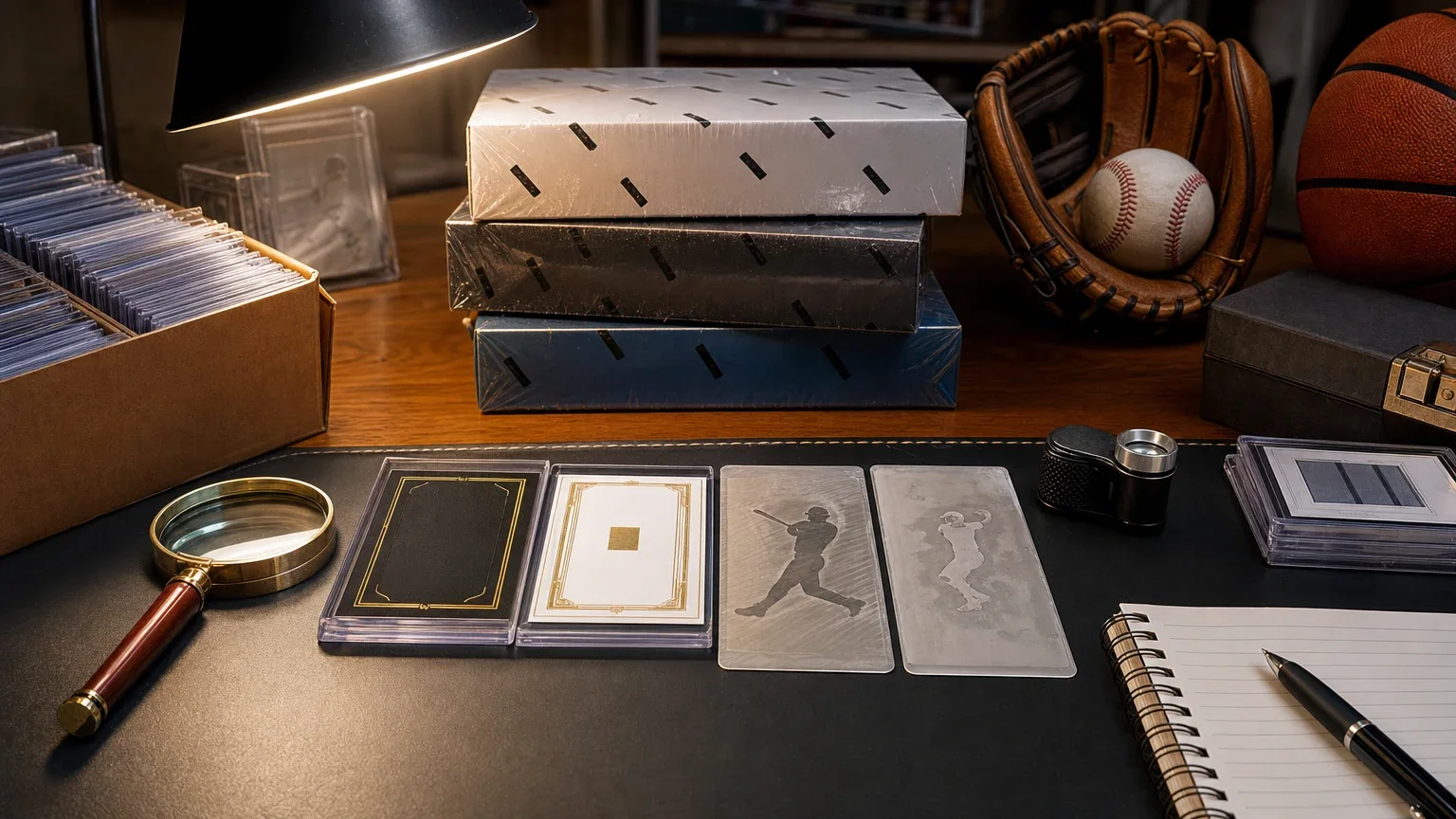
Collectors often talk about printing plates and one-of-one parallels as if they are interchangeable, but the hobby treats them as different animals. Both can be scarce enough to anchor a chase, yet they arrive there in different ways: one is tied to the printing process itself, while the other is a designed variation built into the set.
That distinction matters more than it may first appear. A parallel can be the premium version of a base card, with changes in color, texture, pattern, material, or image treatment. A printing plate, by contrast, is the metal plate used in production, which gives it a manufacturing-story appeal that a normal parallel does not have.
Once you separate those categories, a better framework emerges. Scarcity still matters, but it is only one piece of the decision. Collectors also need to think about how the card was made, how it looks in hand, whether the product includes multiple types of 1/1 chase cards, and how authentication and grading affect confidence in the item.
What is the practical difference between a printing plate and a one-of-one parallel?
A one-of-one parallel is a deliberate card variation. It begins with the same base design, then changes something about the card so that the variation becomes part of the product checklist. Topps describes parallels as versions of the base card that differ through color, texture, pattern, material, or image variation.
A printing plate is different because it is part of the printing workflow itself. Topps defines a printing plate as the thin metal plate used to print cards. That means the plate is not just a special-looking card in the set; it is a production object that exists because the set had to be manufactured in the first place.
That difference shapes how collectors talk about them. A parallel usually feels like the intended premium version of the card. A plate often feels like a behind-the-scenes artifact that escaped the factory floor and entered the hobby as a collectible. They may share scarcity, but they do not share origin.
Source_ids here support the core conceptual split: a parallel is a designed variation, while a plate is a printing-tool artifact. That is the starting point for every other comparison in the hobby.
- Parallel: a planned variation of the base card.
- Printing plate: the metal tool used in production.
- Both can be scarce, but they are scarce for different reasons.
- The origin story affects how collectors value them.
Why does scarcity alone fail to tell the whole story?
The hobby often uses the same shorthand for cards that are not really equivalent. If two cards are both labeled one-of-one, it is tempting to assume they belong in the same bucket. But one card may be a designed premium parallel, while another may be a printing plate tied to manufacturing. Scarcity is real in both cases, but the meaning of that scarcity is different.
That difference matters when you decide what to chase. A collector building a rainbow around a base design may prefer the parallel because it looks like the card was meant to be the finished premium version. Another collector may prefer the plate because it feels closer to the physical history of production and can stand out as a true artifact.
Topps’ collector education materials make that distinction useful rather than theoretical. They frame parallels as lower-quantity versions of the same design, while printing plates are the tools that helped create the cards. Once you see that, scarcity becomes a starting point, not the final answer.
In other words, a card can be equally rare and still not be equally meaningful to every collector. The practical question is not simply how few exist, but what kind of rare object the card actually is.
- Scarcity can be shared across categories without making them identical.
- A collector’s goal often matters as much as the print run label.
- Production origin can affect desirability as much as population size.
- One-of-one status is not a complete description of value or appeal.
How do manufacturers describe parallels in a modern release?
Topps’ education pages are useful because they explain parallels in plain collector language. A parallel usually retains the same core design as the base card, but changes one or more visual or material elements so it stands apart from the standard version. The important point is that it exists by design, not by accident.
Topps also notes that parallels are usually printed in smaller quantities, and some are numbered. That means the checklist itself signals premium status before the card ever reaches a pack. Collectors can evaluate the set logically: base card, then increasingly scarce versions, then in some cases true 1/1 versions within the parallel family.
This is why a parallel can be so central to a rainbow chase. The whole point of the build is that the card remains recognizable while becoming progressively harder to find. The parallel retains continuity with the base image, which makes it feel like a direct extension of the set rather than a separate production artifact.
For collectors who build by design set, that continuity is part of the attraction. You are not just buying rarity; you are trying to complete the visual story of the card.
- Parallels are planned variations, not factory leftovers.
- They often preserve the base card’s core look.
- Numbering can be part of the design language.
- Rainbow builders value the continuity between versions.
What makes a printing plate feel different in hand and in the hobby?
A printing plate does not usually function like a normal premium card. Its appeal starts with the fact that it is tied to production, which gives it a different kind of collector identity. Topps’ definition makes clear that the plate is the printing tool itself, so the object carries a manufacturing-story quality that a standard parallel does not.
That story changes how collectors talk about visual appeal. A parallel may be prized because it is sleek, colorful, or clearly intended as the premium version of a base card. A plate may be prized because it looks technical, utilitarian, or even unfinished, which is exactly what makes it interesting to some collectors. The card can feel less like a redesign and more like a recovered piece of the process.
That is why plates can divide opinion. Some collectors love them because they are true artifacts. Others prefer the cleaner aesthetic of a parallel and want the card that feels more fully designed. Neither view is wrong; they reflect different collecting goals.
If you are deciding between the two, the question is not whether one is rarer in a vacuum. It is whether you want the polished final expression of a card, or the physical trace of how that card was made.
- Plates appeal to collectors who like production artifacts.
- They may look more technical or utilitarian than parallels.
- Their visual identity is tied to process, not polish.
- Preference often comes down to collecting philosophy.
How should collectors read pack odds and checklist language?
One of the easiest mistakes is reading odds too literally. In some products, a pack odds line for printing plates does not mean a single specific plate color. Beckett’s Bowman Draft guide makes that point clearly by noting that odds for printing plates refer to the chance of any plate, while the product includes cyan, magenta, yellow, and black versions.
That matters because a card labeled as a 1/1 may actually sit inside a family of one-of-one plates. If you assume the odds refer to one specific color, you can misjudge both scarcity and your chance of pulling a particular version. The checklist language matters as much as the headline number.
The same caution applies to products that include both plates and one-of-one parallels. A release can contain multiple layers of scarcity, each with a different role. Some cards are 1/1 because they are designed as top-tier parallels. Others are 1/1 because each color plate exists only once. Those are different roadmaps to the same numeric label.
For collectors, the safe approach is simple: read the product page, read the checklist, and do not assume that every 1/1 tells the same story. In many cases, it does not.
- Odds for plates may refer to any plate, not one exact color.
- CMYK-style plate families can create multiple one-of-one versions.
- A 1/1 label does not always describe the same kind of scarcity.
- Checklist language is part of the card’s meaning.
Why do some collectors prefer a parallel over a plate, and vice versa?
Collector preference is usually driven by use case. If someone wants the card to feel like the clean, finished premium version of the base design, the parallel has the edge. It keeps the visual identity intact while offering a scarcer version that still fits neatly into a set run.
A plate is often more appealing to collectors who enjoy the history of production or want something that feels singular in a different way. The attraction is not just rarity; it is proximity to the manufacturing process. Some collectors value that story more than design continuity.
This is where the phrase “scarcity is not the whole story” becomes especially useful. The rarity level may be comparable, but the emotional and aesthetic payoff is not. A rainbow collector may see a plate as a side quest. A production-story collector may see it as the prize. Neither reaction is unusual.
The best choice depends on what kind of collection you are building. If you care most about visual coherence, the parallel usually wins. If you care most about the object’s origin, the plate often has the stronger pull.
- Choose parallels for design continuity and rainbow builds.
- Choose plates for artifact appeal and production history.
- The same rarity can create different collecting experiences.
- Personal collecting goals should drive the choice.
How do authentication and grading change the equation for rare cards?
Scarcity does not protect a card from condition issues, and it does not erase the need for authentication. PSA separates those tasks. Authentication determines whether an item is genuine, while grading assesses condition on a numerical scale after authenticity has been established.
That distinction matters especially with rare cards, because a slab can communicate several different things at once. A card may be authenticated and graded, or authenticated without receiving a strong grade, depending on its condition and the service outcome. The label is not the whole story; it is the summary of a process.
PSA’s certification tools also help with verification, but the company explicitly warns that a valid certification lookup does not eliminate counterfeit risk. That is a useful reminder for anyone shopping for a scarce plate or a one-of-one parallel online. A matching number is helpful, but it is not a substitute for examining the card, slab, and seller details carefully. If you are buying online, a practical companion read is How to Avoid Buying Stolen PSA Trading Cards.
The takeaway is simple: rarity should never replace due diligence. A scarce card can still be mislabeled, tampered with, or misrepresented, and grading does not cancel that risk.
- Authentication and grading are separate steps.
- A valid cert lookup is helpful but not a guarantee.
- Rare cards still require careful inspection.
- Condition and originality remain important even for 1/1s.
What should a collector ask before buying a plate or a 1/1 parallel?
A good purchase decision starts with three questions. First: what exactly is the card? That means identifying whether it is a printing plate, a designed one-of-one parallel, or another premium variation. Second: how was it created? The answer tells you whether you are buying a production artifact or a checklist-driven variation. Third: how will you collect it? The answer helps determine whether design, story, or completion matters most.
Next, ask whether the product contains more than one kind of 1/1. Many modern releases do. That means the scarcity label alone does not tell you how the card fits into the set. A plate may coexist with a true 1/1 parallel, and each may attract a different collector audience.
You should also separate verification from emotion. If the card is graded, confirm authenticity, understand the grade, and verify the certification data. If it is raw, inspect the card and compare it to trusted product images or checklist information. The goal is not to turn collecting into a checklist exercise; it is to make sure your excitement is based on the right object.
That approach will keep you from overpaying for the wrong kind of rarity or dismissing a card that fits your collecting style better than you expected.
- Identify the card’s category before judging the scarcity.
- Check whether the product has multiple types of 1/1s.
- Separate authenticity, grade, and cert verification.
- Buy for fit, not just for the headline rarity label.
How should you think about plates and parallels in the bigger hobby picture?
Printing plates and one-of-one parallels sit at the center of a broader hobby truth: not all scarcity is created equal. One card is rare because it is the finished premium expression of a design. The other is rare because it is a physical remnant of production. Both can be compelling, but they satisfy different collecting instincts.
That is why the smartest collector does not ask only how many exist. They ask what the card is, how it was made, how it fits the checklist, and how it should be verified. Those questions bring clarity to a market that often collapses all scarcity into the same shorthand.
Topps’ educational pages, Beckett’s checklist caveat, and PSA’s authentication guidance all point in the same direction. Scarcity matters, but meaning matters too. The better you understand the object, the better you can decide whether it belongs in your collection.
In that sense, the most useful hobby skill is not chasing every 1/1. It is knowing which 1/1 belongs to your collecting purpose and why.
- Scarcity and meaning are related but not identical.
- Production origin changes how a card is experienced.
- Checklist context matters as much as the 1/1 label.
- The best collectors chase fit, not just rarity.
Frequently Asked Questions
Is a printing plate the same as a one-of-one parallel?
No. A printing plate is part of the printing process, while a one-of-one parallel is a designed variation of the card. Both can be 1/1, but they are not the same kind of collectible.
Why do some plates have color names like cyan or magenta?
Many products use a set of color-separated plates, so each card can have multiple plate versions. Beckett notes that odds for printing plates may refer to any plate, not one specific color.
Should I value a 1/1 parallel more than a plate?
It depends on what you collect. A parallel may be better if you want design continuity and rainbow completion, while a plate may appeal more if you like manufacturing artifacts and production history.
Does a PSA certification number guarantee a card is genuine?
No. PSA says certification lookup helps verify data, but it does not eliminate counterfeit risk. Collectors should still inspect the item and seller context carefully.
Why do collectors care so much about the difference if both are scarce?
Because the origin, look, and collecting role are different. Scarcity is only part of the appeal; the card’s meaning in the set often matters just as much.
Written with AI assistance. Featured image: AI-generated editorial illustration.
Comments
0You must be signed in to comment.
Sign In