

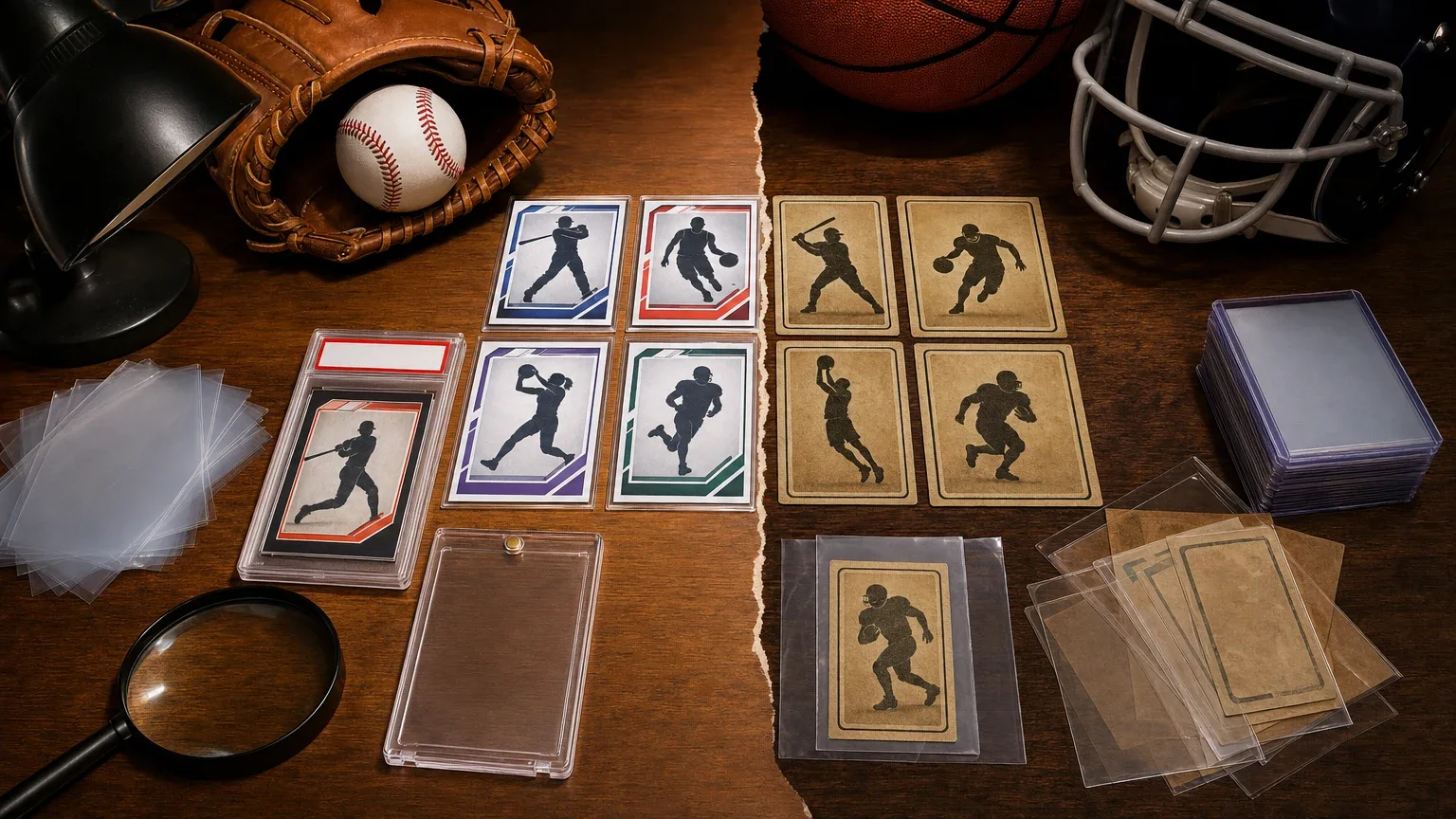
Licensed versus unlicensed sports cards is not just a design question. It is a rights question, a checklist question, and, for many collectors, a trust question. The differences can show up in logos, uniforms, league branding, patch content, and even how a product is described on the back of the box or in its legal fine print.
The simplest way to think about it is this: licensed cards use permissioned intellectual property, while unlicensed cards do not have the same level of clearance for league, team, or sometimes player-related marks. That does not automatically make an unlicensed card unworthy of a collection, but it does change what the card can legally present and how collectors tend to classify it.
Because licensing can change by sport, season, product, and rights-holder, the practical rule is to verify the exact card rather than assume based on the brand alone. A card can be fully official in one era and only partially licensed in another, and some products layer multiple permissions in different ways.
What does “licensed” actually mean on a sports card?
A licensed sports card is one that has permission to use protected intellectual property from the relevant rights-holder or rights-holders. In practice, that can include league marks, team names, logos, uniform designs, colors, slogans, player names, and player images. MLB’s legal notices make clear that its marks and related identifiers are protected and can be used only with permission.
Topps’ legal copyright page is useful because it shows the licensing stack in plain view. For MLB active players, Topps describes MLB trademarks and copyrights as being used with permission of MLB and notes that the product is officially licensed by MLB and MLB Players, Inc. For basketball, Topps separates NBA Properties and the National Basketball Players Association, which shows that the league and player association are distinct rights-holders.
That distinction matters because a card does not become “licensed” all at once. The league, the teams, the players association, and sometimes additional entities may each control a different piece of the card’s visual or commercial identity. For collectors, the question is not merely whether a player appears on the card, but which parts of that card’s presentation were actually cleared.
- Licensed does not mean one blanket approval; it usually means several permissions working together.
- A product can be licensed for some rights and narrower for others.
- The exact wording on the product page or legal page matters more than assumptions from the brand name.
Why are league rights and player rights treated separately?
League and team rights are not the same thing as player rights. A league can control its own marks, while a players association can control group licensing for player names and likenesses. MLB’s legal notices emphasize protected league and club identifiers, while Topps’ legal page shows separate licensing references for MLB active players, retired players, Hall of Fame subjects, and other categories.
The NBA’s own announcement about Fanatics Collectibles and Topps returning as the official exclusive trading card licensee underscores how layered these rights can be. The release ties the new arrangement to fully licensed NBA and NBPA cards and points to specific products and season-based features. That tells collectors the rights structure is not abstract; it is built into product timing and product format.
This separation is why collectors should be careful about shortcuts. A card might have a player image because player-related rights were cleared, but it may still lack league logos or team branding if those permissions were not included. The reverse can also happen in more specialized products, where a specific event or relic element is licensed while other pieces of the design are not.
- League marks and player publicity rights can come from different agreements.
- Active-player cards, retired-player cards, and special inserts may follow different rights paths.
- Product timing matters because licensing can change from season to season.
What visual features usually separate licensed cards from unlicensed cards?
The most obvious difference is usually the presence or absence of official logos and branding. Licensed cards typically show league marks, team logos, uniform insignia, and other protected identifiers that make the card feel like an official piece of the sport. MLB’s notices confirm that those identifiers are protected and require permission to use.
Unlicensed cards can still show a player, a team color palette, or a card-style design, but they often avoid the protected marks that would require fuller rights clearance. The result is a product that may look familiar at a glance while still feeling noticeably different in hand. In the sources reviewed, that conclusion comes from the rights restrictions themselves rather than from a single universal definition of “unlicensed.”
The difference can be subtle or obvious depending on the set. Some unlicensed products lean into a cleaner or more graphic look, while others simply remove the elements that would otherwise require permission. That is one reason two cards of the same athlete can feel like they belong to different collecting ecosystems even when the player image is similar.
- Licensed cards usually show official team and league marks.
- Unlicensed cards may still use player images but often omit protected logos.
- The visual gap is not only aesthetic; it is tied to rights clearance.
Why do some collectors still buy unlicensed cards?
Collectors do not buy only for licensing status. Many buy for the player, the design concept, the checklist, or the moment captured on the card. A set can be unlicensed and still matter if it fills a player gap, documents a key year, or presents a design collectors enjoy. The available sources support that logic indirectly by showing what unlicensed products cannot use, which helps explain why their appeal often shifts toward design and subject matter.
Design freedom is one of the main practical attractions. If a manufacturer is not building around full league branding, it can create a different visual identity. That does not make the product better by default, but it can make it distinctive. In hobby terms, some collectors appreciate that difference instead of treating it as a defect.
Unlicensed cards can also serve as stopgaps when a collector wants a player in a certain uniform, a certain pose, or from a certain era when officially licensed alternatives are not available. The tradeoff is that the card usually sits in a separate lane from the more traditional, logo-heavy flagship style most collectors associate with mainstream releases.
- Collectors may chase the player, not the license status.
- Unlicensed sets can offer visual freedom that licensed products cannot.
- The appeal is often about access to the subject or concept, not official presentation.
What do collectors lose when a card is unlicensed?
The most visible loss is often the official look. Without full rights clearance, a card may lose team logos, league marks, and some of the branding details that help it feel complete to traditional collectors. For many buyers, those elements are not decoration; they are part of the card’s identity and proof that it belongs inside the sport’s official visual language.
There is also a legal clarity issue. Panini’s baseball disclaimer is a concrete example of how an unlicensed product identifies itself: it states that the cards were not prepared, approved, endorsed, or licensed by MLB or MLB Properties, and it also notes that MLBPA intellectual property cannot be used without written consent. That kind of language makes clear that a collector should not confuse appearance with authorization.
Finally, there is market segmentation. Licensed cards usually have broader mainstream familiarity because they match what many collectors expect from a modern sports card. Unlicensed cards may still attract demand, but they often do so from a narrower audience that values the player, the set, or the design more than the official look.
- You may lose official logos, marks, and the strongest “official product” feel.
- Disclosure language can be a major clue to licensing status.
- Unlicensed cards often appeal to a more specialized collecting audience.
How can a product be licensed in one way but still incomplete?
Collectors sometimes assume that if a product is licensed, every visual element must be fully cleared in the same way. The pages reviewed show that is not a safe assumption. Topps’ legal copyright page separates categories such as active players, retired players, Hall of Fame subjects, and other groups, which suggests that different rules can apply to different subjects within the same product family.
The NBA’s partnership announcement also shows how modern card features can add additional layers. The release ties specific programs, including the Rookie Debut Patch and Gold NBA Logoman Patch, to the new license structure. That means a product can be broadly licensed while also relying on separate permissions or procedures for special inserts, patch content, or event-linked materials.
For collectors, the lesson is to inspect the specific card, not just the brand. A card could be part of a licensed product line and still involve narrower rights for a particular subset of subjects or memorabilia elements. The legal pages provide enough evidence to support that practical caution, even if they do not map every exception one by one.
- Licensed product line does not always mean identical rights across every card in the line.
- Different subject categories may have different permission structures.
- Special inserts and memorabilia pieces can involve added layers of approval.
How do changing rights agreements affect older and newer cards?
Licensing is time-sensitive. A card can be aligned with one agreement date and then sit beside a nearly identical card from a different period that was produced under a different rights structure. Panini’s NFL announcement described its agreement as taking effect immediately and being folded into its first NFL product of the season, which is a reminder that effective dates matter in hobby classification.
The NBA release similarly anchors Topps’ return to 2025–26 Topps Basketball and gives a product-specific context for the renewed licensing arrangement. That matters because collectors often judge cards by appearance alone, but the rights behind the appearance can shift across seasons. Two similar-looking cards can therefore have very different legal pedigrees.
That is why year, checklist, and release window should always be part of the buying decision. A collector should not rely only on the manufacturer’s reputation or on a familiar design template. The relevant question is whether the card was made inside the rights structure that was in force when that product was released.
- Check the product year, not just the company name.
- Licensing agreements can begin at a specific moment and affect only later products.
- Cards from adjacent seasons can look similar while having different rights status.
What should you verify before buying a card online or at a show?
Start with the product identity. Confirm the exact set name, year, and manufacturer before assuming anything about licensing status. Then check the product’s legal language or official product page when possible. That is the quickest way to separate a fully licensed release from a product that only uses a player likeness or a narrower slice of the rights package.
If the card is graded or encapsulated, do not confuse the holder with licensing. PSA’s pages make a clear distinction between certification, grading, and authenticity tools. A card can be genuine and still be unlicensed; a holder can verify authenticity or condition, but it does not create rights that were never part of the original product.
It is also worth checking whether the card is being presented with a certification number, an LOA, or a tamper-evident label. Those tools help with authenticity and chain-of-custody questions, but they do not erase licensing concerns. For collectors, the safest habit is to verify the physical item, the product disclosure, and the rights status separately.
- Confirm the exact set, year, and manufacturer.
- Do not treat grading or encapsulation as proof of licensing.
- Check whether the item is being sold with a verifiable certification, not just a label.
How do PSA-style authentication and grading fit into the licensing conversation?
Authentication and licensing answer different questions. Licensing asks whether the producer had permission to use protected marks or player-related rights. Authentication asks whether the item is genuine. Grading asks what condition the item is in. PSA’s pages separate those functions clearly, which is important because collectors often use the same shorthand for all three.
PSA says its certification tools can verify numbers for cards, autographs, tickets, and more, and its security pages emphasize tamper-evident holders. At the same time, PSA explains that grading standards assess condition rather than legal rights. That means a card can be certified, authenticated, or graded without being licensed in the way a collector might expect from a major league release.
The practical takeaway is simple: a slab does not make a card official, and a certificate does not change the original product’s rights position. Those tools are valuable, especially when buying remotely, but they are complementary to licensing research rather than substitutes for it.
- Licensing is about permission; authentication is about genuineness; grading is about condition.
- A certified or graded card can still come from an unlicensed product.
- Security tools help verify the item, not the original rights structure.
Frequently Asked Questions
Can an unlicensed card still be worth collecting?
Yes. Collectibility depends on the player, design, scarcity, set concept, and personal preference. Unlicensed cards usually trade away official logos and some rights clarity, but they can still be desirable for many collectors.
Does a graded card automatically mean it is licensed?
No. Grading or authentication only speaks to the card’s condition or genuineness. It does not create league, team, or player rights that were not part of the original product.
Why do some cards have logos removed even though the player is on the card?
Because the rights to use a player’s likeness and the rights to use league or team marks can be separate. A product may clear one layer but not another, which can change how the finished card looks.
What is the safest way to check licensing before buying?
Check the exact product name, year, manufacturer, and official product language. If possible, confirm whether the release was described as officially licensed by the relevant league and player association.
Written with AI assistance. Featured image: AI-generated editorial illustration.

Comments
0You must be signed in to comment.
Sign In