

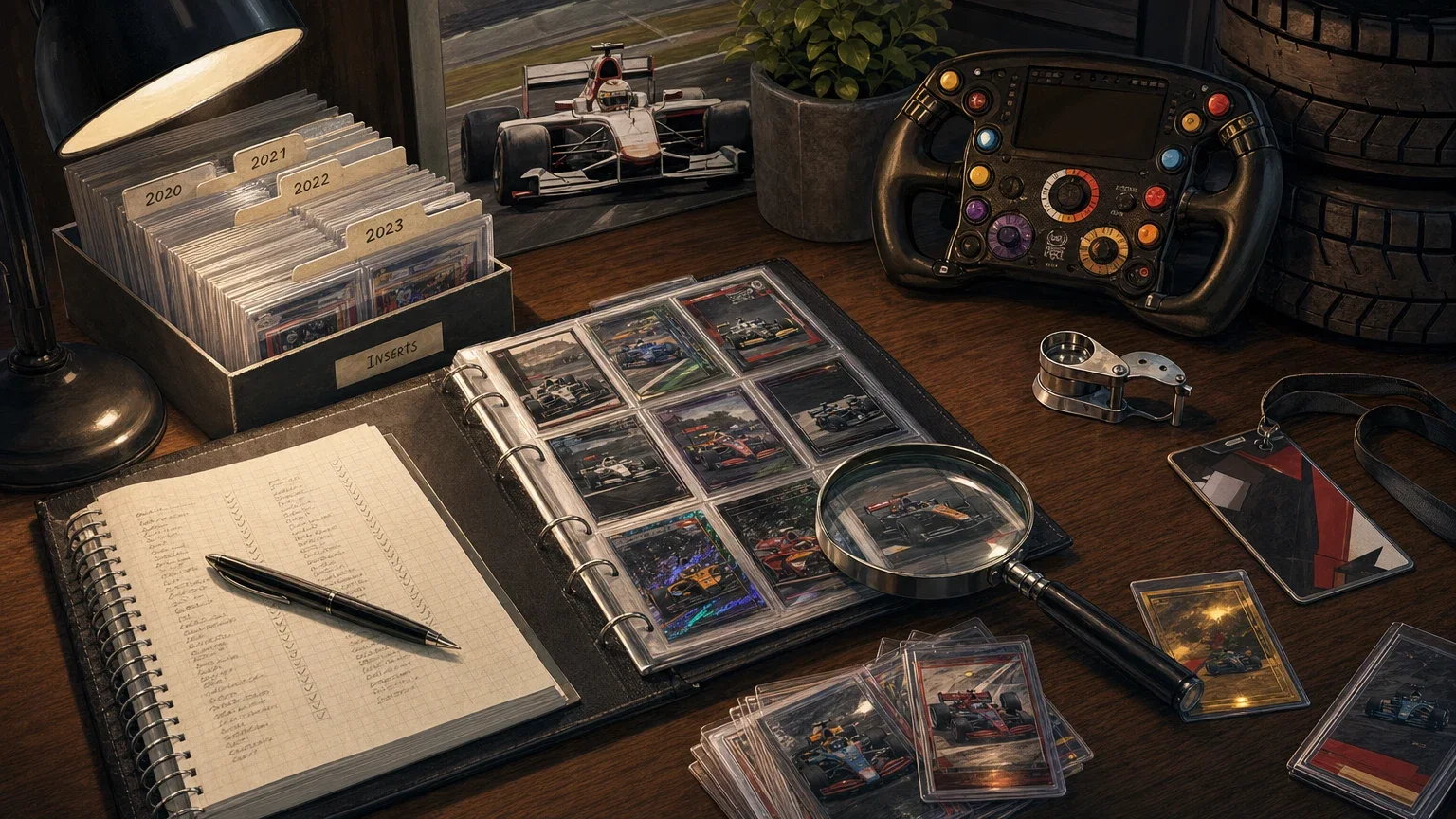
Formula 1 card collecting is easy to overcomplicate because the modern product mix offers so many ways in. You can build around base sets, chase premium parallels, target autographs, or narrow your scope to a single team or driver. The best collections usually begin with a decision about purpose, not a decision about scarcity.
That matters even more now that Topps continues to hold the official F1 trading card and sticker relationship and its current Chrome Formula 1 release is built as a broad, multi-layered checklist. The 2026 product includes drivers from F1, F2, and F3, along with cars, legends, team duos, team logos, and team principals, so collectors are not choosing only between stars and rookies; they are choosing between entire collecting styles.
The simplest way to stay focused is to define three things before you buy anything: your lane, your format, and your end goal. If those three choices line up, the collection grows with intention. If they do not, the result is usually a stack of cards that feels expensive but unfinished.
What should your first Formula 1 collecting goal be?
Start with the question that sounds obvious but gets skipped most often: what do you actually want the collection to look like? In Formula 1, a narrow goal is usually better than a vague one. A collector who says “I collect F1” can end up buying everything from base cards to premium inserts without a clear thread connecting the cards. A collector who says “I want one card of every current-grid driver from an official Chrome release” has a real target.
The current Topps Chrome Formula 1 structure makes that kind of planning easier because the checklist is large enough to support several different collection styles. Topps describes the release as a premium F1 product with a 200-subject base set, and the lineup spans current drivers, feeder-series talent, legends, and team-related subjects. That breadth gives you options, but it also makes focus more important than ever.
- Choose one primary lane before you buy packs: current drivers, teams, prospects, autographs, or base-set completion.
- Set a finish line you can recognize, such as “one card per driver,” “one signed card per season,” or “one team rainbow in a single product year.”
- If your goal is broad and undefined, your spending will usually be broader than your results.
Which Topps format fits your collecting style?
The biggest collecting decision is not which card to chase; it is which format matches your goal. Topps’ 2026 Chrome Formula 1 guide separates the release into seven formats, including Hobby, First Day Issue, Hongbao Edition, Value Box, Mega Box, Logofractor Edition, and Sapphire Edition. That is a strong signal that the product is not meant to be treated as one uniform experience.
A collector chasing base-set depth and built-in autograph chances will usually lean toward Hobby. A collector who cares more about premium feel, higher-end parallels, or format-specific exclusives may be better served by Sapphire, First Day Issue, or Logofractor. Value Box and Mega Box, by contrast, are easier entry points when the goal is more cards at a lower barrier rather than a luxury hit chase.
- Hobby: best when you want a deeper all-around experience and stronger built-in hit potential.
- Value Box or Mega Box: best when you want a more accessible way to open cards and build a base set.
- Sapphire, First Day Issue, or Logofractor: best when your focus is premium parallels and selective chasing.
- Hongbao Edition: best treated as a release-specific format rather than a permanent collecting strategy.
Should you build around drivers, teams, or prospects?
Formula 1 card collecting becomes clearer once you decide whether the subject is the driver, the team, or the future talent pipeline. Current-grid driver collections are the most intuitive because they map neatly to the sport itself and tend to stay seasonally relevant. Team collections can be more elegant than they first appear, especially because Topps includes team logos, team principals, and team duo cards in the current Chrome ecosystem.
A prospect lane can also work well, but it asks for more patience. Topps’ inclusion of F2 and F3 subjects creates a natural bridge between feeder series and the F1 checklist, which is appealing for collectors who enjoy following careers before they become mainstream. The tradeoff is volatility: feeder-series names may rise, shift, or disappear from future F1-focused checklists, so this lane is more about interest and timing than certainty. For collectors who want a broader view of the pipeline, the internal guide on [Three Formula 1 Prospects to Study for a Card Collection: Antonelli, Bearman, and Bortoleto](https://sportscardportal.com/news/three-formula-1-prospects-to-study-for-a-card-collection-antonelli-bearman-and-bortoleto) is a natural companion piece.
- Driver lane: best for a season-to-season collection that follows the grid directly.
- Team lane: best if you want structure, visual consistency, and less pressure to chase every name.
- Prospect lane: best for collectors who enjoy feeder-series crossover and future upside in a hobby sense, not as a promise of value.
- Autograph lane: best when you want fewer cards but more significance per card.
How complete do you want the collection to be?
Completion means different things in Formula 1 than it does in many other sports. A set builder may want every base card. A parallel collector may want only one color run. A team collector may want every driver card, every logo, and every principal card from one release. All of those are valid, but they require very different budgets and levels of patience.
The safest way to stay realistic is to choose a ceiling. For example, you might decide that your target is the base set plus one numbered parallel of each driver you care about. That is still ambitious, but it is finite. Once collectors start trying to complete every parallel tier, every insert family, and every autograph variation, the project can stop feeling curated and start feeling endless.
- Base-set only: ideal for a clean, organized collection that can be completed.
- Base set plus one parallel: a strong middle ground between affordability and rarity.
- Single-driver or single-team rainbow: more focused, but easier to personalize.
- Autographs only: compact in number, but often demanding in cost and availability.
What does a sensible buying plan look like by budget?
A practical Formula 1 plan should match the amount you are comfortable spending with the kind of collection you actually want. If your goal is broad coverage, ripping premium boxes is usually a poor fit. If your goal is one or two premium cards that display well, singles may be the better path. The shape of the product matters more than the excitement of opening it.
One sensible approach is to buy boxes only when opening the product itself is part of the fun, then use singles to finish the collection. Another is to skip heavy ripping entirely and define your target narrowly from the start. Because the 2026 Chrome release has multiple box types and a wide checklist, the more specific your goal, the less likely you are to overbuy in the wrong direction.
- Low budget: define a narrow singles-only target, such as one card per driver from one official release.
- Moderate budget: open a few boxes for the experience, then finish the checklist with singles.
- Higher budget: combine selective box buying with parallel or autograph targeting.
- Best all-around rule: buy the format that serves the goal, not the format that looks most exciting.
When does an autograph card make the most sense?
Autograph collecting can be the most satisfying lane in Formula 1 because it turns a checklist into a display piece. Topps says its 2026 Chrome autograph program spans 100 subjects, including F1, F2, F3, team principals, and legends. That breadth makes signed cards a logical specialty if you prefer fewer acquisitions with more individual significance.
The drawback is that autograph chasing can become expensive quickly if you do not define what “finished” means. A well-built autograph collection might focus on only current drivers, only one team, or only a small group of favored personalities. For collectors who want a more focused primer on this lane, the internal guide on [Formula 1 Autograph Card Collecting Guide: Authentication, Checklists, and Product-Specific Caveats](https://sportscardportal.com/news/formula-1-autograph-card-collecting-guide-authentication-checklists-and-product-specific-caveats) is worth pairing with this approach.
- Choose autos if you want impact over volume.
- Limit the checklist by subject type: current drivers, team principals, or legends.
- Consider whether you want on-card signing, sticker auto formats, or simply authenticated signatures.
- Remember that a signed card can be authentic without being in top card condition.
How should you think about grading and authenticity?
Grading is not the same thing as authenticity, and that distinction matters a lot in F1. A card can be encapsulated as authentic without receiving a numeric grade, and an autograph can be authenticated or graded separately from the card itself. That means a slab tells you something important, but not everything important. It may confirm that the item is genuine; it does not automatically tell you that the card is in top condition.
Verification tools help, but they are not magical shields. PSA’s certification lookup can confirm certification details, and Beckett offers authentication and autograph-related verification tools, but both systems still leave room for counterfeit risk if a label or number has been copied. A thoughtful collector should treat verification as one layer of defense, not the whole strategy. CGC’s grading scale also makes clear that authentic, altered, and numerically graded outcomes are not the same thing.
- Authentic does not mean gem mint.
- Authentication of the autograph is separate from assessing the card’s condition.
- Certification lookup is useful, but it does not eliminate counterfeit risk.
- If you are buying slabbed cards, learn the difference between genuine, altered, and numerically graded outcomes.
What mistakes do focused Formula 1 collectors make most often?
The most common mistake is buying the wrong product for the goal. If your endgame is a base set, a premium chase format can drain your budget without helping much. If your endgame is a handful of display-worthy cards, opening too many lower-end boxes can leave you with volume instead of focus. Product choice should follow the collecting plan, not the other way around.
Another common mistake is trying to collect the entire ecosystem at once. Formula 1 cards are especially tempting because the product can include drivers, legends, team principals, cars, logos, duos, rookies, and feeder-series names. That variety is part of the appeal, but it also means a collection can become scattered very fast. A clean rule — one lane, one format, one target — keeps the hobby enjoyable instead of chaotic.
- Do not let box excitement replace a real plan.
- Do not confuse “broad checklist” with “you should collect every category.”
- Do not make authenticity assumptions just because a card is slabbed.
- Do not let prospect collecting turn into a never-ending chase across every feeder series.
What is a simple roadmap for starting today?
A good Formula 1 starter collection does not need to be large. It needs to be coherent. Begin by choosing your lane: current-grid drivers, a single team, prospects, or autograph cards. Then choose a format that matches that lane, whether that means Hobby for depth, Value Box for accessibility, or a premium format for selective chasing. After that, set a stopping point so the collection stays intentional.
If you want the cleanest possible start, use singles to define the core and boxes only to add enjoyment. If you want a more active collection, open a small amount of product and fill the gaps later. The key is to keep the goal visible. In a sport with a wide official checklist and multiple release formats, clarity is the real advantage.
- Pick one lane and write it down.
- Pick one format that supports that lane.
- Set a completion rule before buying anything.
- Use singles to finish, not to drift.
- Revisit the plan after each release instead of starting over.
Frequently Asked Questions
Is it better to collect Formula 1 cards by driver or by team?
Neither is universally better. Driver collecting is more direct, while team collecting can be cleaner and more consistent. Pick the lane that matches how you follow the sport.
Should a beginner buy boxes or singles?
Singles are usually the simpler starting point if your goal is a specific collection. Boxes make more sense when opening packs is part of the hobby experience.
Are graded Formula 1 cards always better than raw cards?
No. Grading can add structure and verification, but a slab does not automatically mean the card is in top condition. Authenticity and numeric grade are separate ideas.
What is the safest way to build an autograph-focused F1 collection?
Narrow the checklist, buy from reputable sellers, and verify certification details where possible. Even then, treat verification as helpful rather than perfect.
Written with AI assistance. Featured image: AI-generated editorial illustration.
Comments
0You must be signed in to comment.
Sign In