

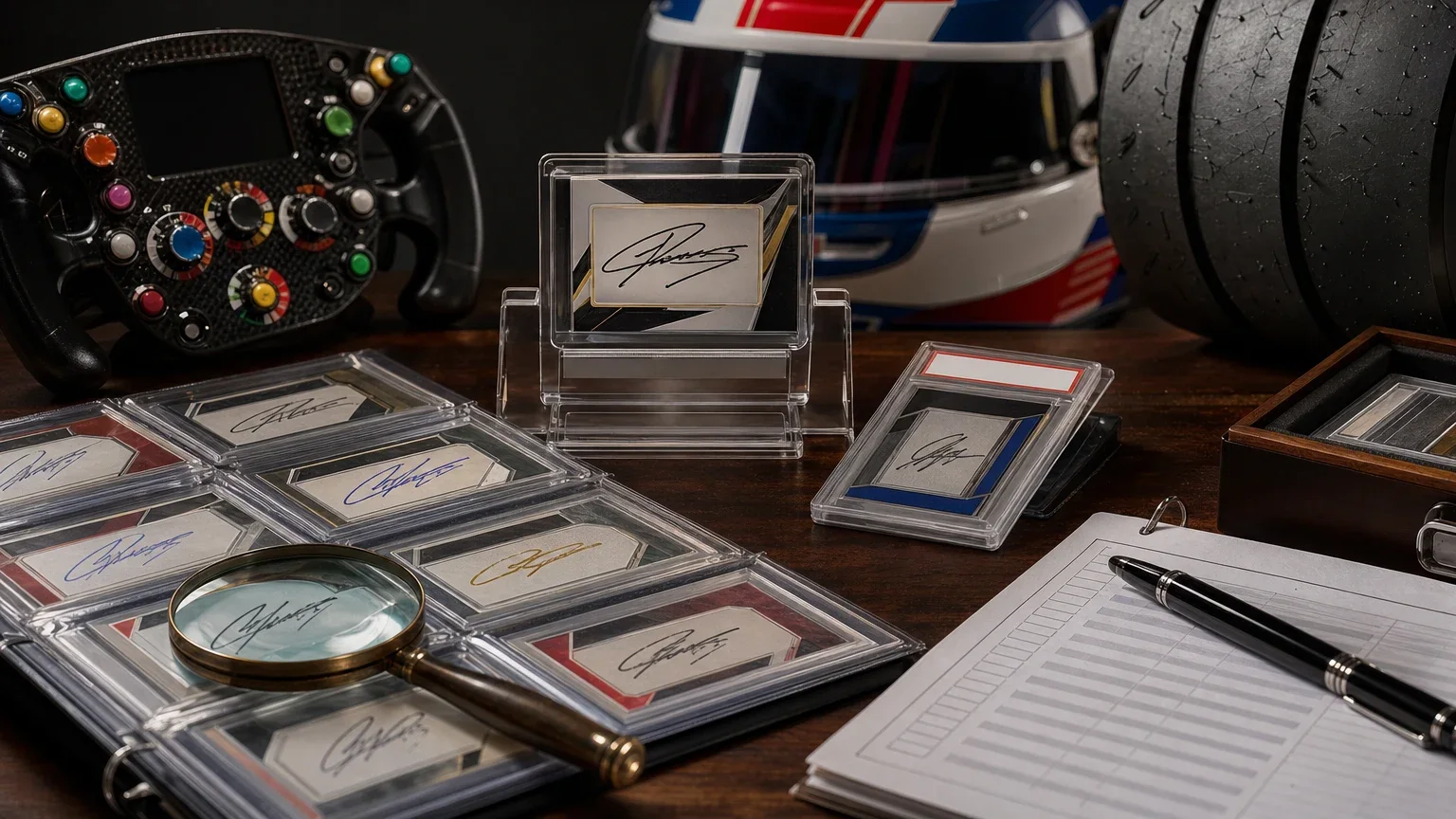
Formula 1 autograph cards can look straightforward at first glance: a signed card is a signed card. In practice, the collecting landscape is more layered. The value of a Formula 1 auto card often depends on whether it is on-card or sticker-signed, whether the autograph has been independently authenticated, and which Topps product family it comes from.
That matters because Topps now spreads F1 autograph content across very different formats. Chrome is the broad entry point, Dynasty is the premium low-numbered lane, and Eccellenza mixes autograph chasing with relic construction and book-style premium pieces. Each one asks a different question of the collector, from checklist coverage to storage to authentication confidence.
The smartest approach is not to chase every signed F1 card the same way. Instead, decide what kind of autograph card you want, then verify the item, confirm the checklist context, and understand the product caveats before you buy. That order matters whether you are building a favorite-driver collection or narrowing in on current-grid autographs only.
What should you actually collect in Formula 1 autograph cards?
The first decision is not which seller to trust, but which autograph category you want to chase. Current Topps Formula 1 releases separate into at least three useful lanes: broad autograph inserts, premium on-card autos, and relic-heavy autograph constructions. That distinction changes everything about scarcity, cost, and the kind of checklist you need to read before buying.
Topps Chrome Formula 1 is the widest lane. The current release is described as a 200-subject base set with a large autograph program spanning 100 racing subjects, plus inserts and multiple parallels. Dynasty, by contrast, is built as a high-end product where nearly every autograph is signed directly on-card and most cards are numbered to 10 or less. Eccellenza sits in between as a premium relic-and-auto format with current-driver on-card signatures and deluxe multi-card chases.
If you are trying to build a practical collection, the right bucket depends on your goal. Chrome suits collectors who want breadth and more frequent checklist hits. Dynasty is for collectors who want premium presentation and scarcity. Eccellenza is for collectors who want autograph cards that also feel like centerpiece relic pieces rather than simple signed singles.
- Chrome: broader checklist coverage and more accessible autograph variety
- Dynasty: premium on-card focus with lower-numbered scarcity
- Eccellenza: relic-heavy premium format with autograph and book-card appeal
How do you tell whether a Formula 1 autograph is actually authenticated?
Authentication and grading are related, but they are not the same thing. PSA states that it can authenticate an autograph and, separately, assign a numerical grade to a PSA-certified autograph. That means a card can be genuine without being graded, or graded without telling you everything you might want to know about the physical card itself.
PSA also explains that authentication can come with either a tamper-evident holder or a Letter of Authenticity, and that the certification number can be checked online. That verification step is crucial because the label alone is not enough. A collector should compare the certification record, the image tied to the cert, and the actual card in hand before treating the piece as fully confirmed.
Topps adds another layer with its own authenticity protection program. The company says it stands behind unaltered Topps autographed cards and relic cards, but it also says it does not control independent grading companies’ authentication decisions. In practical terms, a Topps guarantee, a PSA certification, and a seller description may all point in the same direction, but they are not interchangeable forms of proof.
- Authentication confirms the autograph; grading adds a condition assessment
- Always match the certification number to the public lookup record
- Treat Topps support, third-party certification, and seller language as separate layers of evidence
Why do on-card and sticker autographs matter so much?
Collectors care about on-card versus sticker autographs because the format changes both the feel of the card and the way premium products are positioned. On-card autos are signed directly on the card itself, while sticker autos are signed on a separate sticker that is later applied. Topps has published its own explainer on the difference, and its premium F1 products lean hard toward on-card signatures.
That preference is not just aesthetic. On-card cards often feel more connected to the athlete and usually carry stronger prestige in premium releases. Sticker autos can still be desirable, especially when they expand checklist access or make a broader product possible, but they are generally not the first choice for collectors seeking the cleanest premium presentation.
For Formula 1, the distinction also helps you read a checklist more intelligently. If a product says it emphasizes more on-card autographs than before, that is a clue that Topps is trying to elevate the category. If you are only buying one or two cards, that clue matters. If you are building a wider rainbow or team run, sticker content may be more acceptable because the checklist footprint can be bigger.
- On-card: signed directly on the card and usually favored in premium formats
- Sticker: signed on a separate sticker and then affixed to the card
- Premium F1 lines are increasingly built around on-card autograph content
What should you verify before buying a graded or slabbed F1 autograph?
A slab is useful, but it is not a substitute for verification discipline. PSA says the certification label includes a unique certification number, and that collectors should verify the item through PSA’s lookup system. The practical lesson is simple: do not buy the label; buy the card, then confirm that the label, number, image, and holder all align.
You should also understand what the holder is actually protecting. PSA says the certification becomes null and void if an encapsulated item is removed from the holder. That means a broken holder is more than cosmetic damage. It can undermine the authentication chain and reduce confidence in the item’s provenance, especially when you later go to resell or trade it.
For Formula 1 autograph cards, the safest workflow is to inspect the card surface, compare the signature placement, match the cert number, and ask whether the item was authenticated, graded, or both. A collector who learns to separate those steps will avoid many of the most common mistakes in the slabbed-autograph market.
- Match the cert number and image before purchasing
- Ask whether the item is authenticated only, graded only, or both
- Do not assume a slab guarantees permanence if the holder has been compromised
What makes Topps Chrome Formula 1 the broadest autograph entry point?
Chrome is the most practical starting point for many collectors because it is designed to be wide rather than ultra-narrow. Topps describes the 2026 release as a 200-card base set with a large parallel ladder and an autograph program covering 100 racing subjects. That breadth makes Chrome useful for collectors who want current F1 names, feeder-series names, and some variety in how they chase signatures.
But breadth comes with a checklist warning. Topps says Chrome includes F1, F2, F3, F1 Academy, team principals, and legends. If your goal is limited strictly to current F1 drivers, you cannot assume every autograph hit fits that goal. You need to read the checklist, not the box title, because the product’s structure is intentionally wider than a single category of driver.
Chrome also creates a configuration issue. Topps’ current release information notes that different formats are distributed differently, which affects access and not just price. That means a buyer comparing listings should not treat every box, case, or configuration as equivalent just because it sits under the same annual Chrome banner.
- Best for broad checklist coverage and multiple racing categories
- Not every autograph in the product is a current F1 driver
- Box configuration affects access and should be checked carefully
Why is Dynasty the premium lane for F1 autograph collectors?
Dynasty is Topps’ high-end Formula 1 product, and its structure tells you why collectors treat it differently from Chrome. Topps says nearly all Dynasty cards are numbered to 10 or less, and every autograph is signed directly on-card except cut signatures. That combination of low numbering and on-card construction is what makes Dynasty feel like a top-shelf autograph chase rather than a mass checklist product.
The product also goes beyond simple signed singles. Topps lists patch autographs, jumbo relic autos, dual and triple relic autos, precious relics, dynasty diamond relics, and cut signature booklets. So the collector is not just deciding whether to buy an autograph card; the collector is deciding whether to prioritize signature, relic, booklet format, or a specific premium combination.
That is why Dynasty requires a narrower buying plan. If you want a true signature centerpiece, focus on the on-card auto angle. If you want a relic-first premium piece, Dynasty can still fit that goal. If you only want straightforward, easy-to-store singles, Dynasty may be more ambitious than you need.
- Nearly all cards are numbered to 10 or less
- Every autograph is on-card except cut signatures
- Format matters: patch autos, relic autos, and booklets are all part of the appeal
What is different about Eccellenza for autograph collectors?
Eccellenza is built for collectors who like premium construction as much as autograph content. Topps says each box includes seven cards, including one authentic relic and two numbered parallels, and that 2026 adds short-print on-card autographs from every current driver on the grid. That combination makes Eccellenza feel less like a standard autograph set and more like a luxury release with signatures inside a broader presentation.
The format also introduces more complex pieces, including the Grande Fresco 22-autograph book card and visor relic content. Those features are exciting, but they create practical considerations that standard single-card autograph buyers may overlook. Multi-panel and book-style cards can be harder to store, display, insure, or list for resale than a conventional signed single.
If your collecting style is focused on centerpiece items rather than quantity, Eccellenza can be very appealing. If you prefer easy cataloging and minimal handling risk, the product’s format may be more demanding than a single-card auto lane like Chrome or a straightforward low-numbered premium card from Dynasty.
- Seven cards per box with relic and numbered-parallel content
- Short-print current-driver on-card autographs are part of the 2026 appeal
- Book-style and multi-panel formats require extra storage and handling care
How should you read a checklist without overpaying for the wrong card?
Checklist reading is where many collectors save the most money. Before you buy, identify whether the card is a current-driver auto, a feeder-series auto, a legend, or a relic-autograph hybrid. Topps’ own product pages show that Formula 1 autograph content is spread across those categories, and the same driver can appear in different product tiers with very different levels of scarcity and presentation.
A second checklist habit is to match your collecting goal to the product format. If you want only current-grid signatures, a premium release may be more focused than a broad flagship set. If you want the widest possible autograph menu, Chrome is usually the better starting point. If you want a low-numbered centerpiece, Dynasty may better fit your target than a higher-volume release, even if the driver name is the same.
The final step is to avoid assuming that checklist size equals quality. A 100-subject autograph program is not automatically better for every collector than a smaller premium list. It just serves a different kind of collecting task. A disciplined buyer decides first what the card must be, then uses the checklist to find the cleanest route to that card.
- Separate current drivers, prospects, legends, and relic-autos before bidding
- Choose the product that fits your collecting goal, not just the driver name
- Checklist size should be judged against your own collecting plan
What are the most common mistakes Formula 1 autograph buyers make?
The biggest mistake is assuming that a signed card is automatically the right signed card. In Formula 1, product families vary widely, and the same collector can be misled by a Chrome auto, a Dynasty relic auto, or an Eccellenza book piece if they do not understand the construction. A card can be authentic and still be the wrong fit for your collecting goal.
Another common mistake is trusting the holder more than the evidence. PSA’s guidance makes clear that the certification number, verification lookup, and item details all matter. A label can be copied, a holder can be compromised, and a seller description can be incomplete. Verification is a process, not a single glance.
Collectors also misread Topps’ protections. The company’s authenticity program is useful, but it is not the same thing as a universal promise about every third-party opinion or every market outcome. The safest buyers use Topps’ program, PSA’s verification tools, and the checklist together rather than leaning on any one of them alone.
- Do not confuse an authentic card with the right collecting fit
- Verify the cert number instead of trusting the slab at face value
- Treat Topps protections as support, not as a substitute for careful review
How do you build a practical Formula 1 autograph buying plan?
A good buying plan starts with one honest question: do you want breadth, prestige, or construction? Breadth points you toward Chrome, prestige points you toward Dynasty, and construction points you toward Eccellenza. Once that choice is made, the checklist and authentication steps become much easier because you already know what kind of card belongs in your collection.
Next, verify the evidence chain before paying. If the card is slabbed, check the cert and image. If it is a raw Topps autograph, confirm the product family, the specific autograph type, and whether the card’s presentation matches your collecting rule. If it is a relic-auto or book card, think about storage, shipping protection, and whether the card is practical for your collection style.
The last part is restraint. Formula 1 autograph cards can be exciting precisely because the product mix is so varied. But the collector who slows down long enough to ask what was signed, how it was authenticated, and which product it came from is usually the collector who ends up happier with the card he or she buys.
- Start with a goal: breadth, prestige, or construction
- Verify product family, cert, and autograph format before purchasing
- Consider storage and handling needs for premium relic or book cards
Frequently Asked Questions
Is a PSA-authenticated autograph the same as a PSA-graded autograph?
No. PSA treats authentication and grading as separate services. Authentication confirms the autograph, while grading adds a numerical assessment to the certified item.
Are all Topps Formula 1 autograph cards on-card?
No. Topps’ premium F1 products lean heavily toward on-card autographs, but autograph formats can vary by product, and sticker content still exists in the wider hobby.
Which Topps Formula 1 product is best for a broad autograph checklist?
Chrome is the broadest starting point because Topps positions it as a wide checklist with a large autograph program and multiple racing categories.
What should I check on a slabbed autograph before buying?
Match the certification number, confirm the item in the verification system, and compare the holder, label, and autograph image to the actual card.
Why do collectors care so much about on-card versus sticker autos?
On-card autos are signed directly on the card and are usually preferred in premium formats, while sticker autos are applied from separate stickers and can feel less personal to many collectors.
Written with AI assistance. Featured image: AI-generated editorial illustration.

Comments
0You must be signed in to comment.
Sign In