

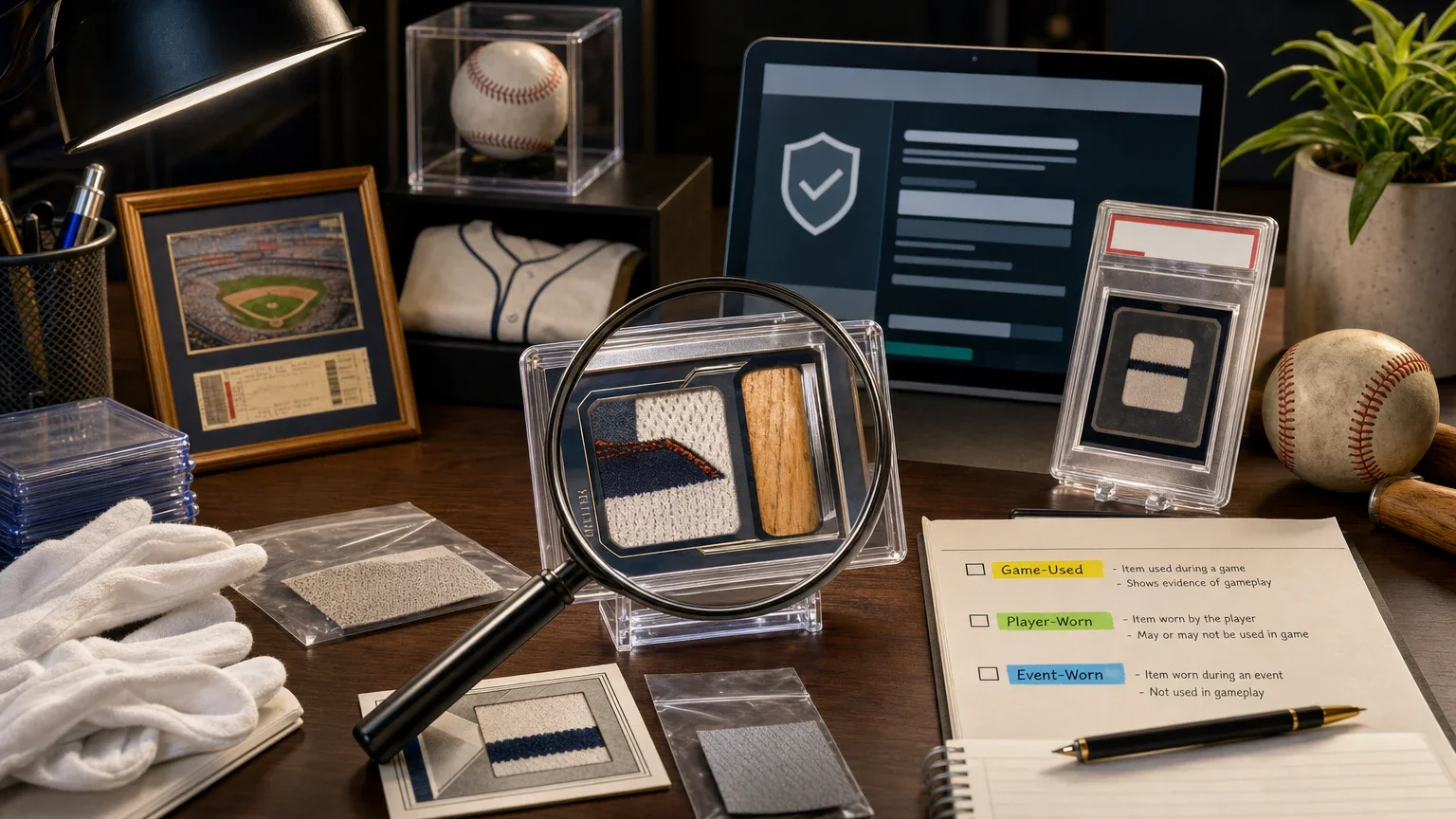
Relic cards look simple on the surface: a swatch, a star, and a promise of something worn or used by an athlete. In practice, the wording matters far more than the window on the card. A relic can be game-used, player-worn, event-worn, or some combination of those terms, and each description carries different meaning for collectors.
That is why the exact guarantee on the product page, checklist, or card back deserves more attention than hobby shorthand. A card described as a relic is not automatically game-used, and a graded holder does not always certify the memorabilia content inside it. If you are buying, grading, or reselling relic cards, the first job is to understand what the manufacturer actually promised.
The useful habit is simple: identify the wording, find the disclosure, and separate condition from provenance. Once you do that, relic cards become easier to compare, easier to evaluate, and much less likely to create surprises after the purchase.
What does relic wording actually tell you?
The most important distinction is between the object inside the card and the way the manufacturer describes it. A relic card may contain material that is genuinely connected to a player or an event, but that does not mean the material was used in a game. Topps’ current language explicitly includes game/event used and player/talent worn relics, which shows those categories are not interchangeable.
That wording matters because collectors often assume the broad label “relic” implies a single standard. It does not. A player-worn swatch can be authentic memorabilia without being game-used, and an event-worn piece can be legitimate without coming from live competition. The label is telling you what kind of provenance the company is claiming, not just that a piece of fabric is present.
The practical takeaway is to read relic language as a product-specific disclosure. If a manufacturer separates game-used from player-worn, it is signaling that those terms carry different standards and, often, different collector expectations. The card may still be desirable, but you should value it according to the exact claim, not the broad category.
When in doubt, ask a simple question: what exact phrase does the product use for the memorabilia, and does that phrase match what you assumed when you saw the card? That one habit can prevent a lot of mistaken comparisons between similar-looking cards.
- Relic is a broad category, not a single provenance promise.
- Game-used, player-worn, and event-worn are not the same thing.
- The exact product wording is more important than hobby shorthand.
Why the exact guarantee matters more than the checklist headline
The manufacturer’s guarantee is the document that actually defines the promise. Topps says it uses game/event used and/or player/talent worn relics and describes different authentication paths depending on the relic type. That means the guarantee may be broader than the simple phrase collectors repeat in conversation, but also more specific in how it treats each type of material.
This is where packaging language can become misleading if you read it casually. A title might highlight a memorabilia card, yet the guarantee may only promise that the piece falls within a certain category, not that it was worn in a game. If the company is offering remedies for authenticity issues or unaltered relic concerns, that is a product policy, not proof that every swatch is game-used.
Panini’s public corrections are a good reminder that labels and material can diverge. In its 2014 Flawless Football disclosures, the company acknowledged that some jerseys were labeled game-worn when they were actually event-worn, and it explained how it had categorized the materials. That example shows why the exact wording is part of the product itself, not just marketing copy.
For collectors, the safest practice is to locate the manufacturer’s own statement, then compare it to the checklist, box text, and the card’s specific wording. If the language differs, the manufacturer’s disclosure is the one that should anchor your interpretation of the card.
- Manufacturer disclosures define the promise, not retailer shorthand.
- A relic card may have real material while still being labeled in a narrower category.
- Public corrections can reveal how a company distinguishes event-worn from game-worn.
How do game-used, player-worn, and event-worn pieces differ in practice?
Game-used usually suggests the strongest connection to live competition, but the exact definition depends on the manufacturer’s language. Topps’ own glossary defines game-worn as memorabilia worn by a player in an official game and embedded in a card. That is a narrower and more specific claim than simply saying a player wore the item at some point.
Player-worn pieces may be worn in the presence of a company representative or authenticated through other means described by the manufacturer. Event-worn can refer to material worn at a public appearance, promotional event, or another non-game setting. Those distinctions matter because they affect what the collector is actually buying: competition use, public appearance use, or a broader memorabilia connection.
The difference can be subtle on a card front, but it is meaningful in the market. Two cards can look nearly identical and still carry different provenance claims. One may have a stronger direct connection to a game, while the other may still be legitimate but sourced from a different setting. The wording is doing a lot of work.
A useful example is Upper Deck’s debut-game jersey language, which ties the card to a specific first professional game and even offers a date-linked certificate. That kind of specificity shows how some relic cards are linked to an exact event, while others are not. Specificity usually strengthens clarity, even when it does not guarantee a higher grade or a higher market price.
- Game-used is the narrowest and clearest of the common relic terms.
- Player-worn and event-worn can be authentic without being used in competition.
- The more specific the event language, the easier it is to understand the claim.
Can a card be authentic memorabilia without being game-used?
Yes, and that is one of the central lessons for relic buyers. A card can contain authentic memorabilia while still falling short of a game-used standard. Topps’ language supports that point by separating game/event used relics from player/talent worn relics. Those are not synonyms, and the company’s disclosure makes that clear.
This distinction matters because collectors sometimes assume authenticity and game-use are the same thing. They are not. A swatch may be genuine, sourced properly, and fully disclosed, yet still come from a setting that is not a live game. That is still a meaningful card for many collectors, but it should not be evaluated as if it carried the stronger game-used claim.
Panini’s 2014 correction is helpful here because it shows the company distinguishing event-worn from game-worn in its own explanation. That is useful evidence that the terms are not interchangeable in product development, even if the end result is still a real piece of memorabilia. The issue is not whether the material is fake; it is what exactly the manufacturer says about its origin.
When you are comparing similar cards, treat the provenance term as part of the card’s identity. If two cards both contain authentic material but one is game-used and the other is event-worn, they are not the same product, and they should not be priced or discussed as if they were.
- Authentic memorabilia is not automatically game-used.
- Event-worn can be real and disclosed without being competition-used.
- The origin of the material is part of the card’s identity.
What should you know before buying older relic cards?
Older cards can be especially tricky because terminology changes over time. A company’s current wording may not match the language used in a set from years ago, and collectors sometimes apply modern expectations to older releases. That can lead to mistaken assumptions about what a vintage or early-modern relic card was actually claiming.
The right approach is to compare the set year, the original checklist, and any public corrections or product notes tied to that release. Panini’s public statements from 2014 demonstrate how a company may later clarify that a card used event-worn material even though a label suggested game-worn. That history matters when you are reviewing older inventory today.
Historical context also helps when a product includes a specific date, event, or debut. Upper Deck’s debut jersey example shows how a release can link memorabilia to a precise game and a matching certificate. Other older products may have looser wording or fewer details, so you should not assume they were described under the same standards as current releases.
In practice, this means old relic cards deserve more documentation, not less. If a seller cannot clearly state the original wording, the year, and any known corrections, you should treat the card carefully and compare it against manufacturer disclosures before making a decision.
- Do not apply today’s terminology to older products without checking the original language.
- Public corrections can change how an older card should be read.
- Date-specific relics are easier to evaluate than vague provenance claims.
Does grading a relic card prove the memorabilia is real?
No. This is one of the biggest misunderstandings in the hobby. PSA’s guarantee is explicit that its authenticity and grade guarantee does not apply to cards with memorabilia pieces, including jersey swatches, logo patches, and game-used bat relics. That means a graded slab may tell you something useful about the card’s condition, but it does not automatically certify the relic content in the way many collectors assume.
That distinction matters because condition and provenance are different questions. A numeric grade addresses centering, corners, surface, and edges under that company’s standards. It does not by itself prove the jersey piece was game-used, player-worn, or event-worn. PSA’s own exclusion language is the cleanest evidence of that separation.
CGC’s published standards add a useful comparison. CGC distinguishes between cards that can receive numeric grades and cards that are only eligible for an authenticity designation. An Authentic AU or similar designation tells you the card is genuine, but it is not the same thing as a full condition grade. For relic cards, that separation helps explain why a slab is not the final word on memorabilia provenance.
The collector’s job is therefore twofold: assess the card’s condition through the holder, and assess the relic claim through the manufacturer’s own wording. If you skip the second step, you may end up treating a condition grade as though it were a proof of source, and that is not what the grading company promised.
- A slab can support condition, but not necessarily relic provenance.
- PSA excludes memorabilia pieces from its guarantee.
- Authenticity-only and numeric grades answer different questions.
What does an authenticity-only holder really tell you?
An authenticity-only holder is useful, but it should not be confused with a full numeric grade. CGC says certified authentic cards can be placed in a tamper-evident holder with a CERTIFIED AUTHENTIC label, and those cards are subject to special limitations. That means the card has been accepted as genuine under that company’s process, but not every collectible in that category can or should receive a numeric condition grade.
This distinction matters for relic cards because the holder may tell you the card is genuine while remaining silent on the deeper provenance of the memorabilia itself. A buyer may see a secure slab and assume all questions are resolved, yet the company may only be certifying the card under a narrower framework. The holder is helpful, but it is not a magic shield against ambiguity.
PSA’s grading service and guarantee language reinforce the same idea from a different angle. A card may be eligible for grading only after being deemed authentic, but the memorabilia content can still sit outside the company’s financial guarantee. That means the holder tells you what the grader examined and accepted, not every historical fact about the relic piece.
When evaluating an authenticity-only card, ask what exactly is being certified: the card stock, the autograph, the relic, or some combination of those elements. The answer affects how much weight you should give the holder when comparing one relic to another.
- Authenticity-only is not the same as a numeric grade.
- The holder may certify the card without fully answering the relic question.
- Always identify what the grader actually covered.
How much should you trust certification numbers and lookup tools?
Certification lookup is helpful, but it is not foolproof. PSA warns that verifying a certification number does not eliminate risk and that counterfeiters may use real certification numbers taken from public sources. That is an important reminder that a valid lookup result does not automatically prove the physical slab in your hand is genuine.
CGC makes a similar point through its security-focused holder and verification tools. It encourages buyers to confirm the certification number and explains that third-party label information is not guaranteed. The message across both companies is consistent: lookup tools are useful checks, not final proof.
For relic cards, that means you need to inspect the whole package. Does the label style match the era and the grading company’s current format? Does the card front align with the description? Does the cert number pull up the same card, condition, and details shown by the seller? If any of those pieces feel off, the lookup has not solved the problem.
A practical buying habit is to treat certification as one layer of verification, not the last step. If you are paying meaningful money for a relic card, you want consistency among the card, the slab, the number, and the manufacturer’s wording. That consistency matters more than any single screenshot or database entry.
- A real cert number does not guarantee the physical holder is real.
- Verification tools reduce risk but do not eliminate it.
- Check the card, label, and lookup together.
What mistakes do collectors make most often with relic wording?
The first mistake is assuming every relic card is game-used. Manufacturer language already disproves that assumption. Topps says it uses game/event used and player/talent worn relics, and Panini’s corrections show that event-worn and game-worn are distinct operational categories. If you ignore those differences, you may overstate what a card actually is.
The second mistake is treating a graded holder as a provenance guarantee. PSA’s exclusions make clear that memorabilia pieces are outside its guarantee, and CGC’s authenticity-only framework shows that not every accepted card receives the same kind of treatment. A holder can be legitimate and still not answer the relic question the buyer really cares about.
The third mistake is overlooking product-year changes. Older sets may have been described differently, and public corrections may have altered how a card should be read. The fourth is relying only on a cert number. A valid lookup can still coexist with a counterfeit holder, so a single point of verification is never enough.
The safest collectors slow the process down. They read the exact wording, compare it with the original checklist, and make sure the slab or certificate matches the claim. That extra minute of scrutiny often separates a clean buy from a future dispute.
- Do not assume relic always means game-used.
- Do not confuse a holder with a provenance guarantee.
- Do not trust a cert lookup without inspecting the card and slab.
A simple checklist for evaluating relic cards
Start with the wording. Identify whether the card says game-used, player-worn, event-worn, or something more specific. Then move to the manufacturer’s guarantee or disclosure and see whether it confirms that exact category or offers remedies if the description is challenged. That step tells you what the company actually stands behind.
Next, separate condition from provenance. If the card is graded, read the grade as a condition opinion unless the grader explicitly says otherwise. PSA’s memorabilia exclusions are especially important here, because they show that a slab can leave the relic content outside the guarantee. If the card is authentic-only, note that you are looking at a different kind of certification altogether.
Finally, verify the holder and the certificate without assuming that verification ends the process. Use the cert lookup, compare the formatting, and check whether the description matches the card in hand. If the card is older, add a final step: search for release-specific corrections or clarifications, because older terminology may not match current practice.
The best relic purchases usually come from cards whose language is clear enough that you do not have to guess. If the wording is precise, the provenance is easier to understand. If the wording is vague, the risk rises immediately, even if the card looks attractive in a slab.
For a related example of how collectors think about card eras and product clarity, see How Skybox Autographics Changed Basketball Cards in 1996. The broader lesson is the same: terminology and presentation shape how the hobby understands a card, and relic cards are no exception.
- Read the exact wording before you read the market.
- Use grading for condition, not as a substitute for provenance.
- Verify the slab, the cert, and the original product language together.
Frequently Asked Questions
Is every relic card game-used?
No. A relic card may be game-used, player-worn, event-worn, or some combination of those terms. The exact wording on the product or checklist matters far more than the broad relic label.
Does a PSA slab prove the swatch is game-used?
Not by itself. PSA’s guarantee excludes memorabilia pieces, so a PSA holder can support condition or authentication in some contexts without guaranteeing relic provenance.
What is the difference between player-worn and game-worn?
Game-worn usually refers to material worn in an official game. Player-worn can include material worn in other controlled settings, and the manufacturer’s own disclosure should define the term used on the card.
Can a valid certification number still be risky?
Yes. PSA warns that counterfeit holders may use real certification numbers, so a lookup result alone does not prove the physical slab or label in hand is genuine.
What should I check first when buying a relic card?
Start with the exact relic wording, then read the manufacturer’s guarantee or disclosure, and only then evaluate the grading holder and certification details.
Written with AI assistance. Featured image: AI-generated editorial illustration.



Comments
0You must be signed in to comment.
Sign In