

Chris Webber Cards That Capture a Unique NBA Skill Set
At his peak, Chris Webber gave defenses problems in almost every way a big man could. He could handle the ball, see the floor from the elbow or high post, score inside and out, and deliver passes that turned difficult possessions into easy baskets. He also brought a level of flair that made him stand out in an era loaded with memorable frontcourt talent.
Webber entered the NBA at the same time premium basketball cards were changing fast. The 1990s brought chromium stock, refractors, premium inserts, and later memorabilia and autograph cards that helped define the hobby. Webber’s playing career lined up with that shift, leaving collectors with a strong run of cards that reflect both his game and the design style of the decade.
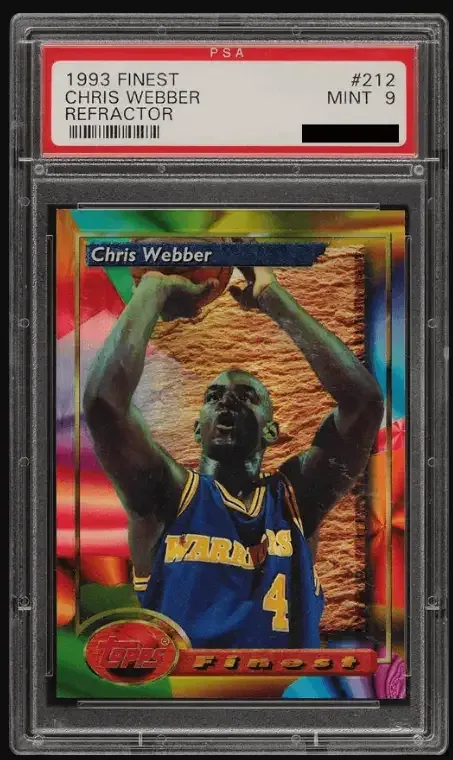
1993 Topps Finest Refractor
Webber’s 1993 Topps Finest Refractor is one of the most important rookie-year cards from his career. Topps Finest was the first basketball product to feature chromium-style cards and refractor parallels, making it a landmark release in the hobby. Webber’s card, numbered #212, remains his most coveted rookie-era issue because of its relative scarcity and its place in that debut Finest checklist.
The card’s rainbow finish gives it the kind of light-shifting look that helped make refractors so popular. Market data cited by Card Ladder shows strong demand for both high-grade copies and lower grades. PSA 10 copies have sold only twice in the past year, with the most recent reaching $5,320. PSA 9 copies have also moved sharply higher, climbing from $492 to $710 over the same period.
For collectors focused on Webber’s earliest premium cards, this is the one that most clearly combines rookie status, brand significance, and long-term appeal.
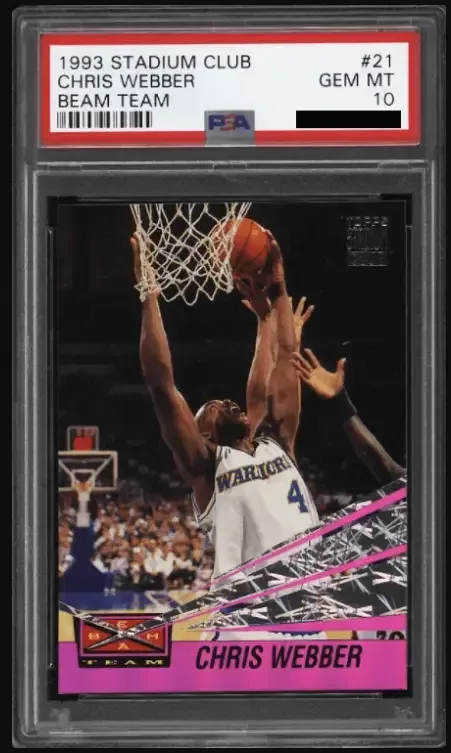
1993 Stadium Club Beam Team
Webber also appears in the second edition of Stadium Club’s Beam Team insert set, one of the more recognizable insert concepts of the era. The design layers metallic beams over action photography, and Webber’s card shows him grabbing a rebound above two defenders. It is a fitting image for a player whose game blended power, timing, and coordination.
Unlike some of his scarcer rookie issues, Beam Team remains relatively affordable. Even so, prices have risen noticeably. Raw copies have climbed to around $8, while PSA 8 copies have reached $31. Both grades are up roughly 120% year over year. PSA 10 copies have nearly doubled as well, moving from $264 to $525, which is a record high in Card Ladder’s database.
The card offers a strong entry point for collectors who want a visually striking Webber issue without chasing the premium attached to his refractor rookie.
Related coverage includes Chris Webber’s Best Basketball Cards Trace the Rise of a One-of-a-Kind 1990s Star.
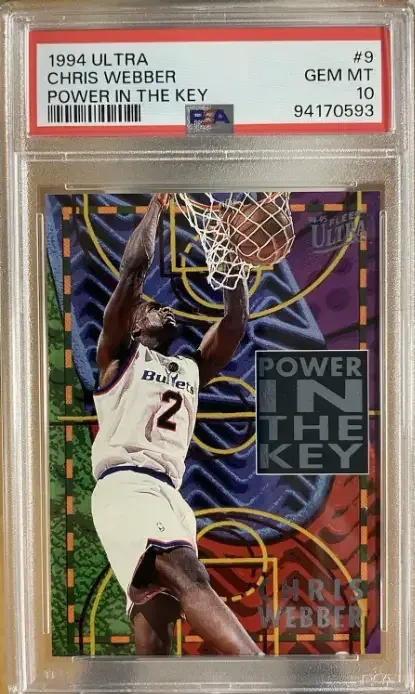
1994 Ultra Power in the Key
Webber’s 1994 Ultra Power in the Key is one of the few cards that show him in a Washington Bullets uniform, which gives it added appeal for collectors who like transitional issues. The card is part of Ultra’s 1994-95 release and features a multicolored court illustration behind a cutout action shot of Webber throwing down a two-handed dunk.
The card also reflects a major turning point in Webber’s career. After one season with Golden State, he clashed with coach Don Nelson and eventually forced his way out of the situation. An unusual contract arrangement allowed him to opt out after just one season, and after sitting out the start of the next year, he was traded to Washington in November 1994. That move reunited him with former Michigan teammate Juwan Howard.
According to PSA population data cited in the source material, only five copies of this card are in the database. The most recent PSA 10 sale brought $300 in June 2025, up 50% from the prior sale a year earlier. PSA 9 copies have sold for $26 and $23, showing how uneven the market can be for lower-grade examples even when the card itself is scarce.
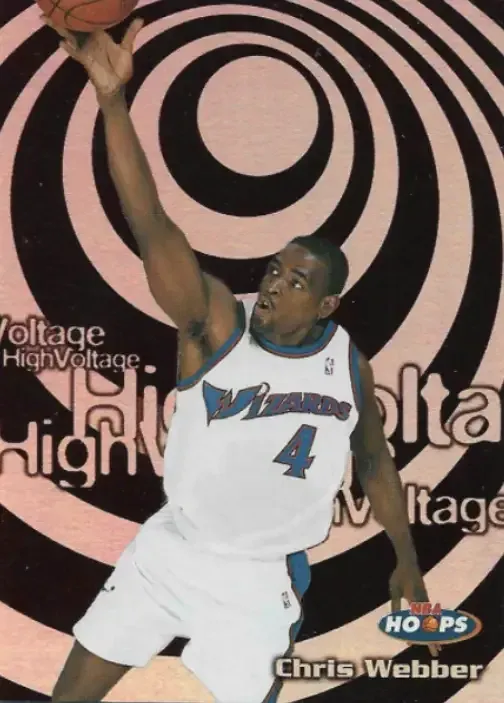
1997 Hoops High Voltage
Webber’s first game against Golden State showed exactly why Washington wanted him. He delivered a 40-point triple-double and quickly became the centerpiece of a team that regained relevance with his arrival. Over four seasons in D.C., he produced All-Star level numbers and helped push the Bullets back into the playoffs.
The 1997-98 Hoops High Voltage insert captures that kind of energy well. Webber is one of 20 players in the set, which was built around athletes who electrify the crowd. His card shows him driving to the basket against a background of black-and-white swirls that give the design a dramatic, almost surreal look.
Card Ladder data shows this card has been one of the strongest movers among Webber issues tracked in the source. Raw copies rose from $20 to $69, a 240% year-over-year increase. PSA 9 copies also climbed, reaching $160 after a 60% gain.
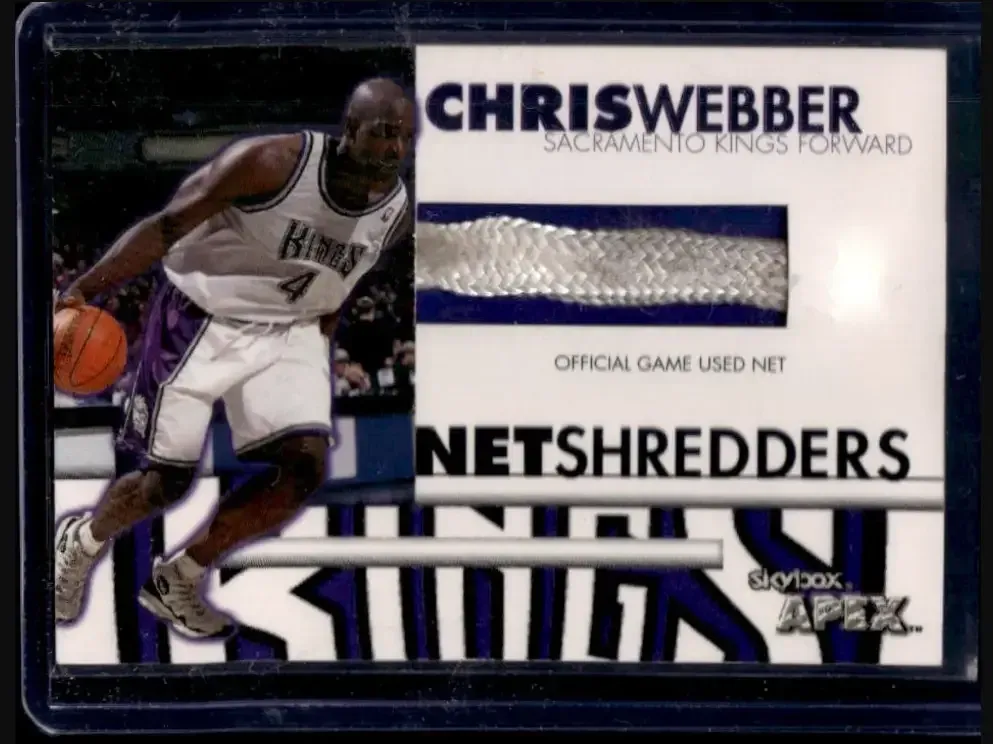
1999 Skybox APEX Net Shredders
Webber’s move to Sacramento became the defining stretch of his career. After being traded by Washington on May 14, 1998, he joined a Kings team that would become one of the league’s most entertaining offenses. Despite early skepticism about the deal, the trade proved to be a turning point. Webber became the versatile hub of Sacramento’s fast, free-flowing attack and showed the full range of his game as a scorer, passer, and rebounder.
Skybox APEX Net Shredders fit that era well because it pushed memorabilia design in a different direction. While game-used jersey cards were still relatively new, this set featured swatches of game-used basketball nets. That detail makes the card one of the more unusual memorabilia concepts of the late 1990s.
Webber was certainly shredding nets at the time. He averaged 24.5 points per game in 1999, which ranked sixth in the league. Over the last two years, only three copies of the card have sold, with prices ranging from $67 to $104.
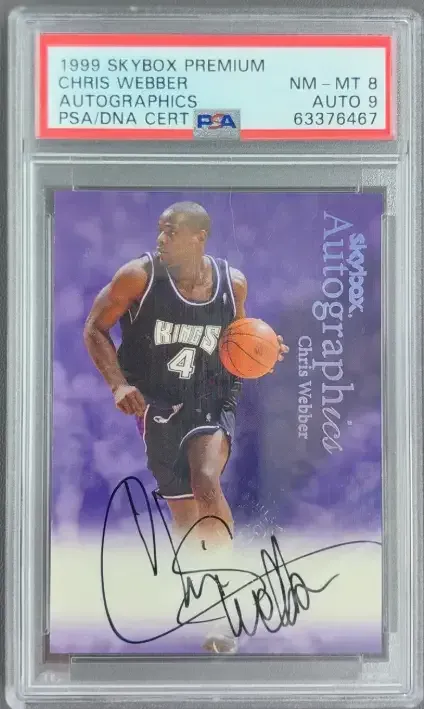
1999 Fleer Focus Fresh Ink and SkyBox Autographics
One of the more interesting parts of Webber’s hobby profile is how few pack-issued autographs he signed during his playing days. Unlike many of his contemporaries, he left behind a relatively small autograph checklist, which makes the available cards all the more notable.
Webber does not appear on the first three 1990s SkyBox Autographics checklists, and he is paired with other players on dual-signed cards in 1997 Stadium Club Co-Signers. His first standalone playing-day autographs arrived in 1999 with short-printed releases from Fleer Focus Fresh Ink and SkyBox Autographics.
Both cards remain important for collectors chasing his on-card signature. Fresh Ink copies have typically sold in the $200 to $300 range. SkyBox Autographics is the more desirable of the two and has reached as high as $1,500, with the most recent copy selling for $911 in September.
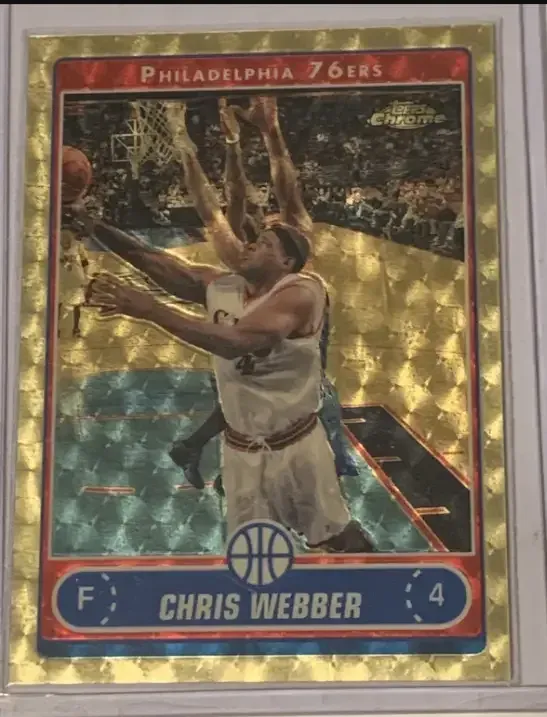
2006 Topps Chrome Superfractor
Webber’s late-career cards are fewer in number, but some still stand out. His 2006 Topps Chrome Superfractor is among the biggest from that phase of his career. It sold for $6,655 in January 2023, giving it a place among the more notable modern-era Webber cards in the market.
That card also sits near the end of the licensed NBA card era before Panini took over as the league’s exclusive manufacturer in 2009. Since then, Panini has produced far more autographed and game-worn patch cards of Webber than were available during his playing days, but those later issues do not replace the appeal of his original-era cards.
Webber’s career was altered by a serious knee injury in 2003, when microfracture surgery reduced much of the explosiveness that had helped make him a star. He remained productive, but his game became more grounded and less dependent on the athleticism that once made him so difficult to defend. After Sacramento, he finished his career with stops in Philadelphia and Detroit, followed by a short second stint in Golden State.
Why Chris Webber’s Playing-Day Cards Still Matter
What makes Chris Webber cards compelling is the combination of player profile and product timing. He arrived just as the hobby was moving into a premium era, and his best cards reflect that transition. From the first Topps Finest refractors to insert sets like Beam Team and High Voltage, his checklist includes some of the most recognizable designs of the decade.
Collectors also have a clear split between accessible cards and tougher chase pieces. Beam Team and some lower-grade issues remain within reach, while the Finest Refractor, SkyBox Autographics, and select scarce parallels carry much stronger demand. Add in the limited number of playing-day autographs and the appeal of cards that show him in both Warriors and Bullets uniforms, and Webber’s market stays interesting across several collecting angles.
For fans of 1990s basketball, his cards offer more than nostalgia. They document a forward who helped redefine what the position could look like, and they do it with some of the most distinctive card designs of the era.
Join the Sports Card Portal Page thread for this story.
Comments
0You must be signed in to comment.
Sign In