

October's $1 Billion Card Market Wasn't Driven by One Segment
Card Ladder's October sales data produced a headline that turned plenty of heads: more than $1 billion in card and sealed wax sales across every category. But a closer look at the numbers shows that the billion-dollar total did not come from a broad-based surge across the hobby. Instead, it came from a relatively small group of buyers and a market that was heavily concentrated in the upper tiers.
October's total reached $1.075 billion across 9,216,743 sales. Breaking that volume into price tiers reveals a market shaped less by sheer transaction count and more by where the money was spent. The biggest share of dollars did not come from the ultra-high-end cards that dominate headlines. It came from the hobby's middle tiers.
Where the Money Came From
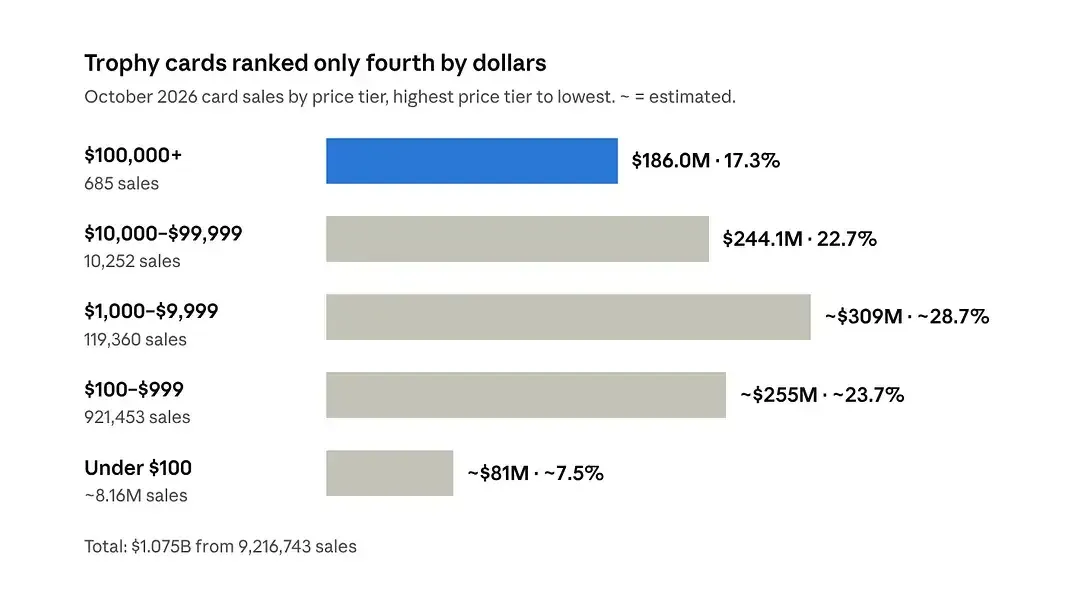
When the October sales data is divided into five price tiers, the $1,000 to $9,999 range stands out as the largest source of revenue. That tier generated roughly $309 million, making it the single biggest contributor to the month's total.
The next layer down, cards priced from $100 to $999, added roughly $255 million. Together, those two tiers accounted for about $564 million, or roughly 52% of October's dollars, from just over 1 million sales.
For more collecting context, read October Card Sales Top $1 Billion, Led by TCG and Sports.
That middle range is where a large portion of the hobby's spending appears to live. It includes graded rookies, lower-numbered parallels, and vintage cards, along with other pieces that sit well below the ultra-elite market but still command meaningful money.
The $100,000-Plus Market Was Big, But Not the Biggest
Cards selling for $100,000 or more brought in $186.0 million in October, which represented 17.3% of the month's total. That came from just 685 sales, or about 22 per day across the entire hobby. In transaction terms, that is 1 in every 13,455 sales.
The average sale in that tier was $271,582, which shows how much weight a relatively small number of trophy cards can carry. These are the kinds of sales that get the most attention, and for good reason, but the data shows they were not the primary engine of the month's total dollar volume.
Related coverage includes October’s $1.075 Billion Card Market Shows Where the Hobby’s Money Really Comes From.
Among the October sales highlighted in the data were a 2017 Panini Flawless Logoman Autograph 1/1 #LMKB Kobe Bryant PSA 9 with a 10 autograph that sold for $4.2 million, a 2026 Panini World Cup Prizm Choice Nebula 1/1 Lionel Messi BGS 9 that sold for $1.25 million, and a 2025 Topps MLB MVP The Game Dynasty Black Shohei Ohtani MLB Logoman Patch Auto 1/1 #SOD-1 PSA 9 that sold for $3.24 million.
Those are real sales, and they matter. They also show how the top of the market can produce eye-catching numbers in a single month. But the data makes clear that the $100,000-plus tier ranked fourth out of five in total dollars, not first.
What Happened Above $10,000
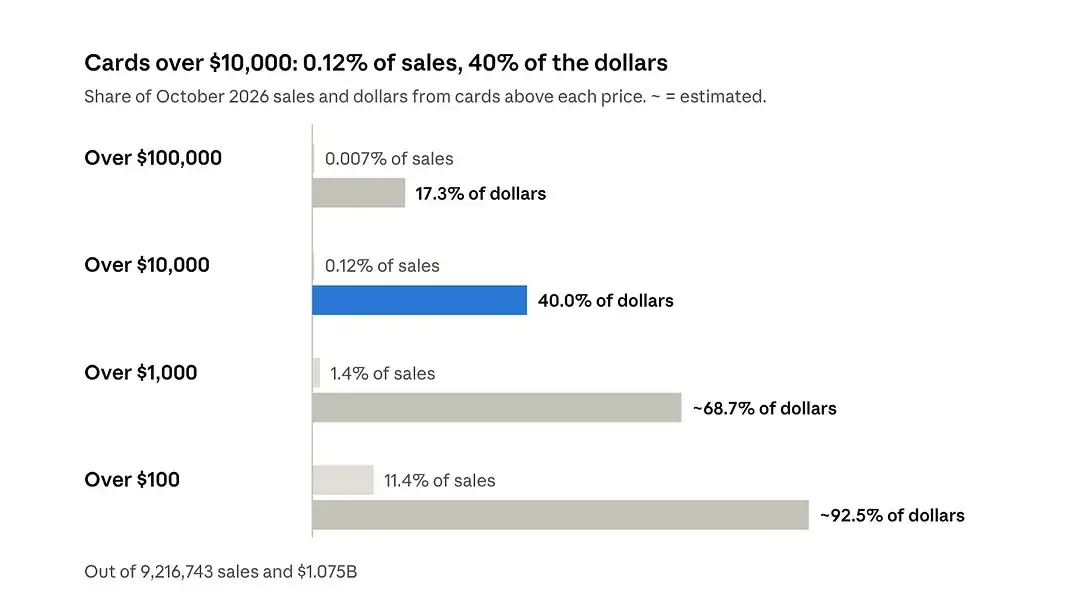
Expanding the view to all cards that sold for $10,000 or more gives an even sharper picture of how concentrated the market was in October. Sales in that range represented just 0.12% of all transactions, but they accounted for 40.0% of the dollars.
That works out to approximately 11,000 sales out of 9.2 million total transactions, generating about $430 million. In other words, less than one-eighth of one percent of all sales delivered two-fifths of the month's dollar volume.
The reverse is just as important. Roughly 99.88% of all sales came in under $10,000, yet those millions of transactions accounted for 60% of the dollars. The headline total may sound like a broad market boom, but the data suggests something more specific: a small number of expensive cards did a lot of the heavy lifting.
The Hobby's Middle Class Carried Half the Month
The strongest case for a healthy market comes from the middle tiers, not the top end. The $100 to $9,999 range brought in roughly half of October's total dollars, and it did so with a meaningful base of activity.
That is the layer where many active collectors operate. It is also the layer that gives the market depth. A million sales in that range is not a thin slice of the hobby. It is a sign that collectors are still spending, upgrading, and chasing cards that fit a wide range of budgets.
By contrast, the under-$100 segment had the highest transaction volume but the smallest share of dollars. About 8.16 million sales fell into that category, representing roughly 88.6% of all transactions, but they produced only about $81 million, or 7.5% of the month's total.
That group includes base cards, personal collection singles, and lower-cost purchases that keep the hobby moving. It is also the part of the market where the most activity happens, even if it contributes the least to total dollar volume.
Why the Billion-Dollar Headline Can Be Misleading
The October total is real, but the way it is discussed can create a false impression. A billion-dollar month sounds like the entire hobby surged at once. The breakdown says otherwise.
The market's top end was strong enough to influence the total in a major way, but the middle tiers were the real engine. The ultra-high-end sales drew the headlines, yet the $100 to $9,999 range supplied the largest share of the month's money.
That distinction matters because a market built on a narrow base can look much stronger or weaker than it really is depending on what happens at the top. If high-end buying slows, the total can fall sharply even if the rest of the hobby stays steady. If a major auction month produces a wave of big-ticket sales, the total can rise even when everyday collecting behavior barely changes.
What the October Data Says About Hobby Health
There are two truths in the October numbers. First, the hobby is still moving a lot of cards, with millions of transactions showing that collectors continue to buy, rip, trade, and build collections. Second, a large share of the month's dollar volume depended on a relatively small number of expensive sales.
That creates a market with both strength and vulnerability. The middle tiers appear deep enough to support serious spending, while the top end remains powerful enough to swing the monthly total in a big way. A 25% pullback in purchases of $10,000-plus cards would remove about $108 million from the month, or roughly 10% of the total, even if the rest of the market stayed unchanged.
That is why the billion-dollar figure should be treated carefully. It is not a simple measure of how healthy the entire hobby is. It is a snapshot of how spending was distributed in one month, with a small number of high-end sales stacked on top of a much larger base of lower-priced transactions.
What to Watch Going Forward
The most useful way to read a month like October is to focus on the tier you actually collect in. If your market is the $100 to $9,999 range, that is where the depth is and where the clearest signal of hobby health may be found. If you collect at the ultra-high end, the top tier will matter most to your view of the market. If you buy lower-priced cards, the transaction count matters more than the dollar total.
October's data shows that the hobby can post a billion-dollar month without that money being evenly spread across the market. It also shows that the middle of the hobby remains a powerful force, even when the biggest sales grab the spotlight.
If another billion-dollar month arrives, the most important question will not be whether the total was reached again. It will be where that money was spent.

Join the Sports Card Portal Page thread for this story.
Comments
0You must be signed in to comment.
Sign In