

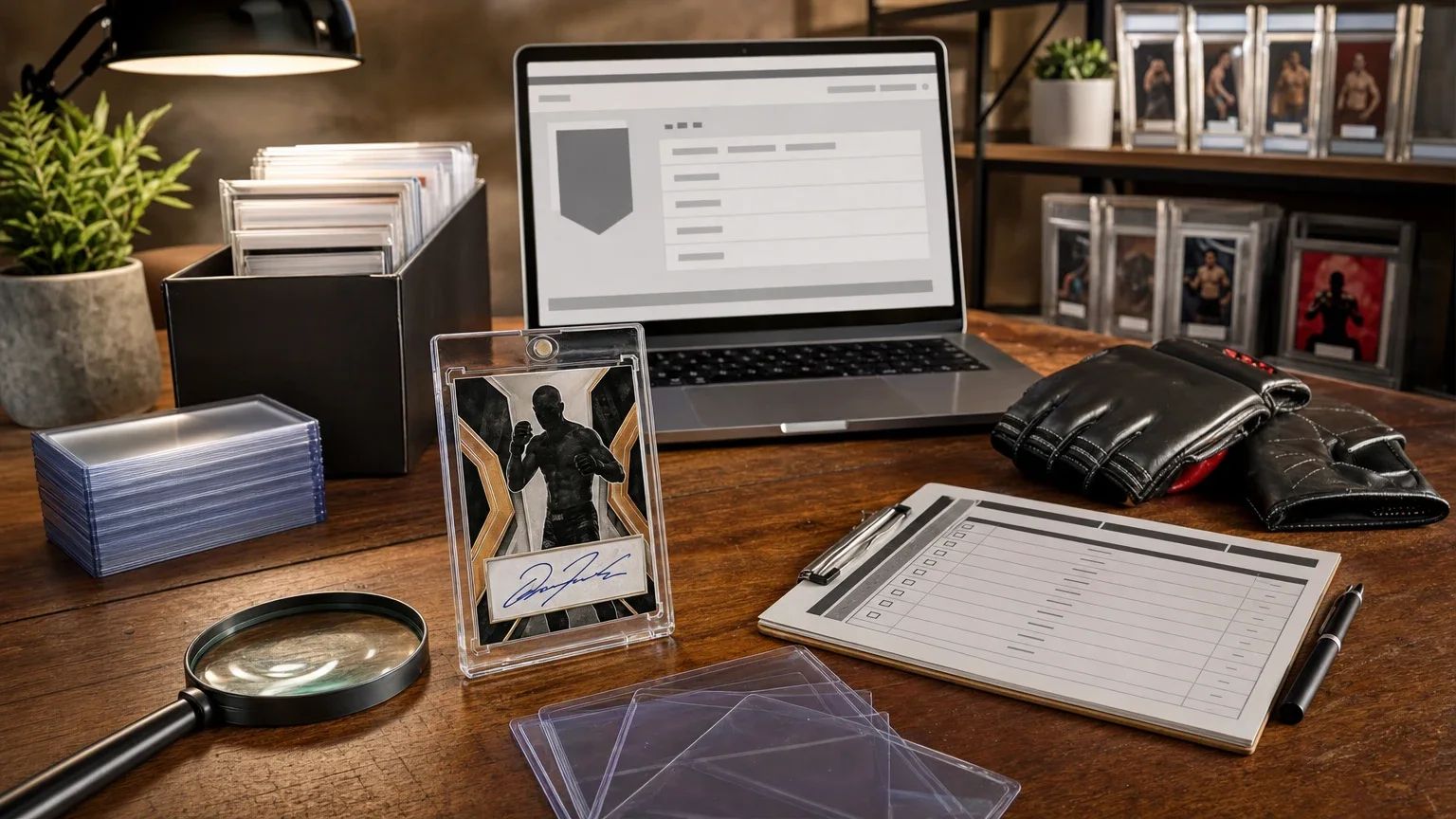
UFC autograph cards can be some of the most rewarding pieces in a mixed-martial-arts collection, but they also demand more caution than many buyers expect. The label on a slab, the wording on a checklist, and the presence of a certification number can each tell you something useful — but none of them tells the whole story by itself.
The smart way to approach the category is to separate three questions before you spend money: is the autograph genuine, is the card itself in the condition you want, and is the specific product checklist actually matching the card in front of you? Those questions sound simple, yet they are where many bad purchases begin.
This guide focuses on the practical side of UFC autograph collecting: how authentication differs from grading, how to verify a holder, what Panini product sheets can and cannot tell you, and why redemptions and mockup images deserve extra scrutiny. The goal is not to chase every possible UFC auto, but to help you buy the right one for your priorities.
What should you verify first on a UFC autograph card?
Start with the most basic question: does the card you are holding match the item that was authenticated or listed on the checklist? For UFC autograph cards, that means checking the product name, year, insert or autograph set name, and the actual subject on the card. If those details do not line up, the rest of the evaluation becomes much less meaningful.
Next decide whether you care more about signature authenticity or about the card’s physical condition. That choice matters because a card can be authenticated for the autograph without the card itself receiving a numeric grade. In practice, many collectors mistakenly treat any slabbed autograph as fully graded, which is not always the case.
A useful rule is to treat the card, the signature, and the holder as three separate objects. If any one of them looks wrong, incomplete, or inconsistent with the listing, pause before buying. UFC autos often move through multiple formats and packaging styles, so the item description should be specific enough to remove guesswork.
- Confirm year, product, and insert name.
- Check whether you want autograph authentication only or card grading too.
- Treat any mismatch between listing and card as a red flag.
What does authentication actually prove?
Authentication is a narrower promise than many buyers assume. A third-party authenticator is deciding whether the autograph is genuine, not guaranteeing that every part of the transaction is safe or that the card has been correctly represented in the marketplace. A valid certification number helps, but it is not a substitute for careful inspection.
That distinction matters because counterfeiters can reuse real certification numbers from public sources or copy label information in ways that look convincing at a glance. A database lookup can confirm that a certification number exists, but it does not eliminate fraud risk by itself. If the image, holder style, label, or item description does not match, the safest move is to stop.
For UFC autograph collectors, the practical takeaway is simple: authentication should reduce uncertainty, not end your due diligence. Read the label closely, compare the cert record to the physical item, and confirm that the holder scope matches what you are trying to buy. A genuine autograph can still be paired with a misleading listing.
- A cert can confirm identity, not the whole sale.
- Real cert numbers can still be copied by counterfeiters.
- Mismatch between holder and database record should stop the purchase.
How do you check a PSA-certified UFC autograph card?
For PSA-certified UFC autograph cards, the most useful workflow is straightforward. Read the certification number, search the PSA database, compare the returned item details to the card in hand, and confirm whether the holder reflects autograph-only authentication or item-plus-grade service. That sequence catches most avoidable mistakes before money changes hands.
The database fields are useful because they can include the year, brand or title, subject, category, item grade, autograph grade, and sometimes an image. Those data points make the lookup more than a yes-or-no tool. They help you test whether the specific UFC autograph card matches the exact certified record, which is especially important when multiple cards in a set look similar.
The important caution is that a clean lookup does not make the card automatically safe. A counterfeit holder can still be paired with a copied number, and a real cert can still be used in a misleading listing. If the label color, scope, or card image does not fit the record, treat that as a meaningful problem rather than a minor discrepancy.
- Use the cert lookup as a matching tool, not just a validation tool.
- Compare scope, subject, and grade fields to the actual card.
- Do not ignore small inconsistencies in label style or record details.
When is autograph-only authentication the better choice?
Autograph-only authentication makes the most sense when your main concern is proving the signature and the card’s condition is secondary. That can be the right call for a scarce UFC autograph, a piece with strong historical appeal, or a card that is valuable mainly because of the signer and the checklist slot rather than near-perfect corners and centering.
It can also be the cheaper and more practical route for cards where the market is focused on the autograph itself. PSA’s blue-label approach was created to make that difference easier to read at a glance. The point is not that autograph-only holders are inferior; the point is that they are narrower, and that narrower scope should match your collecting goal.
The mistake is assuming that a slab automatically means the whole card has been graded. If you plan to resell to condition-sensitive buyers, or if the card is a premium rookie-style piece where centering matters, autograph-only may not be enough. But if your goal is simply to lock down the signature, it can be the cleanest solution.
- Choose autograph-only when signature proof matters most.
- Use it for scarce or historically important UFC autos.
- Do not assume a slab means the card itself was graded.
When does card grading add real value to a UFC auto?
Card grading matters most when the physical card is a major part of the appeal. That is often true for low-numbered parallels, premium rookie-style cards, or formats where collectors strongly care about centering, corners, and surface. In those cases, the autograph is important, but the card’s condition can still influence buying decisions.
A graded card also helps when you expect to trade with buyers who are highly condition-aware. Those buyers often want more than proof of a genuine signature. They want a card that has been evaluated as an object, not just authenticated as a signed item. That is where a holder with both autograph and item grading can be more useful than authentication alone.
The key is not to grade everything automatically. A UFC autograph card in strong condition with a scarce checklist position may deserve full grading attention, while a card bought mainly as a signature piece may not. Grade when the card’s physical quality is part of the value proposition, not just because grading is available.
- Grade cards where condition materially affects value.
- Use grading when selling to condition-focused buyers.
- Do not pay for grading if the autograph is the only part you care about.
What should you know about Panini UFC checklists?
Panini’s public checklist portal shows UFC as a selectable sport, but the available data can be incomplete or absent depending on the year, brand, or program. In this crawl, that portal did not provide a single master UFC-wide checklist, which means collectors still have to build a product-by-product picture from issue sheets and product pages. That is an important limitation, not a dead end.
The practical result is that checklist research for UFC autograph cards should be granular. You are usually not chasing a generic “UFC autograph”; you are chasing a specific autograph set inside a specific product, sometimes with multiple tiers, parallels, or memorabilia versions. The same fighter can appear across different formats, and those versions may not be equally scarce or equally desirable to every collector.
That is why a mockup image or a headline mention of autographs is never enough. You want the final product sheet, the checklist entry, and the exact card name before making a purchase decision. For UFC, the checklist is often the map, but it is not the territory.
- Expect product-by-product research, not one master UFC checklist.
- Verify the exact autograph set inside the product.
- Do not rely on mockup images as a substitute for final checklist details.
How do product sheets change the way you chase UFC autographs?
Product sheets tell you what kind of autograph content a release was designed to contain, and that structure shapes the chase. In a set like 2021 Select UFC, Panini listed two autographs and one memorabilia card per hobby box on average, and the product used a three-tier structure. That kind of layout matters because the autograph you want may sit in one tier or parallel line rather than another.
Other UFC products can mix standard autograph inserts, rookie/autograph formats, and autographed memorabilia cards. That means “UFC autograph card” is really a family of card types, not a single category. A collector who wants a clean signature insert may be looking for something completely different from someone chasing a patch auto or a multi-signature card.
The best habit is to read the product sheet before you buy sealed product or an individual card. If the release mixes formats, you should know which version you are chasing and where it sits in the product structure. Otherwise, you may overpay for a card that looks right but belongs to a less desirable subset of the checklist.
- Read the product sheet before buying sealed or singles.
- Know whether the target is a base auto, memorabilia auto, or multi-signature card.
- Use the set structure to avoid overpaying for the wrong version.
What are the biggest redemption risks in UFC autograph collecting?
Redemptions are one of the most important practical risks in modern UFC autograph collecting. Panini says a card becomes a redemption when components were not received in time for packout, and it also says it makes efforts to avoid that outcome whenever possible. Even so, a checklist entry does not always mean a card is immediately available in hand.
That creates several buyer concerns. You may be waiting months for fulfillment, you may be offered a substitute, or the card may never arrive for reasons outside the manufacturer’s control. Panini also states that redemption cards must be submitted before their expiration date or they become void, which is a detail that matters far more than many casual buyers realize.
The safest approach is to treat redemption status as a real cost, not a footnote. If you are buying sealed product for a chase or buying a redemption directly, factor in time, uncertainty, and the possibility that the final card may not match the original plan. For UFC autos, patience can be part of the hobby, but it should not be mistaken for a guarantee.
- Redemptions can delay or prevent receipt of the card.
- Check expiration dates carefully.
- Treat substitution risk as part of the purchase decision.
What should every UFC autograph listing include before you buy?
A strong UFC autograph listing should tell you exactly what you are buying, not just suggest it. At minimum, you want the exact year, product, card or insert name, autograph format, and whether the item is raw, authenticated, or graded. If the seller leaves out those basics, you are being asked to do too much of the identification work yourself.
For slabbed cards, the certification number should be easy to read and the holder should match the record. For raw cards, the burden shifts to the seller’s photos, description, and reputation. Either way, you should know whether the card is a base auto, a memorabilia auto, or a multi-signature piece, because those categories can behave very differently in the market.
If serial numbering is present, it should be visible and consistent with the listing. If the card is a redemption or has already been fulfilled, that should be disclosed plainly. The more precise the listing, the less room there is for misunderstanding, and in a category full of parallel variations that precision is not optional.
- Look for exact year, product, and card name.
- Confirm autograph format and whether the card is raw or slabbed.
- Check for serial numbering and redemption status if applicable.
How should a buyer decide between raw, slabbed, and authenticated cards?
Raw cards make sense when you trust the seller, want flexibility, or are buying a card whose appeal is mainly in the chase rather than the slab. They can also be the most affordable way to get into UFC autograph collecting. The tradeoff is that the buyer has to do all the verification work without the benefit of an independent holder.
Slabbed cards are useful when you want third-party confirmation and a cleaner resale story. But the label matters. If it is an autograph-only holder, you are buying authentication, not necessarily a condition grade. If it is an item-and-grade holder, you are paying for a broader evaluation, which may be worth it for higher-end cards or condition-sensitive buyers.
The right choice depends on how you collect, not on which option sounds strongest on paper. A well-bought raw UFC auto can be perfectly appropriate, and a slabbed card can still be misrepresented if the buyer does not read the details. The decision is strongest when it matches the card’s role in your collection.
- Raw works when trust, flexibility, or cost matter most.
- Slabbed works when you want third-party confirmation.
- Match the holder type to the card’s real role in your collection.
What is the safest UFC autograph buying process?
The safest process is simple enough to repeat every time. First, identify the exact product and checklist slot. Second, determine whether the item is raw, authenticated, or graded. Third, verify the certification record if a holder is involved. Fourth, check whether the card is a redemption or a fulfilled item. Fifth, compare the seller’s photos and wording against the official or certified details.
That sequence helps because each step closes a different kind of risk. The checklist tells you what should exist. The holder tells you what was authenticated or graded. The redemption status tells you whether you are buying something that is already in hand. And the seller’s presentation tells you whether the listing is precise or vague. UFC autograph cards are easiest to buy well when you are systematic.
If one step creates uncertainty, do not rush to justify it. In this category, a careful buyer is usually better off passing on a questionable card than trying to rescue a weak listing. The better the autograph card, the more you want every detail to be obvious before money moves.
- Identify the exact checklist slot before buying.
- Verify holder scope and cert details if applicable.
- Treat vague or inconsistent listings as avoidable risk.
Frequently Asked Questions
Does a PSA autograph holder mean the card is also graded?
Not always. PSA uses separate label colors to distinguish autograph-only authentication from item authentication plus grading, so you need to read the holder carefully.
Can a valid certification number still be used in a fake listing?
Yes. PSA warns that real certification numbers can be copied, which is why the holder, card image, and database details all need to match.
Why do UFC checklist details matter so much?
Because many UFC releases contain multiple autograph formats, tiers, or parallel versions. The exact checklist slot can change scarcity, desirability, and even whether you are comparing the right card.
Are redemptions a serious issue for UFC autograph collectors?
They can be. Panini notes that redemptions are used when components are not available at packout, and fulfillment can involve delays, substitutes, or, in some cases, no final card at all.
Written with AI assistance. Featured image: AI-generated editorial illustration.
Comments
0You must be signed in to comment.
Sign In