

Marvel Precious Metal Gems are often grouped together by appearance: reflective surfaces, serial numbering, and a familiar color ladder. For collectors and catalogers, however, the more important question is not whether a card looks metallic. It is which product released it, how the checklist identifies it, and whether the available evidence supports the label.
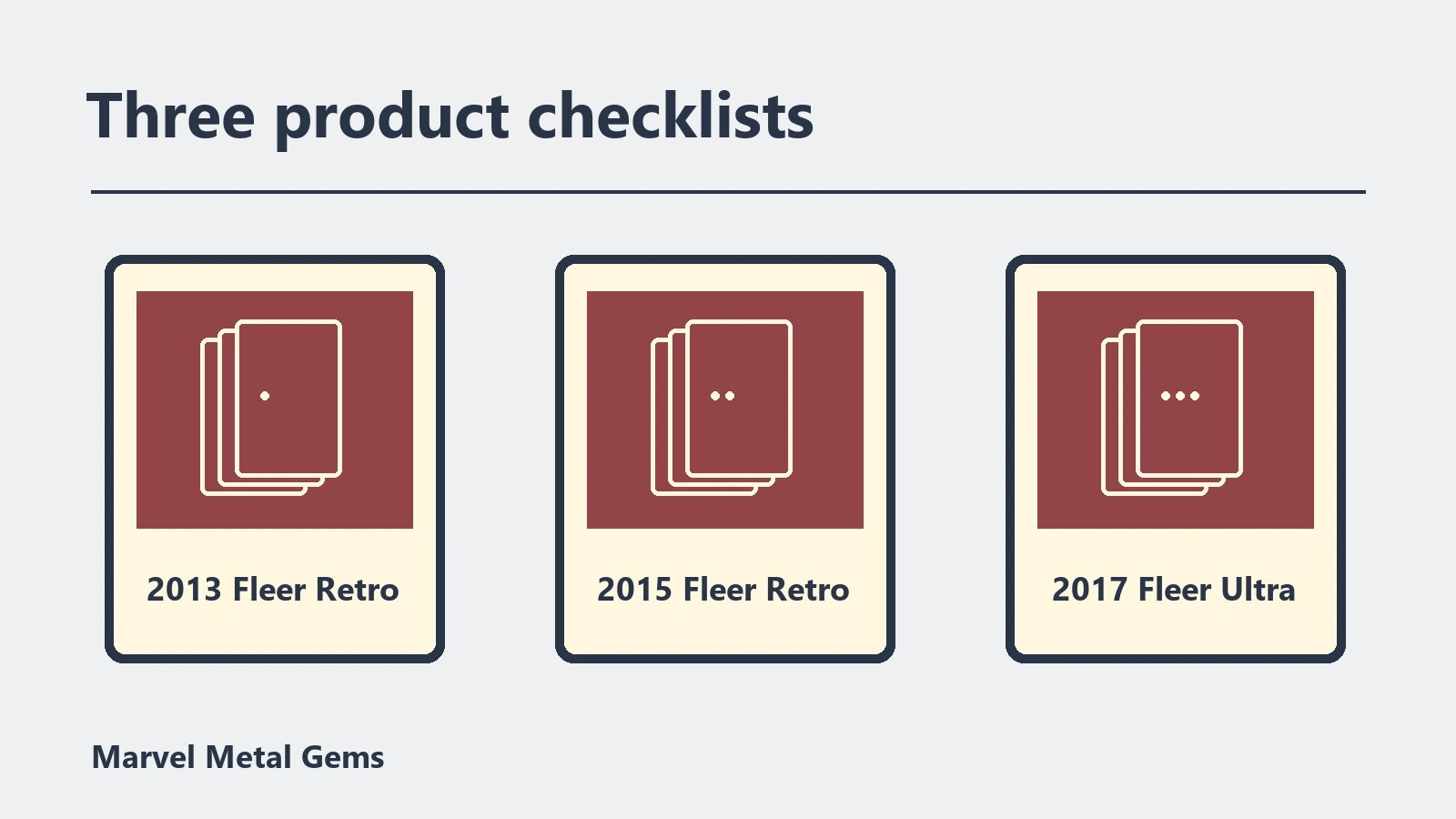
That distinction matters throughout the Fleer Retro Marvel timeline. The defensible core is 2013 and 2015. The 2017 Fleer Ultra Spider-Man and 2018 Fleer Ultra X-Men issues are valuable comparison points, but they are adjacent Fleer products rather than Fleer Retro Marvel releases. Later Metal Universe and Skybox Metal Universe cards continue the PMG concept under still different product families. A fuller year-by-year reference can be found in this related Marvel PMG guide, but the cataloging logic begins with evidence control.
2013: an early documented stop in the product lineage
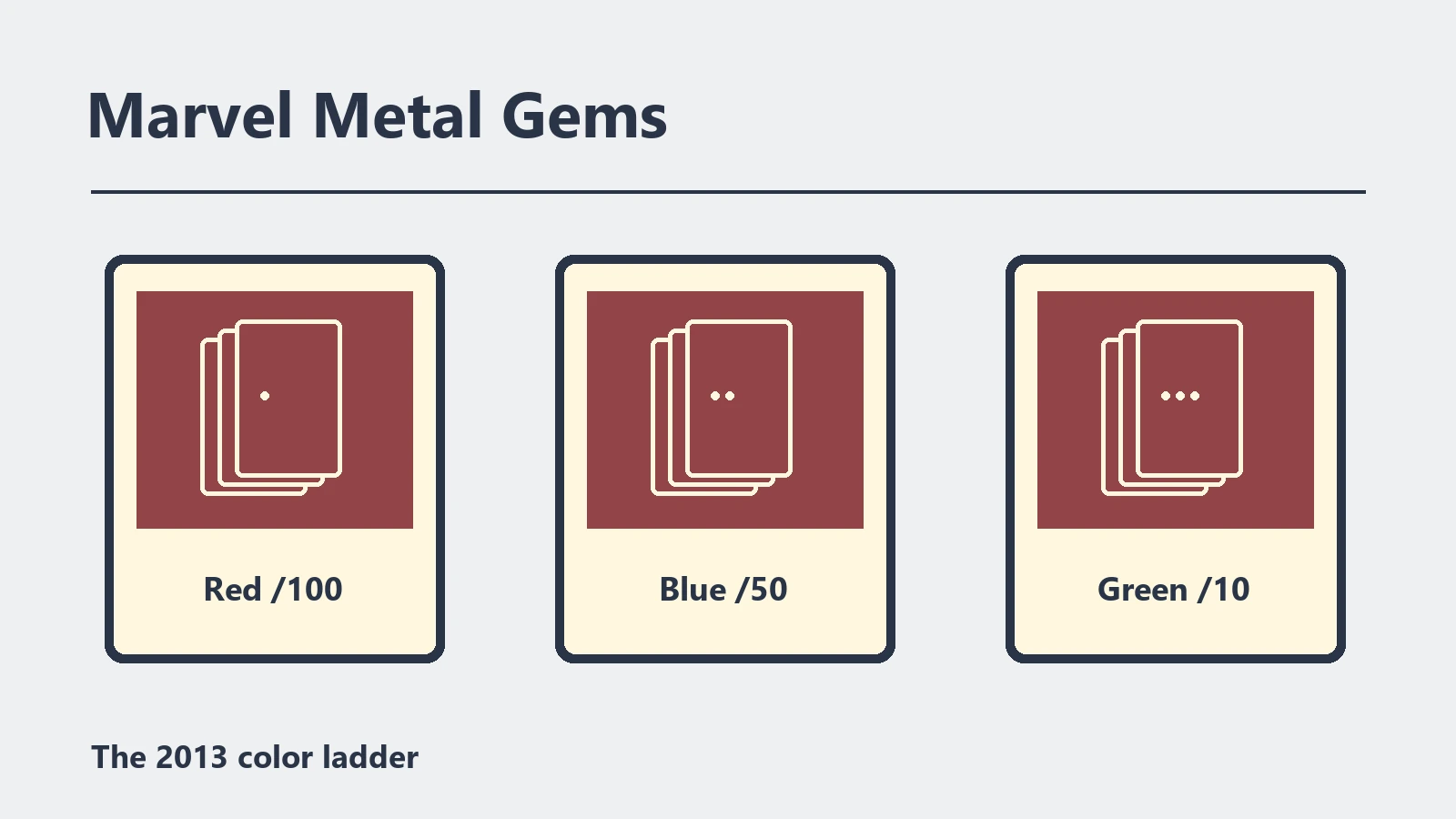
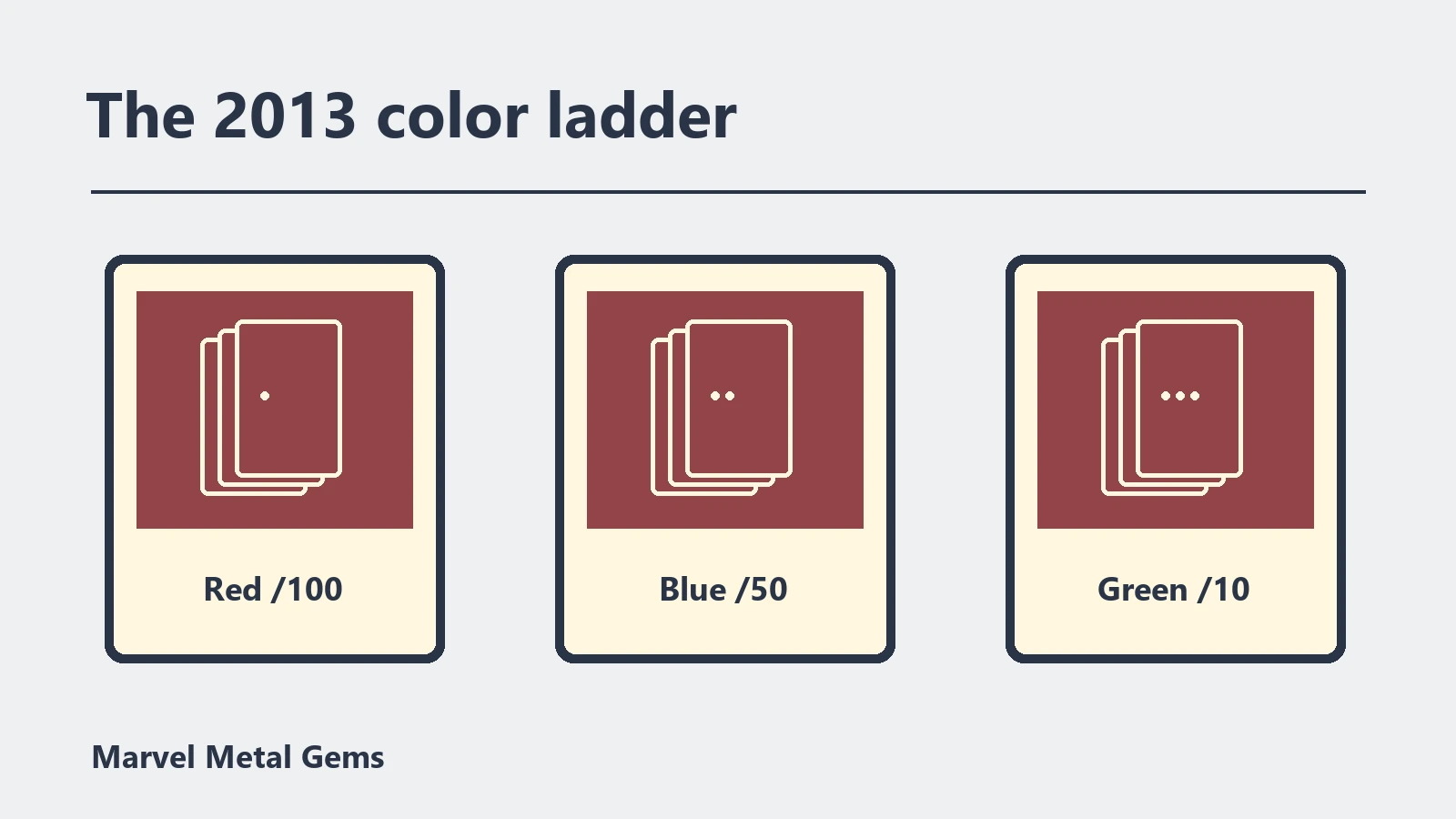
The 2013 Marvel Fleer Retro release is an early documented stop in the modern Marvel PMG lineage. Available product records describe a 42-card Metal checklist with Red, Blue, and Green versions. The documented serial ceilings are Red to 100, Blue to 50, and Green to 10. Those figures describe the numbering structure; they do not prove that every possible serial number was manufactured, distributed, or retained.
The checklist itself is especially useful for avoiding shorthand. The sequence begins with Mr. Fantastic, Invisible Woman, Thing, Human Torch, and Spider-Man, and concludes with Mystique, Apocalypse, and Galactus. In between are characters from the Fantastic Four, Avengers-associated ranks, X-Men, cosmic stories, street-level titles, and villain rosters. Calling these simply “Spider-Man and Avengers PMGs” obscures the actual 42-card selection.
Collectors should also understand the evidence level. The 2013 names and numbering are independently recorded in secondary checklist transcriptions, including House of Checklists and Cardboard Connection records, rather than in an accessible Upper Deck-hosted historical checklist. That makes the roster useful and repeatedly documented, but not equivalent to fully primary-source verification. A Gold 1/1 tier should not be added to the 2013 catalog without stronger documentation.
2013 configuration: separate the box claim from the pack claim
Product records commonly describe 20 packs per hobby box and one PMG per box, while the reported number of cards per pack is not consistent across the available records. One contemporary product listing describes five cards per pack; an independent checklist record describes 10 six-card packs per mini box and 20 packs per box. The responsible catalog entry should preserve the conflict rather than silently selecting one version.
This distinction also prevents a familiar error: calculating total production from serial ceilings or advertised box odds. A Green card numbered to 10 is a scarcity designation for each card, not proof of a complete ten-card population. Without verified manufacturing, replacement, and distribution records, “numbered to” is the strongest safe wording.
2015: the second Fleer Retro Marvel PMG release
The 2015 Marvel Fleer Retro release again presents a 42-card PMG checklist, but its design lineage points back to the 1995 Metal Blaster character lineup. That makes the modern card a 2015 release with a retro design relationship—not an original 1995 PMG. The sequence begins Ant-Man, Black Panther, Apocalypse, Black Widow, and Captain America. Its ending is Storm, Thor, Ultron, Vision, Wolverine, and Venom, with Vision an important correction for checklist-based catalogs.
Accessible checklist records list Red to 100, Blue to 50, Green to 10, and Gold 1/1. However, the product-summary evidence does not consistently present the Gold tier alongside the other colors. The best catalog description is therefore qualified: Gold is listed in the accessible checklist record, but its inclusion should not automatically be treated as fully confirmed manufacturer documentation or proof of identical pack distribution.
The 2015 roster should be checked against the retro subset’s 42 names, not against the 60-card base set. A useful catalog line would read: “2015 Marvel Fleer Retro, PMG, 1995 Metal Blaster-derived lineup, card number, character, color, serial limit.” That format records both the modern release year and the older design reference without conflating products.
2017 and 2018: the boundary cases
2017 Fleer Ultra Spider-Man belongs in a comparison section, not in the Fleer Retro Marvel chronology. Available checklist records describe a 50-card Marvel Metal sequence numbered MM1–MM50, with MM0 identified as an e-Pack achievement. The reported PMG structure is Bronze /199, Red /99, Blue /49, Green /10, Purple /5, and Gold 1/1. Those details should be rechecked directly against the cited checklist record before being treated as final production documentation.
2018 Fleer Ultra X-Men is another adjacent release. Its available checklist record describes 49 Metal Blasters cards, MB1–MB49, with reported tiers of Bronze /199, Red /99, Blue /49, Green /25, Purple /10, and Gold 1/1. The contrast is instructive: color names do not carry a permanent scarcity meaning. A Green PMG is /10 in the reported 2017 configuration but /25 in the reported 2018 configuration.
Later Metal Universe releases and a practical catalog rule
2022 Metal Universe Spider-Man and later Skybox Metal Universe Avengers cards continue the Marvel PMG tradition, but their product names establish a separate family. Official Upper Deck checklist pages identify those releases independently from Fleer Retro. They should therefore be cataloged by their own product title, checklist prefix, year, and serial structure rather than folded into one uninterrupted Fleer set.
For every Marvel PMG, record the release year, manufacturer and product, insert or subset name, prefix, card number, character, color, serial ceiling, and distribution mode. Add an evidence note: official manufacturer checklist, contemporaneous product record, or secondary checklist transcription. This method keeps the history clear. Fleer Retro Marvel PMGs are not one endless checklist; they are a sequence of documented releases whose names, rosters, and numbering deserve to remain distinct.



Comments
0You must be signed in to comment.
Sign In