

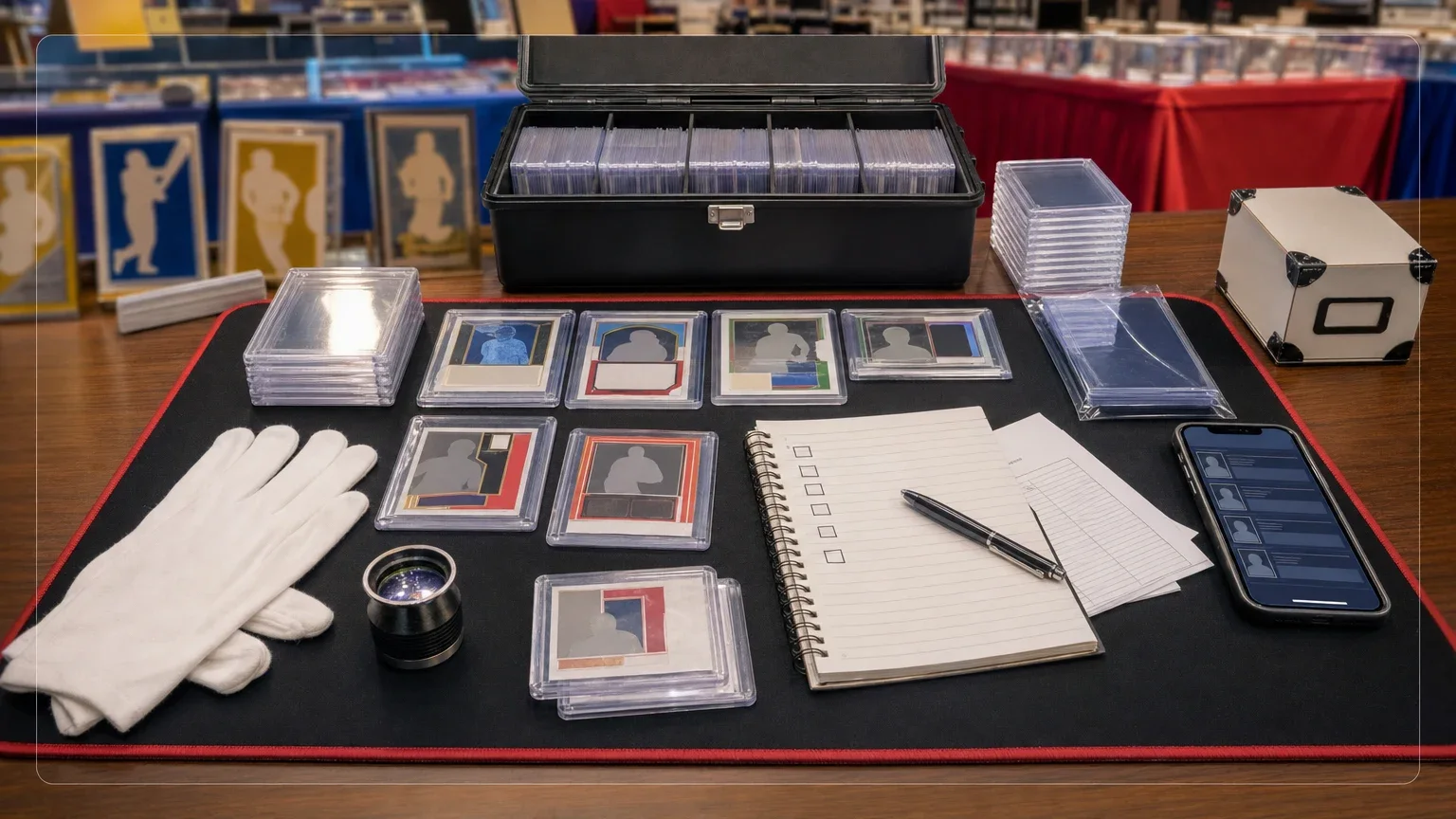
Card shows reward people who arrive with a plan. If you are buying or trading, the goal is not to carry everything you own, but to bring the right cards, the right holders, and the right expectations for the day.
Prepared buyers and traders separate three jobs before they walk in: what they want to acquire, what they are willing to move, and what might eventually be submitted for grading. That distinction matters because raw cards, slabbed cards, and authentic-only holders each demand a different level of inspection.
The safest approach is simple but disciplined. Use protective supplies that fit the card, verify slabbed cards before money changes hands, and do not confuse a certification lookup with a guarantee of authenticity. The show floor is fast, but your decisions should stay slow enough to be deliberate.
What does being prepared actually mean at a card show?
Prepared does not mean carrying a full collection and hoping to improvise. It means knowing which cards you are actively hunting, which ones you might trade away, and which ones are candidates for grading rather than immediate sale. That keeps you from wasting time on the floor and helps you judge whether a deal fits your actual goals.
It also means understanding the different paths a card can take. PSA and Beckett both distinguish between numeric grading and authentic-only outcomes, while PSA’s grading process starts with authenticity checks before any numeric score is assigned. If you are not clear on that distinction, it is easy to overpay for a card that looks impressive in a holder but does not mean what you think it means.
- Build a short buying list before you leave home.
- Separate cards for buying, trading, grading, and holding.
- Treat authenticity and condition as different questions.
- Bring only the inventory you are ready to move or submit.
How should you pack cards for a show?
The most practical packing rule is to match the holder to the card’s purpose. BCW’s product guidance describes penny sleeves as the first layer of protection, toploaders as a standard option for thinner cards, and semi-rigid holders as a common submission-prep choice. PSA also recommends a penny sleeve followed by a semi-rigid holder when preparing cards for grading submission.
For show travel, that usually means penny sleeve plus semi-rigid for cards you may submit, and penny sleeve plus toploader for cards you want to transport safely and still inspect quickly. Thickness matters. BCW notes that different products are designed for different card dimensions, so forcing a thick or unusual card into the wrong holder is a mistake you can avoid before you leave home.
- Use penny sleeves as the basic protection layer.
- Choose semi-rigids for likely submission candidates.
- Use toploaders for standard cards you plan to carry or display.
- Do not force thick or nonstandard cards into a holder made for slimmer stock.
Which cards belong in your show box and which should stay home?
A focused show box is better than a broad one. Keep cards that are likely to be bought, traded, or submitted in the next short window of time, and leave the rest at home. That reduces clutter, makes negotiation easier, and lowers the chance that you mishandle something valuable while searching through too much inventory.
A useful filter is to ask whether the card has a clear purpose at the show. If the answer is no, it probably does not belong in the box. That is especially true for cards that are expensive, delicate, unusually thick, or emotionally important but not actually part of your plan. A show is a working environment, not a storage unit.
- Bring only cards tied to a current objective.
- Leave sentimental and inactive inventory at home.
- Prioritize cards you are willing to price, trade, or submit soon.
- Keep the box slim enough to review without constant shuffling.
How do you decide whether a card belongs in a raw, slabbed, or submission-ready pile?
Raw cards demand inspection. Beckett’s grading framework is built around centering, corners, edges, and surface, and PSA’s standards show that small flaws can keep a card from reaching the grade you hoped for. If you are buying raw, you need to examine those areas yourself rather than relying on a seller’s quick description.
Slabbed cards are simpler to compare, but only if you confirm the certification and inspect the holder. Submission-ready cards are a separate category again. These are the items you may want to send in later, which means they should already be sleeved and organized for a grading path. A good show routine keeps those categories apart instead of blending them into one loose pile.
- Raw cards require your own condition check.
- Slabbed cards require cert verification and holder inspection.
- Submission candidates should already be protected for transit.
- Do not price every card as if it belongs in the same category.
What should you look for in a slab before you buy or trade it?
Start with the certification number and the label. PSA, Beckett, and CGC all provide certification lookup tools, and those lookups help confirm the card’s description, grade, or holder record. That is useful, but it is only one step. PSA is explicit that certification verification does not eliminate counterfeit risk, and its guidance notes that counterfeit inserts can use real certification numbers.
The physical slab still matters. Look at the seams, the label, and the overall consistency of the holder, and compare the label text with the card in hand. If something feels off, pause. A matching lookup can still leave you with a tampered or misrepresented slab, so the safest practice is to combine database verification with a hands-on inspection of the holder itself.
- Verify the cert in the grading company’s database.
- Check that the label text matches the card.
- Inspect holder seams and label structure for tampering clues.
- Treat a lookup as a tool, not a guarantee.
How should you think about authentic-only holders versus numeric grades?
This is one of the easiest mistakes to make at a show. A numeric grade is a condition judgment; an authentic-only result is primarily a statement about genuineness or eligibility, not a promise of strong condition. PSA, Beckett, and CGC all support some form of authentic-only pathway, but that designation should not be treated as if it were a high numeric grade in disguise.
A practical example helps. If two cards are otherwise comparable and one is in an authentic-only holder, that does not automatically make it equal to a higher-grade slab. The certification tells you what the service concluded, not what the market must pay. Use the holder to understand the card’s status, then price it according to what it actually is rather than what you wish it were.
- Numeric grade and authentic-only are not the same thing.
- Authentic-only does not imply premium condition.
- Use the holder to guide evaluation, not to replace it.
- Price the card based on its actual certification outcome.
What is a sensible negotiation process on the show floor?
The best negotiating habit is to slow down enough to compare like with like. For raw cards, that means adjusting for the fact that condition risk is still unresolved. For slabbed cards, it means verifying the cert and holder before you discuss price. If the seller resists basic inspection, that is a signal to move on rather than force a deal.
It also helps to set a ceiling before you start talking. Once you decide what you can pay, you are less likely to get pulled into a rushed decision because a card looks clean under bad lighting or because a table feels busy. If a card is expensive, ask whether the slab, the cert, and the condition story all align. If they do not, the safe answer is usually to keep walking.
- Compare raw and graded cards on different terms.
- Set a spending limit before negotiation starts.
- Walk away if a seller blocks normal inspection.
- Do not let show energy replace your price discipline.
What should you do after the show ends?
Your work is not finished when you leave the venue. Recheck any slabbed card you bought by running the certification again, and keep receipts, seller contact information, and photos of the card and holder. That creates a record if you discover a mismatch or need to revisit a purchase later.
If you plan to submit cards afterward, leave them in their protective holders and avoid unnecessary re-handling. PSA’s show guidance emphasizes advance preparation for submissions, and that same logic applies after the show: the less you disturb a card once you have selected it, the better your chance of preserving the condition you intended to protect.
- Reverify certs after the purchase.
- Keep receipts, photos, and seller information together.
- Leave submission candidates protected until you are ready.
- Avoid re-handling cards that already have a planned next step.
What are the most common mistakes buyers and traders make?
The first mistake is assuming that a certification lookup removes all risk. It does not. PSA warns that counterfeit collectibles can still circulate even when a cert number appears valid, which is why the holder and the seller matter too. The second mistake is treating authentic-only as if it were a condition grade. That blurs two different ideas and can lead to overpaying.
A third mistake is using the wrong holder. A thick or unusual card may not fit the same way a standard card does, and BCW’s size guidance makes clear that holder choice depends on dimensions and intended use. A fourth mistake is ignoring service updates. Submission availability can change, so the show-specific or date-specific plan matters more than a generic one.
- Do not rely on a cert lookup alone.
- Do not price authentic-only like a premium numeric grade.
- Do not use a holder that does not fit the card.
- Check current submission availability before the show.
Frequently Asked Questions
Should I bring my whole collection to a card show?
Usually no. Bring only the cards you are ready to buy, trade, compare, or submit. A smaller, focused box is easier to manage and safer to transport.
Is a certification lookup enough to prove a slab is real?
No. A lookup is useful, but PSA warns that counterfeit collectibles and tampered holders can still exist. Always inspect the holder and label as well.
Should I use a top loader or semi-rigid for submission candidates?
For many submission candidates, a penny sleeve plus semi-rigid is the cleaner path because that is the format PSA commonly recommends. Toploaders are better for standard cards you want to transport or display, but fit depends on thickness.
Can authentic-only cards be priced like graded cards?
Not automatically. Authentic-only confirms genuineness or eligibility, not strong condition. Price should reflect the actual certification outcome and the card’s overall appeal.
Written with AI assistance. Featured image: AI-generated editorial illustration.


Comments
0You must be signed in to comment.
Sign In