

1997 Metal Universe Basketball Cards Are Heating Up Fast
Something unusual is happening with 1997 Metal Universe basketball cards. Base cards from the set are suddenly posting major price jumps, even though they are not serial-numbered cards or rare inserts. The move has been especially noticeable for Michael Jordan, Kobe Bryant, Tim Duncan and Shaquille O'Neal.
One example is a Tim Duncan PSA 9 rookie base card from the set, which recently sold for $395. In April, a PSA 9 sold for around $35. That is an increase of more than 1,000 percent in less than five months. Similar gains have shown up across other key cards in the set, suggesting collectors are paying far more attention to 1997 Metal Universe as a whole.
Big Gains for Jordan, Kobe and Duncan
The price movement is not limited to one player. A PSA 9 Michael Jordan 1997 Metal Universe #23 sold for $300 on May 27, 2025. On September 7, 2026, another PSA 9 sold for $3,183, a jump of 961 percent in just over 15 months.
Kobe Bryant has followed the same pattern. A PSA 9 Kobe 1997 Metal Universe #81 sold for $154 on September 6, 2025. On September 8, 2026, another PSA 9 sold for $1,650, an increase of about 971 percent in almost exactly one year.
These are base cards from a set released nearly 30 years ago, not scarce parallels or chase inserts. The broader sports card market has been strong in 2026, but the scale of the move in 1997 Metal Universe suggests something more specific is going on with this product.
Why Collectors Are Paying Attention to the Set
One reason for the renewed interest is the growing recognition of how important 1997 Metal Universe is within 1990s basketball card history. The decade produced many memorable sets, but no single release has long been viewed as the clear basketball equivalent of 1986 Fleer. 1997 Metal Universe is starting to make that case.
The set combines several factors that collectors tend to value highly. It includes Michael Jordan, a second-year Kobe Bryant card, rookie cards of Tim Duncan and Tracy McGrady, and a deep checklist of Hall of Famers and stars. It also has a distinctive look that separates it from nearly every other basketball product of the era.
The Precious Metal Gems Connection
It is impossible to discuss 1997 Metal Universe without talking about Precious Metal Gems. The red and green Precious Metal Gems parallels are among the most desirable basketball cards ever made, and they helped define the set's long-term legacy.
Related coverage includes 1997 Metal Universe Base Cards Are Joining the PMG Spotlight.
A BGS 8.5 green Kobe Bryant PMG, serial-numbered to 10, sold for two million dollars in 2022. A PSA 5 red Michael Jordan PMG, serial-numbered to 90, sold for $640,000 in March. More recently, the 1997 Metal Universe Michael Jordan PMG, numbered to 90, sold for $1.473 million on August 13, 2026. A Kobe Bryant PMG sold for $3.15 million in April.
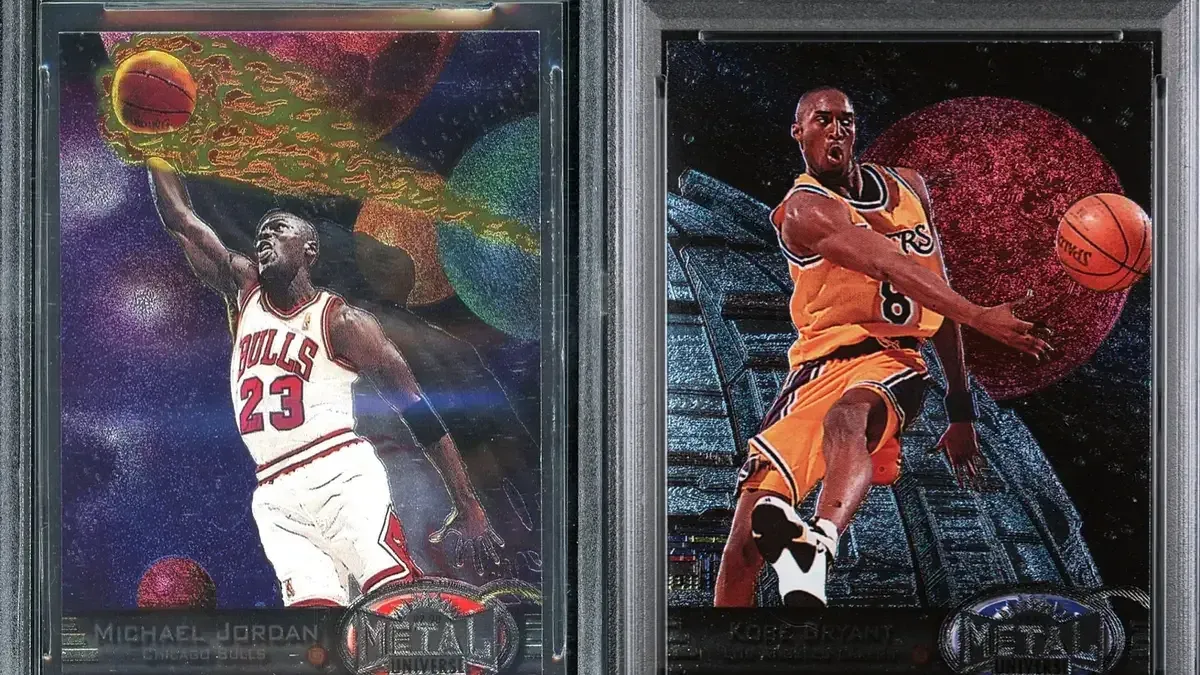
What matters for the base cards is that the same player images and artwork appear on both the PMGs and the regular cards. The iconic Michael Jordan image collectors know from the PMG also appears on the standard Jordan base card. That visual connection appears to be helping the base set gain value as collectors increasingly view the PMGs as the centerpiece of the product.
Collector Mark Tanaka said that connection is a major part of the story. “The 1997 Jordan is not special because of the year. It is because the PMG Jordan is so iconic,” Tanaka said. “That is the story the hobby has not fully digested.”
For many collectors, the base card offers a way to own the same memorable image without paying PMG-level prices. That accessibility may be one reason the market is moving so quickly.
The Artwork Still Stands Out
The design of 1997 Metal Universe remains one of the set's biggest strengths. The cards use a comic book-inspired style with NBA stars placed against planets, moons, fire, futuristic landscapes and other colorful backgrounds. The result is a product that looks unlike almost any other basketball release from the 1990s.
That visual identity is no accident. Fleer/SkyBox was owned by Marvel Entertainment at the time, and SkyBox used Marvel artists to help create the artwork. The influence shows up throughout the set and gives it a dramatic, heroic feel that still resonates with collectors today.
The Michael Jordan card is the clearest example. Jordan is shown soaring toward the basket with a flaming basketball and planets behind him. It is bold, flashy and impossible to miss. The design helped Metal Universe stand out when it was new, and it is a major reason the set still looks fresh decades later.
That kind of visual impact matters in today's hobby. Collectors continue to gravitate toward cards that look different, memorable and display-worthy. The popularity of comic book-style modern inserts such as Kabooms shows that the hobby still responds strongly to that type of design language.
Nostalgia Is Working in the Set's Favor
Another factor behind the surge is nostalgia. Collectors who grew up in the 1990s are older now and often have more money to spend on the cards they remember. 1997 Metal Universe is one of those sets that feels unmistakably tied to the decade.
The product captures a very specific era in basketball. Michael Jordan was still leading the Chicago Bulls dynasty and would win his sixth NBA championship that season. Kobe Bryant was entering his second season. Tim Duncan and Tracy McGrady were rookies. Shaquille O'Neal, Hakeem Olajuwon, David Robinson, Patrick Ewing, Grant Hill, Scottie Pippen, Karl Malone and other stars were still in their prime. Allen Iverson was entering his second year after one of the most memorable rookie seasons of the decade.
Few basketball card products bring together that many eras and star levels in one checklist. That makes the set feel like a snapshot of 1990s basketball at its peak.
Jordan, Kobe, Duncan and Shaq Moved First
The market movement has not been random. Jordan and Kobe appear to have moved first because they remain two of the biggest names in basketball card collecting. From there, attention began shifting to the Tim Duncan rookie card.
Duncan's card has already seen a dramatic rise. His card in raw condition went from under $10 earlier this year to over $60. His PSA 10 recently reached $2,280 after selling for around $250 in April. That kind of movement is notable for a player whose base rookie card was not always a headline item in the hobby.
Shaquille O'Neal has also joined the surge. His PSA 9 card #50 sold for around $30 in May, and one recently sold for $550 on September 9. Shaq's card market has been strong over the past few months, but the speed of the move in his 1997 Metal Universe base card is still striking.
Tracy McGrady may be next. His PSA 10 recently sold for $600. In April, it was selling for around $100. Less than a year ago, the 1997 Metal Universe Tracy McGrady rookie was selling for around $50 in PSA 10. That kind of jump suggests collectors are starting to look beyond the biggest names and into the rest of the checklist.
Other Hall of Famers Could Benefit Too
If the market continues to treat 1997 Metal Universe as a landmark set rather than a collection of individual player cards, other Hall of Famers in the checklist could also see more attention. Allen Iverson, Kevin Garnett and other stars may become more important to collectors as the set's reputation grows.
That is the broader question now facing the hobby. Is this just a short-term run on a few key cards, or is the market beginning to assign 1997 Metal Universe the kind of historical importance that changes how the entire set is collected?
Could 1997 Metal Universe Become the 1990s Basketball Standard?
There will never be another set quite like 1986 Fleer Basketball. It includes Michael Jordan's rookie card along with rookie cards of Charles Barkley, Hakeem Olajuwon, Patrick Ewing, Karl Malone, Clyde Drexler and Isiah Thomas. That combination makes it a unique benchmark in the hobby.
The 1990s are different because the era produced so many products, inserts and parallels that no single basketball set has clearly separated itself in the same way. 1997 Metal Universe may be starting to do that.
The set has a strong checklist, unforgettable Marvel-influenced artwork, the PMG legacy, and a mix of stars and rookies that spans multiple generations of NBA history. It also has some notable population data in high grade. Michael Jordan's base card #23 has a PSA 10 population of 154 and a total PSA population count of 8,263. For comparison, the 1986 Fleer Michael Jordan has a PSA 10 population of 341 and a total PSA population of 31,361.
Those numbers do not make 1997 Metal Universe ultra-rare, but they do show that high-grade examples are not unlimited. Combined with the set's design and star power, that helps explain why collectors are suddenly treating the cards underneath the PMGs as important in their own right.
For now, the strongest evidence is the market itself. Jordan, Kobe, Duncan and Shaq have all moved sharply, and the rest of the checklist is worth watching as collectors continue to re-evaluate one of the most distinctive basketball sets of the 1990s.
Comments
0You must be signed in to comment.
Sign In