

Lugia Still Defines Johto Collecting
Charizard may own Kanto and Rayquaza may dominate Hoenn, but Johto belongs to Lugia. The legendary bird trio leader has remained one of the most important Pokémon in the hobby since its debut, and the cards that matter most to collectors come from print windows when far fewer packs were opened than anyone realized at the time.
Lugia’s popularity was built early. It arrived as the box art legendary of Pokémon Silver and carried a feature film, landing in front of a generation at exactly the right moment. That combination of nostalgia, scarcity, and strong artwork has kept Lugia cards near the top of the Pokémon TCG market for years.
The Classic Collection inside 30th Celebration, arriving September 16, is reported to include one of the cards below, though only the announced Base Set Charizard has been confirmed by The Pokémon Company.
The 3 Best Lugia Pokémon Cards
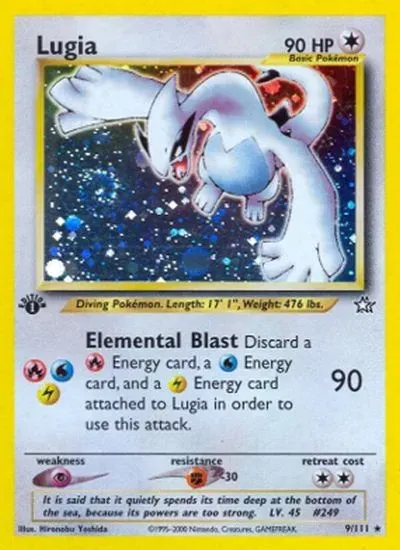
Lugia 9/111 - Neo Genesis, Rare Holo
This is the card that built the Lugia market. It was the first Lugia ever printed and remains the centerpiece of Johto-era collecting. Illustrated by Hironobu Yoshida, this Colorless Basic has 90 HP and a single attack, Elemental Blast, which does 90 damage and requires a Fire, Water, and Lightning Energy to use.
The attack cost is a direct nod to Lugia’s role as leader of the legendary birds, with one Energy representing Articuno, Zapdos, and Moltres. That kind of design detail helped make the card memorable long before it became a major chase item.
Neo Genesis holos are known for print lines running through the foil, and the dark surface shows scratches easily. That makes high-grade copies especially difficult to find in strong condition. First edition raw copies trade around $1,500, while graded 10 examples have crossed six figures at auction this year. The gap between raw and perfect is wider here than on any other Lugia card on this list.
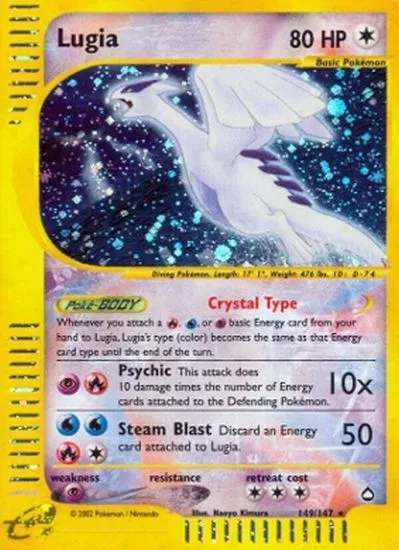
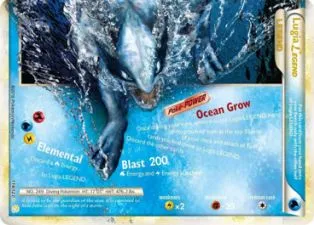
Lugia 149/147 - Aquapolis, Secret Rare
Naoyo Kimura’s Crystal Lugia is the prettiest Lugia card on this list and the hardest to find. It is also one of the most distinctive cards in the entire Pokémon TCG because of the Crystal Type Poké-BODY, which lets you change Lugia’s type by attaching a Fire, Water, or Psychic basic Energy from your hand.
The card itself is Psychic and attacks with Psychic, which does 10 damage for each Energy attached to the Defending Pokémon, plus Steam Blast for a flat 50. The mechanics are unusual, but the real story is scarcity. The e-Card era shipped fewer boxes than the sets on either side of it, and the Crystal cards buried inside those boxes are genuinely scarce rather than artificially hyped.
Even heavily played copies can clear four figures. Raw copies run just under $3,000, and graded 10 cards have repeatedly sold near $80,000 through 2026. This is also the Lugia reported to be in the 30th Celebration Classic Collection, though that lineup remains unconfirmed beyond the announced Base Set Charizard.
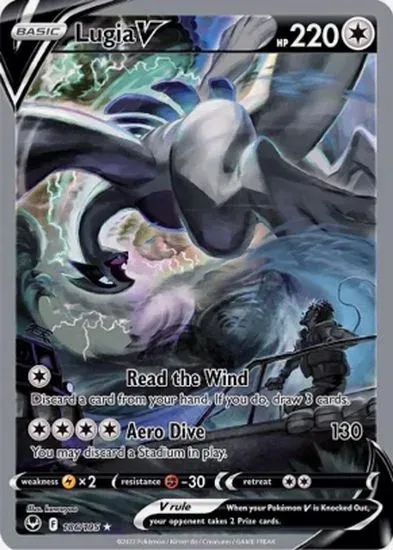
Lugia V 186/195 - Silver Tempest, Ultra Rare
The modern chase card on the list is also the one most Sword & Shield collectors are likely to recognize immediately. Silver Tempest printed Lugia V in three versions, including a regular print by Mitsuhiro Arita, a Full-Art by 5ban Graphics, and this Special Full-Art by kawayoo, which is the version the market cares about most.
This 220 HP Colorless Basic has Read the Wind for card draw and Aero Dive, which hits for 130 damage and gives you the option to discard a Stadium. Kawayoo’s alternate art gave Silver Tempest much of its identity, and the card has held its ground while many late Sword & Shield chase cards cooled off.
Clean, ungraded copies trade around $400. It is the Lugia most likely to move when Johto nostalgia gets a fresh boost, and it remains the most accessible of the three cards here for collectors who want a modern centerpiece with strong demand.
Why These Lugia Cards Matter Most
These three cards represent the full arc of Lugia collecting. Neo Genesis is the origin point, Aquapolis is the scarce collector grail, and Silver Tempest is the modern chase that keeps Lugia relevant in today’s market. Together, they show why Lugia remains one of the most durable names in Pokémon collecting.
Each card also reflects a different type of demand. Neo Genesis is driven by first-print nostalgia and condition sensitivity. Aquapolis is driven by rarity and the appeal of the Crystal card design. Silver Tempest is driven by artwork, accessibility, and the strength of modern alternate-art collecting.
For collectors, that means there is no single way to approach Lugia. Some chase the earliest print and the strongest grades. Others focus on the hardest-to-find Crystal card. Others prefer the modern card that still carries the character’s legacy into a new era.
What Collectors Watch With Lugia Cards
- First-edition Neo Genesis copies remain the most important vintage Lugia cards.
- Aquapolis Crystal Lugia stands out for scarcity and its Crystal Type Poké-BODY.
- Silver Tempest Lugia V is the modern alternate-art chase with the strongest current visibility.
- Condition matters heavily, especially on Neo Genesis holos and Crystal-era cards.
- Any new Lugia-related product or reprint discussion can quickly affect collector interest.
With 30th Celebration on the horizon and Lugia already tied to one reported Classic Collection card, the legendary Pokémon is positioned to stay in the spotlight. Whether collectors are chasing the first print, the rare Crystal version, or the modern alternate art, Lugia remains one of the clearest examples of how nostalgia and scarcity can shape a Pokémon TCG market for decades.

Join the Sports Card Portal Page thread for this story.
Comments
0You must be signed in to comment.
Sign In