

T205 and T207 Deserve a Closer Look
When collectors talk about early tobacco cards, the conversation usually starts and ends with T206. The 1909 to 1911 issue has earned its place as the most famous prewar baseball card set, but it is not the only notable American Tobacco Company release from that era. The T205 and T207 sets, both produced around the same time, have their own identities, visual styles, and collecting challenges.
Each set is smaller and less celebrated than T206, but both offer strong historical interest and a distinct look that separates them from the better-known monster issue. For collectors who appreciate vintage tobacco cards beyond the headline names, T205 and T207 remain important parts of the hobby's early history.
T205 Gold Border Cards Stand Out Immediately
The T205 set is usually dated to 1911, with some sources extending distribution into early 1912. That timing has long created confusion because Jefferson Burdick assigned it the T205 designation even though it followed T206 chronologically. Whatever the cataloging oddity, the set has become known as the Gold Border issue.
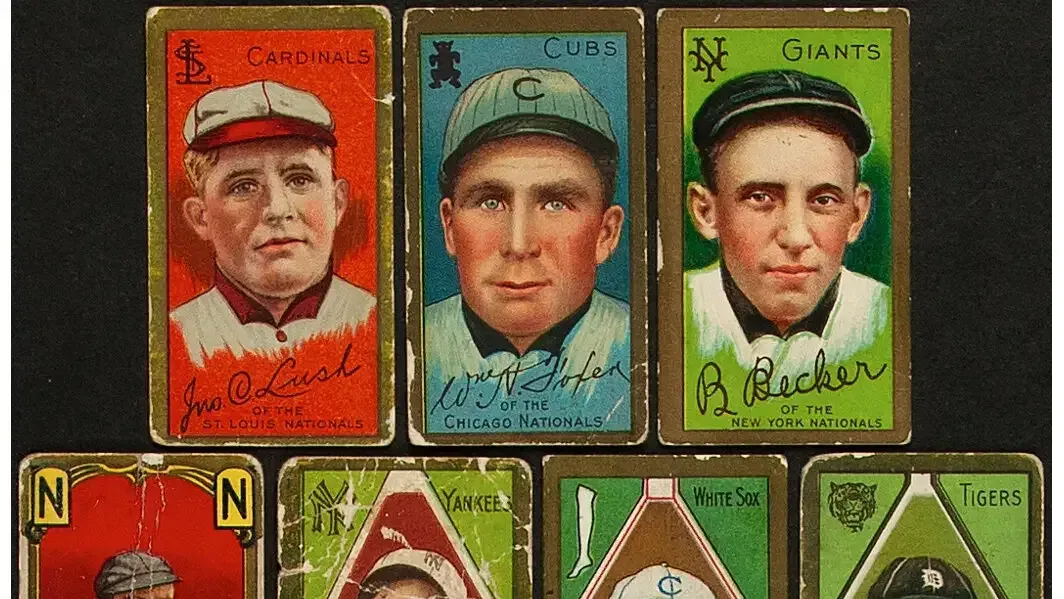
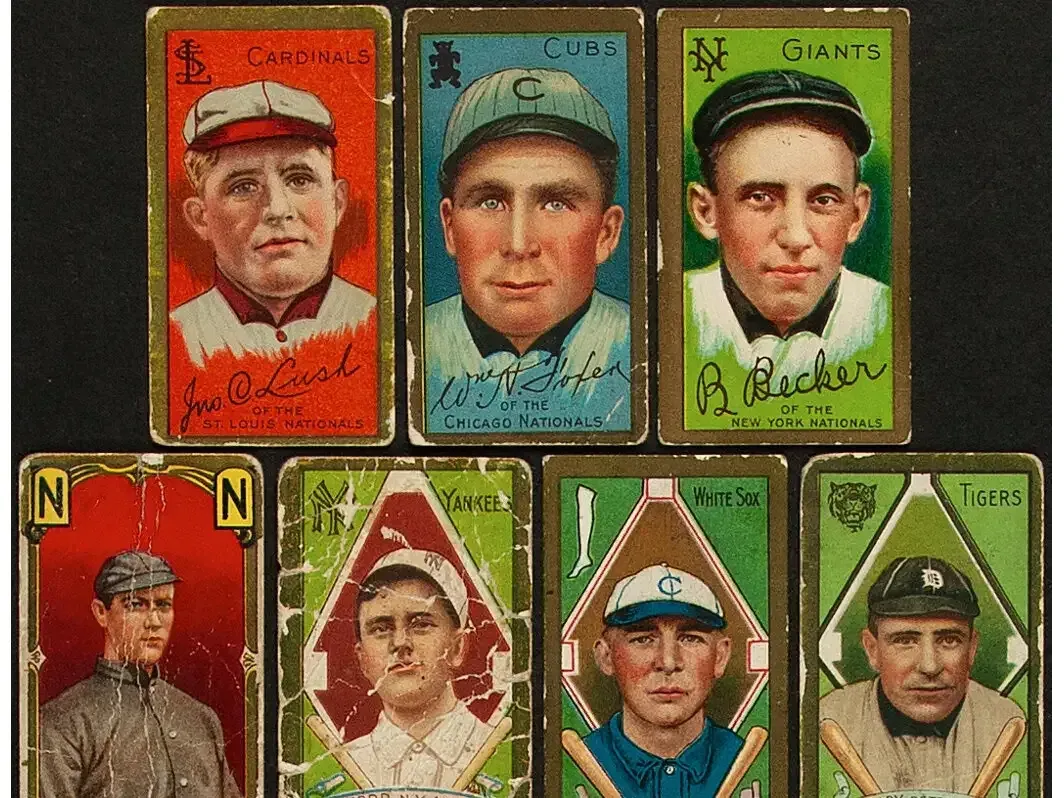
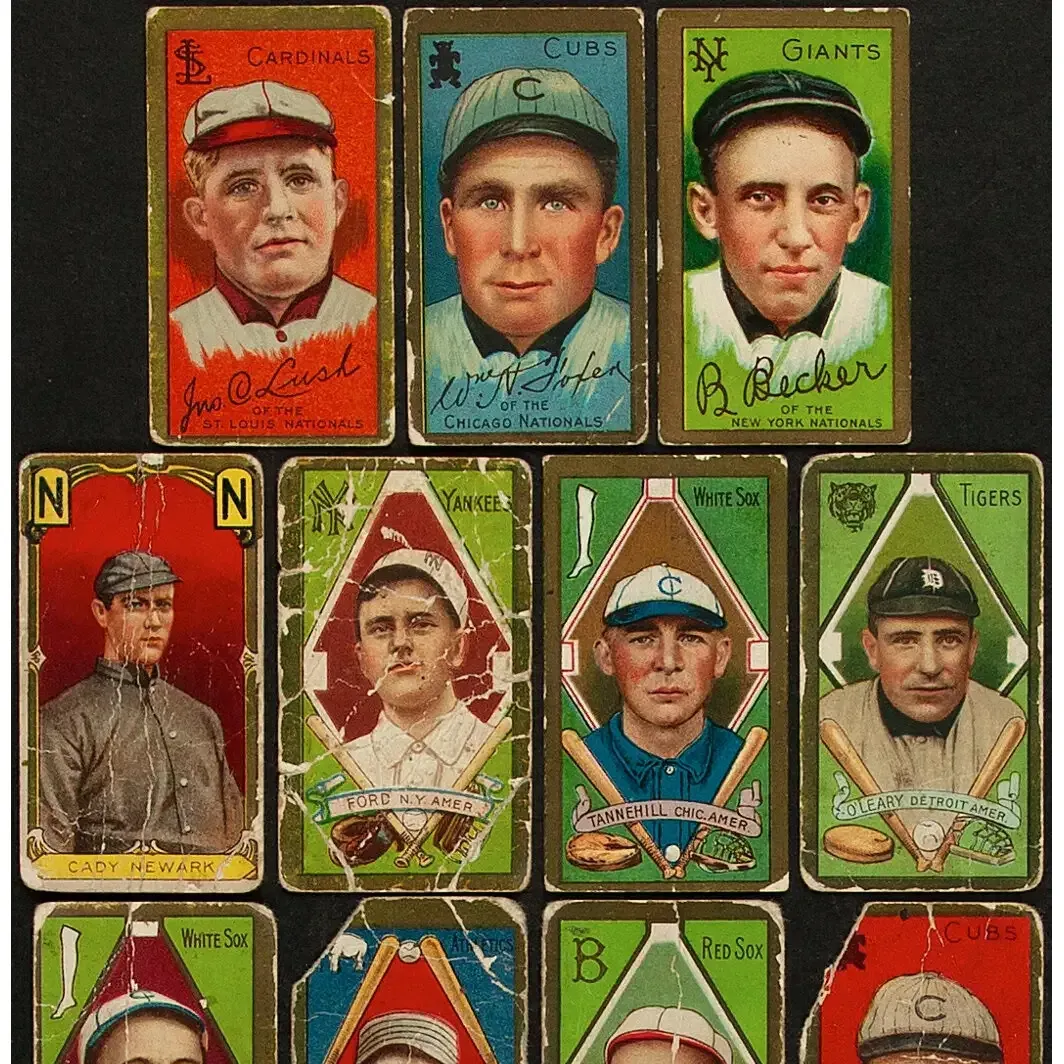
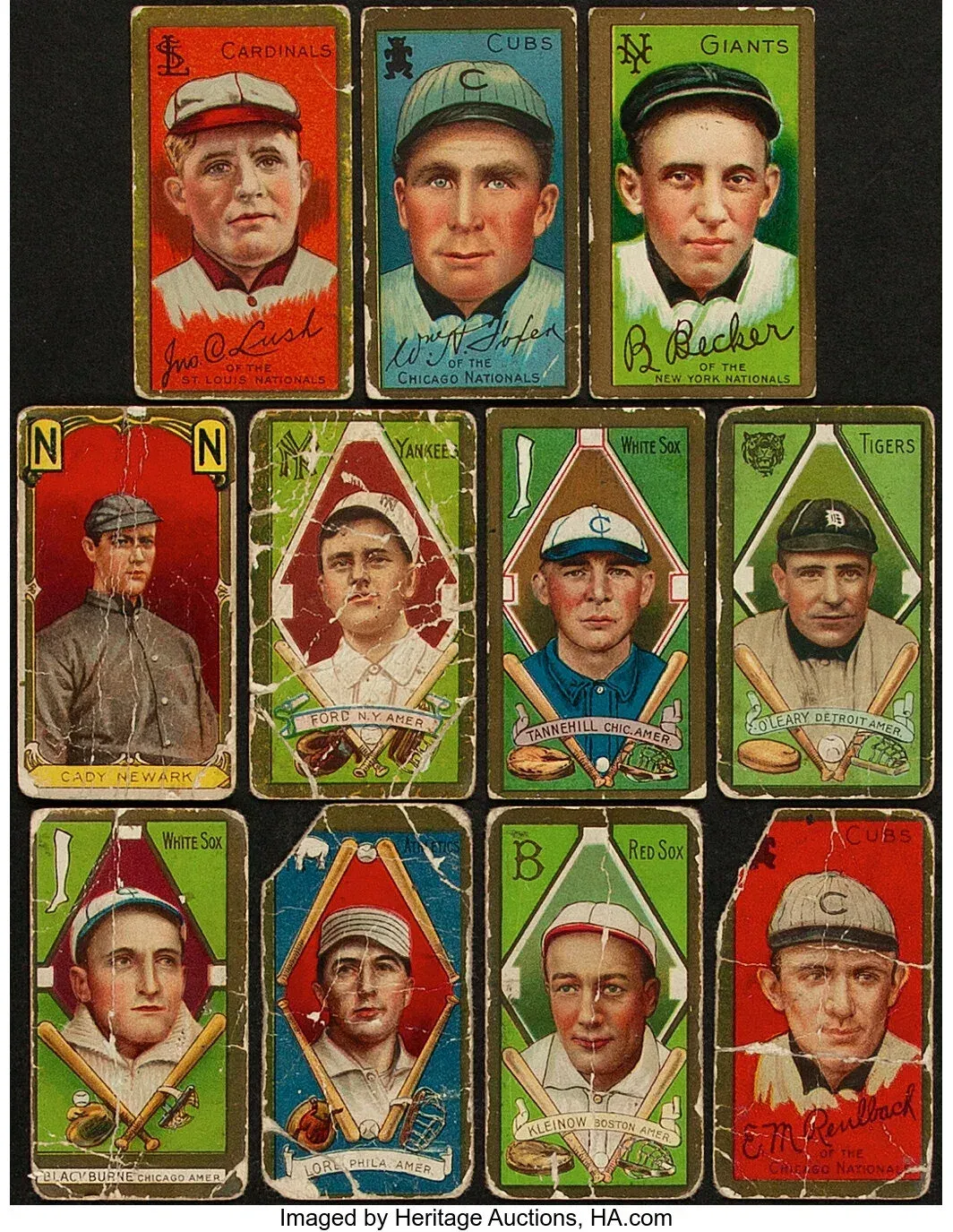
That nickname comes from the shiny gold frame surrounding each card front. Unlike the white borders seen on many cards of the era, the T205 design gives the set a rich, eye-catching appearance. The downside is condition. Gold borders show wear quickly, and chips and rubbing are common. As a result, high-grade examples are difficult to find.
The fronts themselves are among the most attractive of the era. American League players appear as headshots inside a baseball diamond, with bats, gloves, and catcher's masks decorating the margins and the player's name shown in a scroll. National League players are also shown in headshot format, but on a plainer background and often at a larger size because the design lacks the extra ornamentation. Team names appear in the upper right corner, while a team logo or letter sits in the upper left.
The minor league cards are especially distinctive. All 12 minor leaguers in the set come from the Eastern League and are shown in ornate frames, with four using a frame partly made of baseball bats. Some have plain backgrounds, while others, including Doc Adkins and Charlie Hanford, feature stadium scenes that echo the style of T206 artwork.
T205 Backs Add Statistics and Biographical Notes
The reverse side of a T205 card is just as interesting as the front. Players are usually identified by their legal names, such as Christopher Mathewson and Denton T. Young. The cards are unnumbered, but they include player biographies and, for the first time in sports card history, limited past-season statistics.
The statistical information is narrow in scope. The set covers only the 1908 through 1910 seasons, and the dozen minor leaguers have no statistics at all. Batters are listed with games played, batting average, and fielding average. Pitchers are listed with games won, games lost, winning percentage, and fielding percentage.
Related coverage includes T205 and T207 Tobacco Cards Show Why Baseball’s Prewar Story Is Bigger Than T206.
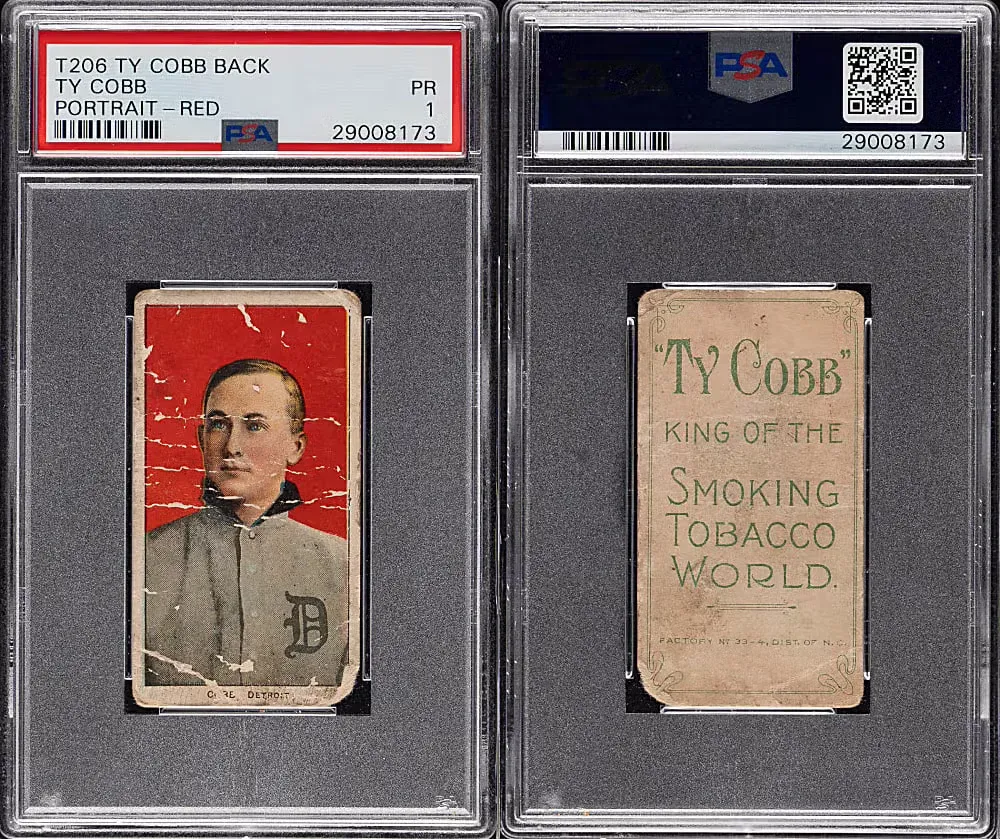
The biographies range from simple career summaries to more colorful descriptions. Ty Cobb is described as “lightning on the bases” and “one of the fastest ball players that ever stepped on a diamond.” Mathewson is praised for his “splendid control,” while Eddie Collins is credited with rising as a new star after moving from shortstop to second base. Frank Baker and other players receive similar short career notes, and some cards include a batting championship or other highlight.
T205 backs also advertise 10 cigarette brands and one loose tobacco brand, Polar Bear. Piedmont and Sweet Caporal are among the more common backs, while Hindu and Drum are scarcer. Some backs appear in different print colors, and not every player can be found with every brand or color combination. The minor leaguers are limited to Hassan or Polar Bear backs.
T205 Checklist Size and Variations
Most sources list the T205 set as 200 players and 208 cards, though some references expand the total to 217 or 219 when additional variations are counted. The set includes many of the biggest names of the era, with one important exception. The Wagner in T205 is not Honus Wagner, but Boston Red Sox shortstop Charles “Heinie” Wagner.
Other Hall of Famers in the set include Tris Speaker, John McGraw, Three Finger Brown, and the famous trio of Tinker, Evers and Chance. Cy Young appears in the final active year of his career, and Addie Joss is included despite having died on April 14, 1911. His card notes his death, making it a posthumous tribute, although it incorrectly identifies him as a native of Cleveland.
The set is also known for its variations. Some are obvious, such as Peaches Graham and Dave Shean being listed with either the Boston Rustlers or the Chicago Cubs after early 1911 trades. Roger Bresnahan and Eddie Collins can be found with mouths open or closed. William “Dolly” Gray appears with or without statistics, even though the stats shown are for a hitter rather than for Gray himself, who was a pitcher.
One of the most famous T205 variations involves Mathewson, whose 1908 record appears as either 37-11 or the much rarer and incorrect 37-1. The 11-loss version is the correct one, while the one-loss version is found only on cards with the Cycle cigarette advertisement.
Other differences are often treated as printing inconsistencies rather than true variations, including the E.B. Barger cap lettering, the Otis Crandall name detail, and the Danny Hoffman second-base color difference. Doc Hoblitzell is among the most complicated cards in the set, with four known versions involving statistics, team information, and even a misspelling of his surname on the back.
T205 Scarcity Makes Completing the Set Costly
Collectors usually build T205 sets by front only, without trying to match every back brand or print color. Even so, assembling a complete set is expensive and time-consuming. The cards were printed in smaller quantities than T206, and that scarcity shows today. Even common cards in fair condition can approach $100, while Hall of Famers and tougher variations bring a premium.
Graded examples are more common than raw cards, and true mint condition examples are essentially nonexistent because of the fragile gold borders and more than a century of wear. Minor league cards are often even tougher and typically command more money because they are generally believed to have been printed later in the 1911 season and in smaller numbers.
T207 Brown Background Cards Take a Different Approach
The T207 set, issued in 1912, is even more visually stripped down than T205. If T205 is remembered for its ornate gold borders, T207 is known as the Brown Background set for obvious reasons. Every card features a dark brown background, with a tan or beige border around the image.
The design is stark. There are no elaborate team logos, no decorative scrolls, and no stadium scenes. The player image is the focus, and the result is a much more monochromatic card than collectors saw in T205 or T206. The set also includes one notable exception to its vertical format: Jack Barry's card is horizontal and shows the Philadelphia Athletics shortstop stretching to field a line drive.
T207 includes 200 players and a small number of variations, but unlike T205, all of them are major leaguers. Cy Young is absent because he was inactive, though he was still officially on the Boston Rustlers or Braves roster until his retirement on May 24, 1912. Cobb, Mathewson, and Eddie Collins are also missing. Speaker and John McGraw return, and Walter Johnson is included, though his portrait does not resemble him closely.
The only Hall of Famers added to the set are Max Carey and Harry Hooper. The absence of many of the era's biggest stars is one reason the set has never matched the popularity of T206 or even T205.
T207 Backs, Brands, and Scarce Cards
The backs of T207 cards are similar in structure to T205, but without statistical tables. The cards are unnumbered and include a short career summary, often little more than a list of teams with an occasional descriptive phrase. John McGraw is called “the smartest, most resourceful and most original manager in the game to-day,” while Tris Speaker is described as a “brilliant outfielder.”
The backs advertise six cigarette brands. Recruit Little Cigars is the most common, with Napoleon somewhat less common. Broadleaf and Cycle are much scarcer, Red Cross is extremely rare, and Coupon cards exist without advertising and are cataloged as anonymous. Most players can be found with Recruit or Napoleon backs, while a smaller group appears only with Broadleaf or Cycle. Hall of Famers in the set are generally in the more common group.
Most T207 backs are printed in black ink, although Cycle backs are usually red. Some examples can also be found with brown printing. As with T205, few collectors attempt to build a complete run of every back and color combination.
There are also a number of recognized and debated variations. Paddy Livingston's card changed after his December 6, 1911 trade from the Philadelphia Athletics to the Cleveland Naps, leading to different uniform lettering. Jimmy Austin and Tom Clarke can be found with or without team emblems on their shirts, and some cards show slight printing differences in uniforms and hats.
One long-accepted oddity is the pair of Bill Carrigan and Heinie Wagner cards that can be found with each other's backs. Rumors persist that additional switched-back pairs may exist, but none have been confirmed on recognized checklists.
The Rarest T207 Cards Draw the Most Attention
Three T207 cards have long been recognized as especially rare: Irving Lewis, Louis Lowdermilk, and Ward Miller. Their scarcity has never been fully explained, but their careers offer possible clues.
Ward Miller spent 1911 in the minors before joining the Cubs and had an eight-year major league career with five teams. Lowdermilk's brief major league time ended early in 1912 after a short run with the St. Louis Cardinals. Lewis may be the toughest of all. He had no major league experience before being signed by Boston Rustlers president John Montgomery Ward and never appeared in a major league game in 1912 before being released to the minors.
Lewis is especially notable because his card exists in two variations, with and without the Boston “B” on his sleeve. Both are scarce, and the version without the emblem is even tougher. For many collectors, Lewis remains the key rarity in the entire set.
Like T205, T207 is unnumbered and includes a mix of common cards, tough variations, and a handful of extreme rarities. The set is widely considered more difficult and less attractive than T205, and it lacks the star power that helped make T206 famous. Even so, it remains an important vintage issue with its own place in tobacco card history.
Why T205 and T207 Still Matter to Vintage Collectors
T205 and T207 may not command the same attention as T206, but both sets offer a strong combination of history, scarcity, and design. T205 stands out for its gold borders, detailed player presentations, and early use of statistics and biographies. T207 takes a different route with its stark brown backgrounds, simpler backs, and unusual checklist makeup.
For collectors who want more than the usual T206 conversation, these sets provide a deeper look at the early tobacco card era. They show how varied and experimental card design could be in the years before World War I, and they remain challenging, distinctive, and highly collectible in their own right.


Join the Sports Card Portal Page thread for this story.
Comments
0You must be signed in to comment.
Sign In