

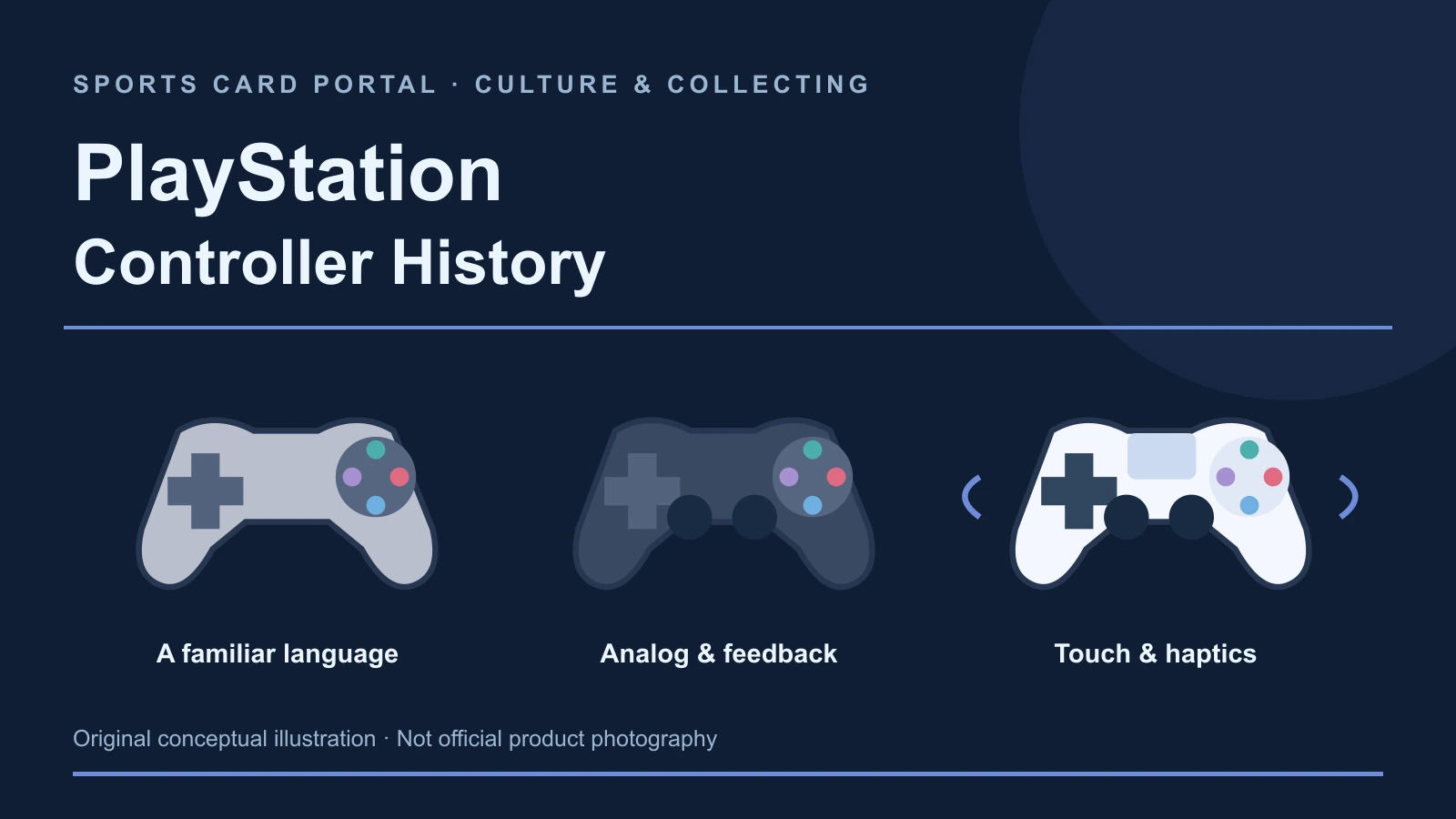
Triangle, circle, cross and square can make a controller recognizable before its model name is visible. That familiarity is central to the PlayStation story. The platform repeatedly changed what a controller could do while preserving enough visual and physical continuity for the family relationship to remain clear.
Joking Joystick's recent PlayStation controller history explores that balance from the original pad to DualSense and beyond the standard controller. For readers interested in the objects surrounding popular culture, it is a useful reminder that an accessory can carry a platform's identity just as effectively as a console or a game case.
Recognition is a design resource
The original controller combined a grip-based body with distinctive face-button symbols. Those symbols should not be mistaken for instructions that have one permanent meaning. A game assigns actions to them, and a player learns that assignment. Their consistency as a group helps the system communicate even when the software changes.
This distinction makes the controller interesting as an object. Its markings can be familiar while its practical meaning remains contextual. A photograph of a pad can communicate PlayStation immediately, but understanding the specific experience requires the appropriate console, software and, where relevant, supporting equipment.
The introduction of Dual Analog widened that vocabulary through two analog sticks. Instead of only selecting discrete directions, a player could express a position within a range. Different games could use the sticks differently, so their importance lies in the additional possibilities rather than one universal formula for movement and camera control.
A controller also talks back
DualShock made vibration part of the recognizable controller family. That helped frame the device as a two-way interface: the player sent inputs, and the game could return tactile signals. The significance was not that every vibration had a fixed meaning, but that feedback could become another part of a game's design language.
Later PlayStation 3 controllers illustrate why exact model identification matters. SIXAXIS incorporated motion sensing, while DualShock 3 combined motion sensing with vibration. Treating the two as interchangeable would erase a meaningful difference. A chronological presentation can show both the continuity of the family and the particular capability associated with each object.
Specialized accessories expand the picture further. Motion-oriented devices and other forms of input can serve experiences that a standard pad approaches differently. Their presence does not establish that they replace the conventional controller across an entire console library. The software relationship remains part of the historical record.
New channels within a familiar shape
DualShock 4 brought a touch pad, light bar, speaker, headset connection and motion sensing into a familiar grip-based layout. Each offered a possible channel for interaction or information. A developer might use one prominently and another sparingly, which is why a feature checklist cannot by itself describe the experience of playing a particular game.
For a collection, that creates a richer way to organize the story. Instead of arranging objects only by release sequence, it is possible to compare different kinds of interaction: directional input, analog movement, tactile feedback, motion, touch and sound. The same controller can belong to several of those categories while retaining a recognizable identity.
DualSense continues that approach with haptic feedback and adaptive triggers. In supported circumstances, the controller can communicate tactile information and changes in trigger behavior as part of play. Support depends on the game, device and connection. It would be misleading to infer identical behavior everywhere simply because the controller has the relevant hardware.
One family does not mean one player
Customization and accessibility complicate any claim that there is a single ideal controller. DualSense Edge places configurable controls within the PlayStation family. The Access controller approaches interaction through a different set of layout and orientation possibilities, developed with input from accessibility experts. These designs acknowledge that people may need or prefer different arrangements.
They do not prove that every option suits every person. The useful observation is that the platform leaves more than one route into play. That is a meaningful part of the design history, and it deserves to sit alongside the better-known story of sticks, vibration and button symbols.
A careful description of any example should keep model identity, condition and intended supporting equipment distinct from nostalgia. A familiar shell does not guarantee compatibility, and a newer accessory does not make an earlier one historically redundant. The objects record different decisions about how games communicate with people.
Across the family, the lasting pattern is continuity used to make change approachable. Symbols and grips help introduce the platform; later inputs and feedback broaden the conversation. Seen this way, PlayStation controller history is less a competition between generations than a record of how a familiar object can keep making room for different games and different ways to play.
Read the complete PlayStation controller history on Joking Joystick for the longer generation-by-generation feature.
Illustration: original conceptual editorial artwork, not official product photography.

Comments
0You must be signed in to comment.
Sign In