

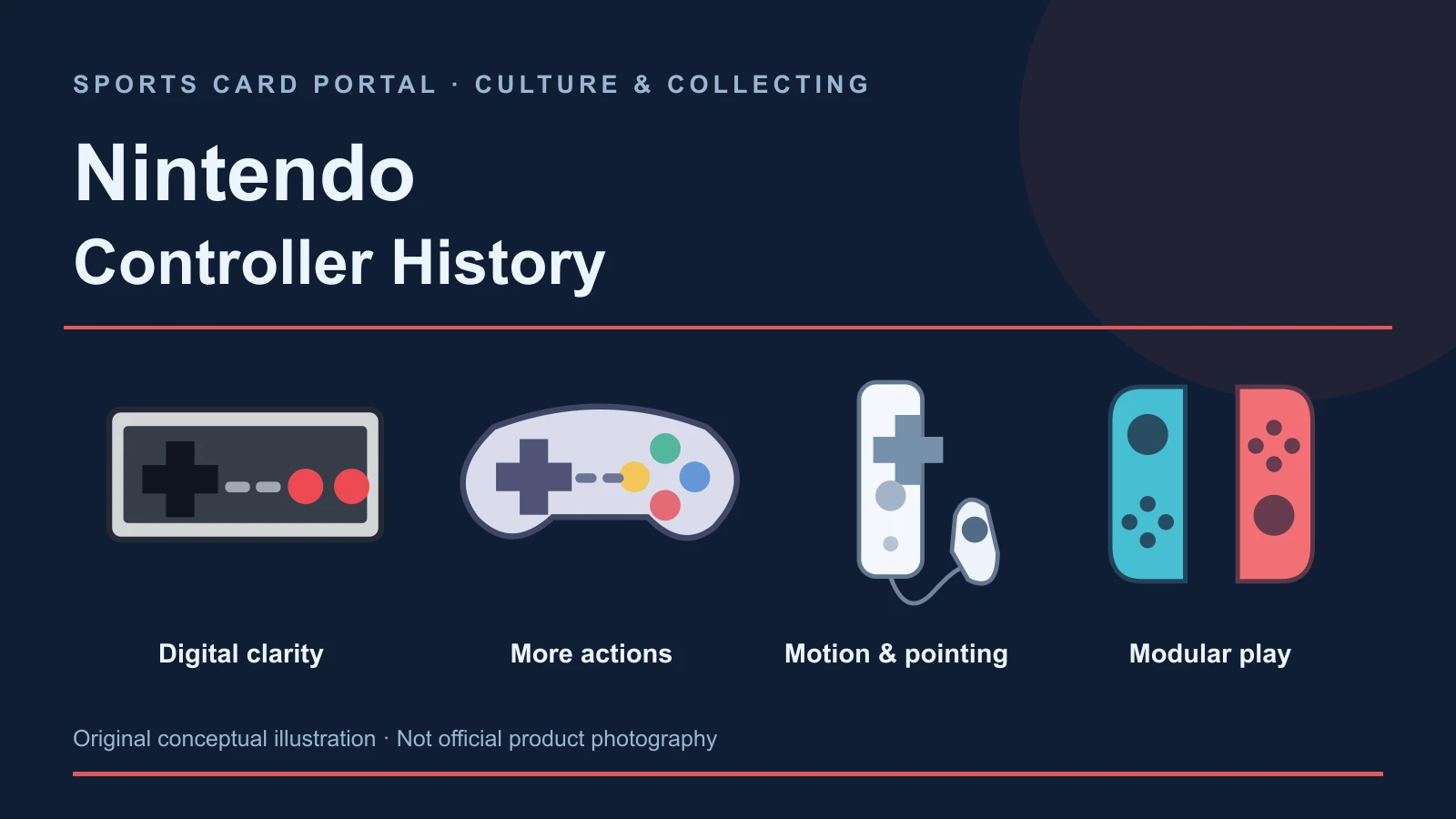
A collection does not always need a large object to tell a large story. Nintendo's controllers trace a history of changing game design through things small enough to hold in both hands. A directional cross, a shoulder button, an analog stick or a detachable half-controller can reveal what a particular generation expected from its players.
That is the perspective behind Joking Joystick's recent Nintendo controller feature. Rather than treating the controllers as a straight march toward one perfect shape, it follows different answers to a recurring question: how should a person communicate with a game? The answer changes when the software, screen, room and audience change.
The familiar arrangement starts with limits
The NES pad made its priorities easy to see. Movement sat under one thumb, two main action buttons under the other, with Start and Select between them. Its compact digital vocabulary could support many games because the software supplied the meaning. The same physical button could represent a jump, an attack or a menu choice in different contexts.
That relationship between a fixed object and changing software is useful for understanding collectible hardware. The controller preserves the arrangement, but the games preserve what people did with it. A display that includes a pad and an explanation of its intended system can communicate more than an isolated object presented only as a familiar shape.
The Super NES expanded the arrangement through additional face buttons and L and R shoulder controls. Those shoulder buttons gave the fingers another role without asking the thumbs to leave their main areas. It was a change in how actions could be distributed across the hands, not simply a higher button count.
Three-dimensional worlds ask another question
The Nintendo 64 controller visibly made room for analog movement. Its three grips and central stick capture a transitional moment in the way console games presented space. Looking at the hardware makes that transition tangible: a familiar directional pad coexists with another way to express movement, while the unusual body suggests that different games may invite different approaches.
The GameCube controller approached organization differently. A prominent A button gives the face-button cluster a clear center, with other controls surrounding it. Its two grips, sticks and analog triggers belong to a layout that can be read as a hierarchy of actions. That is an interpretation of the design, rather than a claim that every hand or game finds it ideal.
Wireless play adds another layer. WaveBird used a receiver-based connection, an important distinction when describing or preserving the accessory. A controller can represent a complete interaction only when its associated hardware is understood. A missing receiver is not just missing packaging context; it changes what equipment is available to make the system function.
Motion and modularity change the collection
Wii made orientation and movement part of the controller's identity. The Wii Remote could support motion and pointing, while accessories and alternative controllers served different software requirements. The important historical detail is coexistence: the platform did not make every earlier control habit disappear merely because a new interface was prominent.
This is why a controller's history is more precise than a simple list of features. A feature creates an opportunity for a game designer; it does not establish that every title uses it. A motion-capable accessory, a conventional pad and an additional attachment can belong to the same console while offering quite different experiences.
Joy-Con turned another choice into a physical mechanism. Controllers could remain attached to Switch or separate for supported arrangements. A controller held sideways, a pair held apart and a pair attached to the console are not identical postures. The hardware makes that flexibility visible, while individual games determine which arrangements are supported.
What the objects teach
For people who enjoy collecting tangible pieces of popular culture, Nintendo controllers offer a useful comparison with other objects that carry a larger story. A distinctive layout can evoke a period of play, but careful description gives that memory a firmer foundation. Identify the model, note the equipment it belongs with and distinguish the original object from a later recreation.
Modern reproductions or official wireless recreations may preserve a recognizable form while changing charging, connectivity or system buttons. That difference is worth documenting without deciding that one version is automatically more desirable. They answer different questions: one about the original accessory environment, another about bringing a familiar control language into a newer system.
The larger pattern is Nintendo's willingness to make the controller express a theory of play. The NES emphasizes a small, readable vocabulary. Nintendo 64 gives analog movement a conspicuous place. Wii foregrounds motion and the room, while Joy-Con makes adaptability part of the object. A controller collection can preserve those ideas alongside the hardware, showing how a game platform is designed as an encounter between software and the body.
Read the complete Nintendo controller history on Joking Joystick for the longer generation-by-generation feature.
Illustration: original conceptual editorial artwork, not official product photography.


Comments
0You must be signed in to comment.
Sign In