

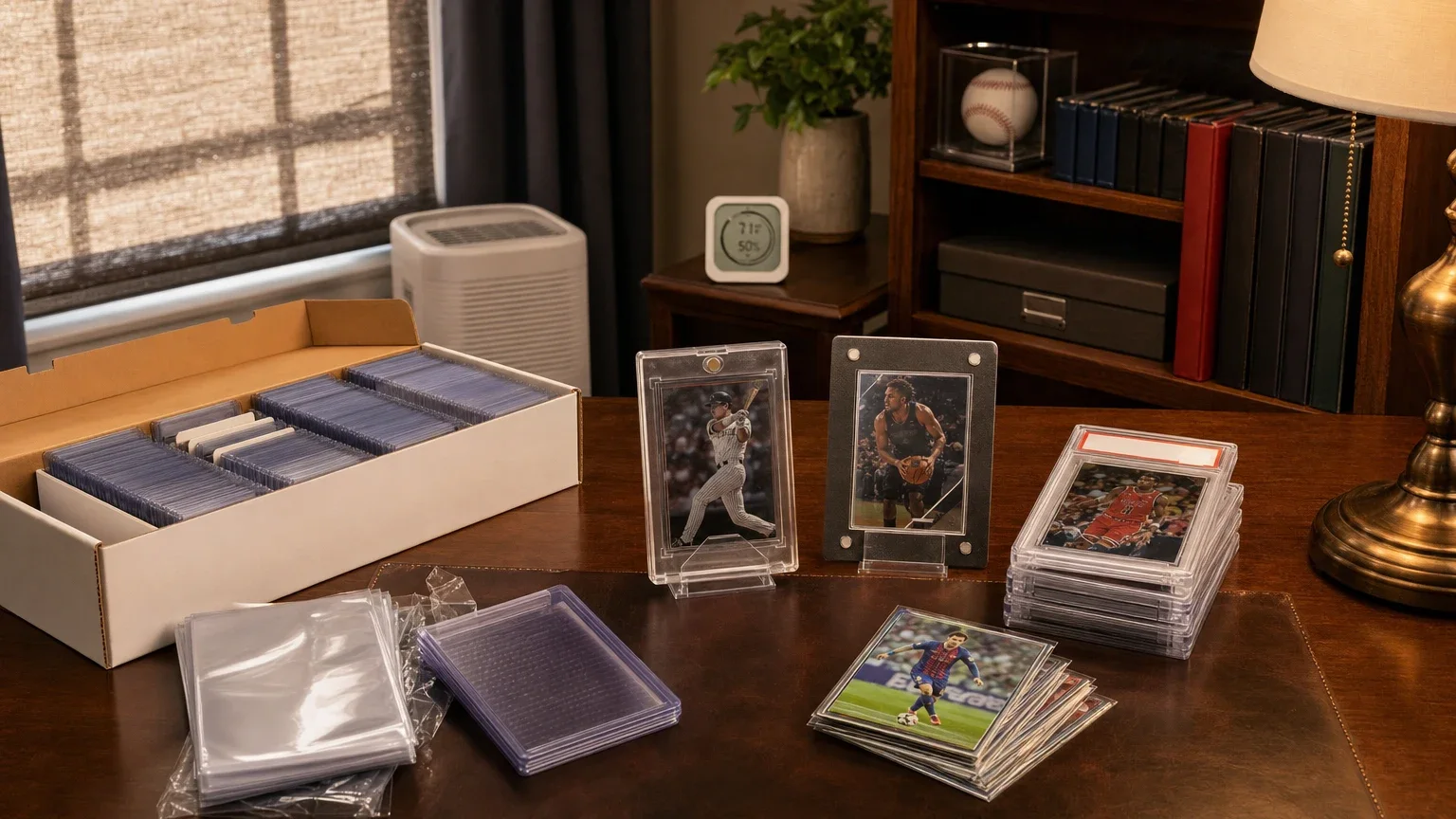
A lot of card damage happens slowly, and by the time it is obvious, it is usually permanent. Moisture warps cardboard and can stain surfaces. Heat and sunlight fade colors, raise temperatures, and can accelerate material breakdown. Handling adds fingerprints, edge wear, scratches, and accidental bends that collectors often notice only after the damage is done.
The good news is that most of this damage is preventable. The sources behind this guide point to the same practical habits again and again: store cards in a cool, dry, stable, low-light place; reduce handling; and match the holder to how you use the card. A sleeve helps with everyday contact, but a sleeve alone is not enough if the storage room is damp, hot, or sunny.
That layered approach matters because packaging and environment solve different problems. A rigid holder can limit scuffs and crush risk, but it does not fix humidity. UV-resistant plastic can help, but it is not a license to leave cards in direct sun. Even a graded slab protects best when the room around it is sensible. The strongest collection setups are usually the simplest ones, because they remove the biggest sources of harm before they start.
What does moisture actually do to cards?
Moisture is not only a matter of spilling water on a card. Humidity is a long-term problem because cardboard responds to the air around it. High humidity can cause warping, especially in foil cards, and direct liquid exposure can leave stains, softening, or mold. Once that kind of damage begins, no holder can truly reverse it. The best defense is to keep cards away from damp rooms and away from anything that regularly condenses.
That makes basements, attics, and places with frequent temperature swings poor long-term storage choices. A room can seem fine one week and then become a problem after a storm, a broken seal, or a summer heat wave. If you have ever seen a closet smell musty, noticed condensation on a window, or felt a sticky dampness in the air, that is a warning sign for a collection, even if the cards are inside boxes or binders.
The sources do not give a universal humidity number to target, and it would be misleading to invent one. So the safest evidence-based advice is practical rather than technical: avoid damp storage, keep cards away from leaks and spills, and do not assume a sealed container makes a wet room acceptable. Environment comes first because once water or persistent humidity reaches the card itself, the damage can become visible and lasting.
For collectors, this also changes how you think about different formats. A raw card in a penny sleeve, a card in a toploader, and a slabbed card are all still vulnerable if the room is bad enough. The holder can slow exposure, but it does not eliminate it. That is why moisture control is a room-level decision, not only a packaging decision.
- Avoid basements, attics, window ledges, and other damp or temperature-shifting spaces.
- Treat musty smells, condensation, and visible leaks as collection risks.
- Do not rely on packaging alone to solve a humidity problem.
- Keep cards away from spills, standing water, and long-term moisture exposure.
Why are heat and sunlight such a bad combination?
Heat and sunlight usually arrive together, and that combination is especially rough on cards. Sunlight can fade inks over time, while rising temperature can stress materials and contribute to warping or softening. Even if a holder offers some UV resistance, direct sun still carries heat risk. The practical issue is not only light hitting the card; it is also the heat trapped around the card and holder.
That is why a UV-protective box or display case should be thought of as a partial safeguard, not a permission slip. Ultra PRO’s guidance is explicit that collectibles should still be kept out of direct sunlight even when the container offers UV protection. In other words, the product can reduce one layer of exposure, but it does not cancel the basic physics of a hot window, bright shelf, or sunlit desk.
PSA’s holder materials are described as resistant to heat, humidity, water, and UV light, which is useful, but it should be read as a product-strength claim rather than a storage recommendation. A sturdy slab does not make a windowsill a safe archive. If a place is uncomfortably warm for you, or if a surface gets hot to the touch in afternoon light, that is not a good resting place for cards either.
When collectors ask where to put a favorite piece, the answer is often less about the holder and more about the room. Move the collection away from direct sun first, then think about display. A card in the right holder can still age poorly in the wrong location, while a modest holder in a dark, stable spot will usually outperform a premium case in a harsh environment.
- Direct sun can fade inks and raise temperatures around the card.
- UV-protective packaging is helpful but not a substitute for shade.
- Hot rooms, sunlit windows, and bright shelves are all poor storage choices.
- Place display items where light exposure is indirect and heat is controlled.
What is the safest first step for handling cards?
The safest first step is to touch the card as little as possible. Handling introduces oils, dust, dirt, and the chance of bending a corner or catching an edge. Even if your hands look clean, cards can pick up smudges and micro-wear from repeated contact. That is especially true for glossy finishes, dark borders, foil surfaces, and cards that already have delicate corners.
The practical habit is simple: sleeve first, then decide whether the card needs more protection. Beckett and Ultra PRO both frame sleeves as the first layer because they reduce handling exposure right away. For a card that will be sorted, traded, or viewed often, a penny sleeve is usually the minimum sensible barrier before any rigid holder or binder page comes into play.
It also helps to stop thinking of handling as an all-or-nothing issue. Many collectors damage cards not during dramatic accidents but during routine moments: removing them from a stack, sliding them into a binder, showing them to a friend, or checking the back one more time. Each extra touch adds small risk. Over time, those small risks are what blur corners, dull surfaces, and create visible wear.
If you want a simple rule, use this one: every unplanned touch is a chance for damage. Clean, dry hands matter, but the bigger win is reducing the number of times the card leaves its protective layer. For cards you rarely handle, move them into a more rigid holder and leave them there.
- Sleeve before repeated handling, sorting, or display.
- Use clean, dry hands, but do not treat bare-handed handling as harmless.
- Limit extra removals from binders, stacks, and boxes.
- Glossy and foil cards deserve especially careful handling.
When is a sleeve enough, and when should you upgrade?
Sleeves are the first line of defense, but they do not solve every problem. A sleeve is excellent for limiting fingerprints, dust, and light surface wear, and it works well for cards you browse or move often. It is not, however, much help against crushing force, heavy bending, flooding, or a rough box environment. That is where the next layer of protection comes in.
A top loader or semi-rigid holder makes more sense when the card is a prized single, a submission candidate, or a card you want to handle less often. Ultra PRO recommends putting the card into a soft sleeve before a rigid holder, which is an important step because a bare card can get scratched while you are inserting it. The sleeve is not optional just because the outer holder is hard.
For many collectors, the decision is less about absolute value and more about use. A card that comes out of storage for trade nights or sorting sessions may stay in a sleeve and binder page. A card that mostly sits in a box may move to a semi-rigid or top loader. The point is to match the holder to the amount of handling, not to use the same holder for every card simply because it is available.
If you are choosing between one holder and another, think in terms of risk reduction. Sleeves reduce contact. Rigid holders reduce bending and edge damage. Neither one fixes a damp room or direct sunlight. The best setup is usually a sequence of protections, not a single product pretending to solve everything.
- Sleeves are best for cards that are handled and viewed often.
- Use a soft sleeve before any rigid holder.
- Top loaders and semi-rigids add structure and reduce bending risk.
- Do not expect any holder to fix a bad environment.
What should you use for display pieces?
Display pieces need a different balance than archive cards. A card meant for a desk stand, shelf, or display case should still be protected from dust, fingerprints, and accidental knocks, but it also needs to look presentable. That is why one-touch style holders and similar display-first products exist: they provide a cleaner presentation than a loose sleeve while still creating a physical barrier.
Ultra PRO positions ONE-TOUCH holders as premium cases for collectible cards, and Beckett notes that some holders are designed to protect while remaining stackable and tamper-evident. Those features matter for display because you usually want the card to stay protected without repeated opening and closing. Repeated handling is often the enemy of a display card, even when the card never leaves your room.
The important limitation is that display protection is not environmental protection. A beautiful case still cannot protect a card from a hot shelf, a sunny windowsill, or a damp display cabinet. If a display area gets direct afternoon light or sits near a heat source, the case is only solving part of the problem. That is why display setups work best when the card is already in a stable room.
A good display setup is therefore two decisions, not one: choose the right holder, then choose the right location. If the room is stable and the holder is appropriate, display can be a safe option. If the room is unstable, the most attractive holder in the world is still the wrong tool.
- Use display-style holders for cards meant to stay visible and protected.
- Choose holders that minimize opening and closing.
- Keep display pieces away from sun, heat sources, and damp cabinets.
- Presentation matters, but location matters more.
How do graded slabs fit into a protection strategy?
Graded slabs are useful because they combine encapsulation, identification, and a strong protective shell. Beckett describes its graded holders as protective and display-friendly, while PSA’s materials emphasize holder integrity, certification, and label security. For collectors, that makes slabs especially appealing for cards that are important enough to preserve, but not frequently handled.
Still, a slab is not magic. It protects the card from many forms of contact damage, but it does not make the card immune to environmental stress. Heat, humidity, and sunlight remain relevant, and a slab can also be compromised by cracks, tampering, or counterfeit-holder issues. In that sense, the slab is a strong barrier, not a fortress.
It is also worth separating two ideas that collectors sometimes blend together: authenticity and condition. PSA’s grading standards allow for cards to be encapsulated as authentic without a numeric grade. That means the card was judged genuine, but it does not mean the card is high grade or damage-free. A slab can confirm identity without promising surface perfection.
For practical storage, slabs are best treated as the final layer, not the only layer. If a slabbed card sits in a hot room, beside a sunny window, or in a damp area, the holder is doing too little too late. Think of the slab as a preservation tool that works best when the surrounding environment is already under control.
- Slabs protect well against handling and display contact.
- Authentic-only and numerically graded are not the same thing.
- A slab does not cancel heat, humidity, or sunlight risk.
- Inspect holder condition and label integrity as part of collection care.
How should you organize a collection by risk level?
The easiest way to organize a collection is by how much risk each card faces in daily life. Cards that are frequently traded, sorted, or looked through should be in sleeves and accessible storage. Cards that are handled rarely can move into more rigid holders. Cards that matter most for preservation or display can be slabbed or placed in a more protective sealed holder.
This approach keeps you from overprotecting low-risk cards and underprotecting the ones that are most exposed. A common mistake is to use one expensive container for everything, which can be wasteful or inconvenient. Another mistake is to leave important cards in loose stacks because they are not being played with. The correct holder depends on use, not just on price or sentiment.
A useful way to think about it is in three questions: How often is the card handled? How much light and heat does the storage spot receive? How stable is the room itself? If the card is handled often, sleeve it and reduce friction. If the card is stored long term, prioritize a dark, dry, stable spot. If the card is especially important, add a rigid or encapsulated layer after the environment is right.
That logic also helps with mixed collections. A binder can make sense for browseable cards, while boxed storage can make more sense for archive cards. One-touch holders can be ideal for a few display pieces, and slabs can be reserved for cards where identification and preservation both matter. The best setup is usually not one format for everything, but a system that matches the role of each card.
If you are also building a focused collection, the same principle applies to your storage choices. The setup should fit the card’s role in the collection, not the other way around. For a related planning mindset, see How to Build a Focused Football Card Collection.
- Sort cards by handling frequency, not just by perceived value.
- Use sleeves for active cards, rigid holders for rarely handled cards, and slabs for key pieces.
- Match storage style to the card’s role in the collection.
- Build a system, not just a pile of products.
What are the most common mistakes collectors make?
The biggest mistakes are usually the simplest ones. Cards stored in attics, basements, or sunny rooms are exposed to the three main threats at once: moisture, heat, and light. Another common mistake is assuming a UV-protective container makes direct sunlight harmless. It does not. At best, it reduces one part of the risk; it does not remove the rest.
Another frequent error is skipping the sleeve before using a rigid holder. That seems minor, but it can create scratches during insertion, especially on delicate surfaces. Handling cards with dirty or oily hands is another avoidable problem, because smudges and grime can become permanent-looking marks on glossy stock. The damage may not be dramatic, but it is cumulative.
Collectors also sometimes treat a slab as proof that nothing can go wrong. PSA’s security and terms materials make clear that counterfeit holders and tampered labels are recognized concerns, so holder integrity matters. A good slab in a bad environment is still a compromised setup, and a suspicious slab should be inspected, not trusted automatically.
In other words, the most common mistakes are less about buying the wrong product than about misusing the right one. Cards are usually damaged by location, routine handling, and storage habits long before they are damaged by a catastrophic event. If you fix those everyday habits, you prevent most of the avoidable wear.
- Do not store cards in hot, damp, or sunlit spaces.
- Do not assume UV protection equals safe sunlight storage.
- Do not place a bare card directly into a rigid holder.
- Do not treat every slab as automatically trustworthy.
What is the simplest safe setup for most collectors?
For most collections, the simplest safe setup is also the most durable: keep the room cool, dry, and out of direct sun, sleeve the cards you handle, and use a rigid holder only when the card’s role justifies it. That order matters because it addresses the biggest risks first. Packaging is important, but it cannot compensate for a poor location.
A good baseline might be a sleeve for most individual cards, a top loader or semi-rigid for selected singles, and slabbed holders for the pieces you want to preserve or display with extra confidence. Binder pages can work for browseable cards, while boxed storage can work for archive cards. The key is consistency: every card should have a place, and that place should reflect how often the card is touched.
If you do only one thing today, move the collection away from moisture and direct sunlight. If you do a second thing, sleeve the cards you handle most. Those two moves prevent a surprising amount of damage because they attack the most common sources of wear before the collection even gets to the point of needing a premium holder.
A collection does not need to be complicated to be well protected. It needs to be stable, low-handling, and stored with intention. Once those basics are in place, the fancier holders become what they should be: useful tools, not emergency repairs.
- Start with room choice, then choose holders.
- Use sleeves for routine handling and rigid holders for selected cards.
- Keep the collection away from direct sunlight and damp spaces.
- Consistency beats complexity in collection care.
Frequently Asked Questions
Is a UV-protective case enough to store cards in a sunny room?
No. UV protection can help, but direct sunlight still creates heat risk and may still allow some damaging exposure. The safer choice is to keep the card out of direct sun altogether.
Do graded slabs protect cards from humidity?
They help with physical protection, but they do not eliminate environmental risk. A slab is only one layer of protection, and the room still needs to be cool, dry, and stable.
Should every card go straight into a top loader?
Not necessarily. Many cards are better served by a sleeve alone, especially if they are handled often and stored in boxes or binders. Rigid holders make the most sense for cards that need more structure or less frequent handling.
What is the best place to store a card collection?
A cool, dry, low-light room with stable conditions is the safest general answer. Avoid damp spaces, sunlit windows, and areas that heat up quickly.
Written with AI assistance. Featured image: AI-generated editorial illustration.


Comments
0You must be signed in to comment.
Sign In