

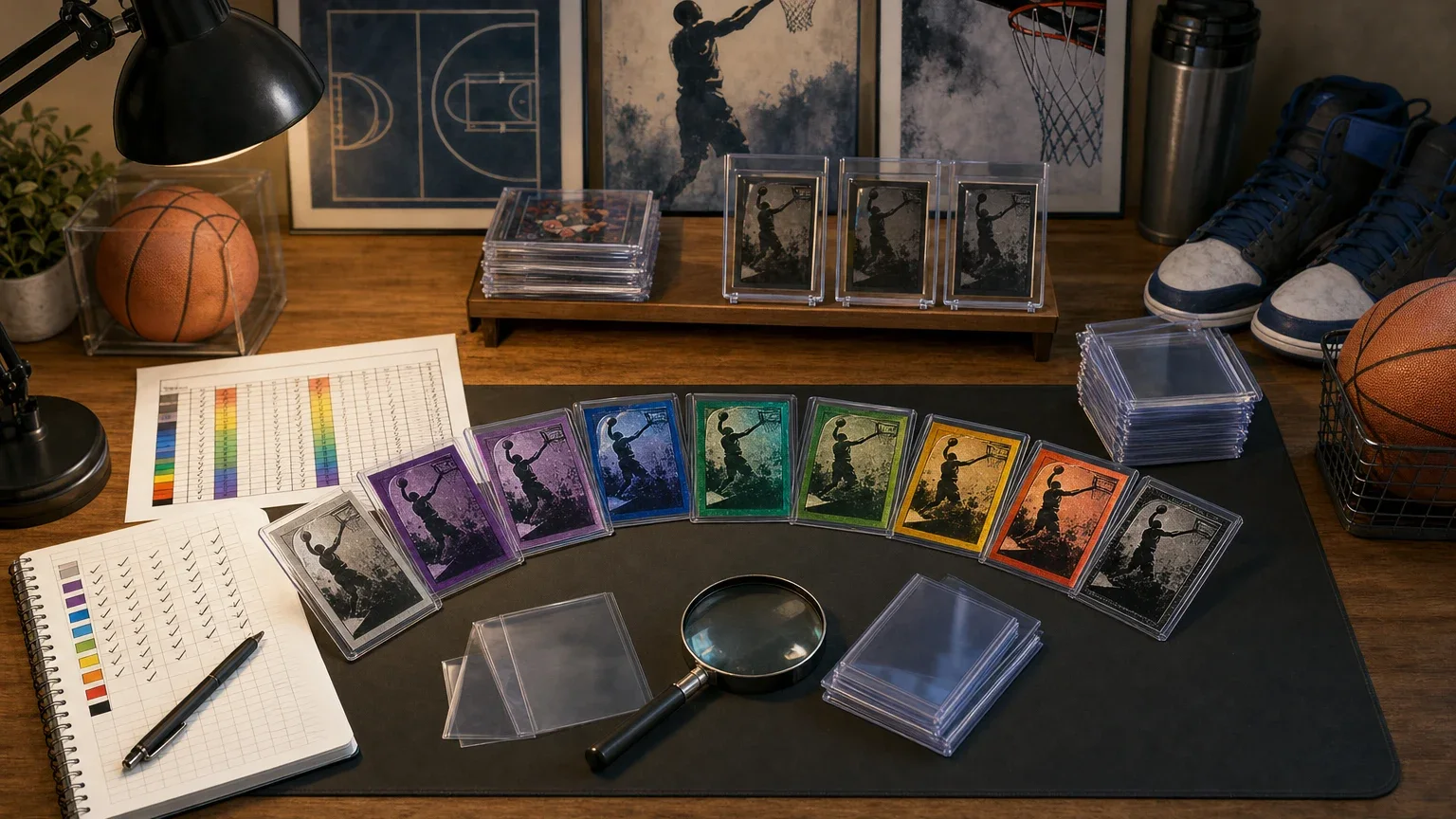
A good parallel rainbow looks simple from the outside: one card, then a long run of color and finish variations. In practice, it becomes messy fast. Product names blur together, checklist lines get mistaken for parallels, and collectors often chase cards that were never part of the release they actually meant to build. The safest way to stay organized is to treat the official checklist as the foundation and the rainbow as a project built on top of it.
That matters because parallels are not one universal hobby category. In official collecting language, a parallel is the same core card presented with a different color, texture, pattern, or material. That means the rainbow is not just a player concept or a general theme; it is a product-specific list of versions tied to one checklist entry. If you start with the player and ignore the checklist, you can easily end up tracking the wrong cards, the wrong release, or a version that does not even exist in the format you want.
The most useful rainbow plan is the one that answers a few questions early: Which product are you building from? Are you collecting every visual variant or only the numbered ones? Are you willing to include retail exclusives, unnumbered refractors, or autograph versions if the product offers them? Once those questions are clear, the checklist becomes a working tool instead of a scavenger hunt. The rest of the process is about keeping that tool clean, current, and specific enough that you know exactly what belongs in the run and what does not.
Why should the checklist come before the rainbow idea?
The checklist should always come first because it tells you what the product actually contains. A rainbow is simply the same base card repeated across approved variations, so the checklist is the only reliable way to know which versions belong in the chase. If you begin with a vague idea like a “player rainbow,” you may accidentally mix base cards, inserts, image variations, and parallels that live in different corners of the release.
This is especially important in modern products, where the card universe around one subject can include base cards, inserts, autograph versions, relics, and a range of finish changes. A clean rainbow tracker starts with the base card line and then maps the parallel names underneath it. That keeps the project anchored to the product instead of to whatever shows up in a search result or marketplace listing.
- Use one checklist row per base card before adding parallel columns.
- Write down the exact card number and release name first.
- Treat inserts and variations as separate unless the checklist clearly places them in the same rainbow path.
- Do not assume that a player’s card in one product matches the same player’s card in another product.
How do you build a master tracker that stays usable?
The simplest tracker is usually the best one. Start with one row for each checklist card and add fields for card number, base or insert status, known parallel names, serial numbering, release channel, and acquisition status. If you want the rainbow to stay manageable, the tracker should make it obvious at a glance what you still need and what version you have already seen on the market.
A useful tracker also separates facts from assumptions. If a parallel is confirmed in the official checklist, note it as confirmed. If you have only seen it listed by sellers but have not verified it in the release details, mark it as unconfirmed until you can support it. That distinction saves time later, especially when products contain similar-sounding finishes or region-specific exclusives that look like they belong together but are not part of the same chase.
- Add columns for serial number, if present, and for the channel where the card appears.
- Create a status field such as needed, pending, acquired, or unverified.
- Keep separate notes for hobby, retail, and shared distribution if the product makes that distinction.
- Use one master sheet instead of separate lists scattered across apps, notes, and messages.
What is the difference between a numbered rainbow and a visual rainbow?
These are related projects, but they are not the same. A numbered rainbow includes only parallels with serial numbering, so the chase is limited to cards that can be counted and identified by print sequence. A visual rainbow is broader and can include unnumbered color and finish changes, texture shifts, retail exclusives, or other variants that belong to the same base subject even when no numbering appears on the card.
That distinction matters because many collectors use the word rainbow loosely, while product language can be broader than the hobby shorthand. If you do not define the project early, you may spend months chasing cards that you later decide do not belong in your version of the rainbow. The best approach is to define the target in writing before you buy the first single or rip the first box.
- Numbered rainbow: only serial-numbered parallels count.
- Visual rainbow: all relevant finish and color variants count, even if unnumbered.
- Write your definition at the top of the tracker so the rules stay consistent.
- If you change the rules later, start a second tracker rather than rewriting the first one.
How should you rank your targets before buying anything?
A good rainbow plan needs priorities, not just enthusiasm. The easiest way to stay disciplined is to sort the chase into tiers. The base card comes first, then the most accessible parallels, then the mid-range numbered versions, and finally the scarcer cards such as short prints or 1/1-style finishes if they are part of that release. This prevents you from spending heavily on a low-probability card before you have secured the easier pieces of the run.
That tiering also makes the project feel achievable. Many collectors stall because they start with the rarest card in the set and ignore the cards that can actually be found in the market. A better plan is to create momentum with the lower-friction cards, then decide whether the final chase is worth the time, budget, and patience. If the product also includes autograph or relic versions, treat those as separate goals unless they are clearly part of the exact rainbow you want to build.
- Tier 1: base card.
- Tier 2: common or lower-friction parallels.
- Tier 3: mid-tier numbered parallels.
- Tier 4: short prints, rare finishes, or 1/1-style cards if they belong to the same checklist path.
- Tier 5: autograph or relic versions only if your rainbow explicitly includes them.
When do pack odds matter more than wishful thinking?
Pack odds are not a promise; they are a reality check. If the checklist and odds show that a target parallel is extremely scarce, you can save yourself frustration by deciding early that ripping for that card is unlikely to finish the job. In that case, singles become the more realistic path. Odds are most useful when they help you separate what is possible from what is practical.
This is also where collectors get tripped up by product marketing. A release may be presented as a rainbow-friendly chase, but that does not mean every parallel is equally easy to pull or that every box guarantees the cards you want. The product page and its published odds are the reliable starting point for understanding what is actually in circulation and how hard it may be to obtain.
- Use odds as a budgeting tool, not a promise of what you will pull.
- If a key parallel is very scarce, plan for singles rather than pack search alone.
- Check the product page whenever you are unsure whether a version is hobby-only, retail-only, or shared.
- Do not equate a colorful product description with a complete checklist map.
How do you keep product-specific rainbows from bleeding into each other?
The safest rainbow plan is release-specific. A Chrome rainbow is not interchangeable with a flagship rainbow, even if the player is the same, because the checklist, parallel structure, and distribution details can differ sharply. One product may center on refractor-style finishes, while another may emphasize a completely different set of colors or materials. If you mix them together, the tracker stops being a roadmap and turns into a jumble of similar-looking cards.
This is why the product name belongs in every tracking field and every purchase note. Even when two cards share the same subject and year, they may belong to different collecting goals. A clean system keeps each release in its own lane, which makes it easier to compare apples to apples when you are deciding whether a card fills a gap in the rainbow or belongs to a separate project altogether.
- Write the exact product name beside every tracked card.
- Keep separate trackers for separate releases, even if the subject overlaps.
- Do not merge parallel lists from different products unless the official checklist tells you to.
- Use the release year plus product name as your default label format.
What should you record when buying graded singles?
Buying slabbed cards can make completion easier, but it adds another layer of recordkeeping. A rainbow tracker should note the certification number, the service type, and whether the holder reflects authentication only or includes a numeric grade. That information matters because a slab can mean very different things depending on the submission service used. A card that is authenticated is not automatically a high-grade card, and a grade does not by itself tell you everything about the submission category.
Certification lookup is helpful, but it is not the same as total certainty. Verification can confirm that a certification number exists, yet it does not remove every counterfeit risk. That is why serious collectors compare the cert details, the label, the card, and the holder itself. If something looks inconsistent, the tracker should reflect that uncertainty rather than pretend the problem does not exist.
- Record the certification number every time.
- Note whether the service is authentication only, grading only, or both.
- Compare the label information with the actual card and holder before filing it as complete.
- Treat certification verification as one check, not the final word.
How can you spot slab and label problems before they become mistakes?
Counterfeit risk is one of the least glamorous parts of rainbow collecting, but it is a real one. PSA notes that its tamper-evident label is designed to show removal and that certification documents can include security features, yet it also warns that counterfeiters may still copy public certification information. For collectors, that means the slab itself should be part of the evaluation, not just the card inside it.
In a rainbow project, this is especially important when you are trying to close a rare hole with a single expensive purchase. A copied label or a mismatched certification record can create false confidence. The best defense is a habit of documentation: save the cert number, note the visible condition of the holder, and flag any mismatch immediately instead of assuming the problem will sort itself out later.
- Inspect the holder, not just the card image.
- Save the cert number and compare it against the certification record.
- Look for inconsistencies in label style, holder condition, or service details.
- If a slab looks questionable, mark it as unconfirmed until you verify more fully.
What are the most common ways rainbow collectors lose the thread?
The most common mistake is assuming every color equals a separate card family. In many products, the parallel is the same base subject with a changed finish, not a new checklist line. Another common error is trusting a marketplace title more than the official checklist. Sellers may describe a card in a way that sounds right but does not match the product’s actual structure, especially when similar cards appear across multiple releases.
Collectors also lose track when they confuse product completion with packout logic. A box can be complete by its own guaranteed contents even if it never yields the parallel you wanted. That is a product reality, not a failure of the checklist. The tracker should therefore separate what you pulled, what you bought, and what you still need, rather than mixing all three into one undifferentiated status line.
- Do not assume a color variant is automatically a new checklist entry.
- Do not treat marketplace titles as more reliable than the official product details.
- Separate pull history from purchase history in your tracker.
- Remember that a box can be complete by its own rules even if your rainbow remains incomplete.
What does a strong rainbow plan look like in practice?
A strong plan is specific enough to answer decisions quickly. It tells you which exact release you are chasing, which parallel types count, which versions are optional, and which cards you will only buy as singles. It also tells you how to record the card once you find it. That structure keeps the project moving, especially when new listings, new product pages, or new market prices appear and tempt you to rewrite the rules halfway through.
The real advantage of checklist-first planning is that it reduces noise. You no longer have to wonder whether a card belongs in the rainbow, whether a slab is authentic enough to count, or whether a numbered version should outrank an unnumbered visual parallel. The answers are already in the framework you built at the start. That makes the chase more deliberate, more readable, and much less likely to collapse into duplicate purchases or false starts.
- Define the release, the parallel types, and the stopping point before you begin.
- Keep the tracker simple enough to update quickly after every purchase.
- Use the checklist and odds to decide whether ripping or buying singles makes more sense.
- Separate confirmed cards from maybes so the project stays trustworthy over time.
Frequently Asked Questions
Should I start a rainbow chase before I have the official checklist?
It is better to wait. The checklist tells you which versions belong to the product, which makes it the foundation for every later decision.
Is a numbered rainbow always better than a visual rainbow?
Not necessarily. A numbered rainbow is more narrowly defined, while a visual rainbow can be more complete aesthetically. The right choice depends on the project you want to build.
Can I trust a slab label on its own?
No. Certification verification helps, but it does not eliminate counterfeit risk. You should compare the cert, the holder, and the card itself.
Do pack odds tell me whether I should rip boxes or buy singles?
They help, but they do not guarantee results. If the card is very scarce, the odds often make singles the more practical route.
What is the biggest mistake new rainbow collectors make?
Mixing products, parallel types, and checklist lines into one list. A clean, product-specific tracker prevents most of the confusion.
Written with AI assistance. Featured image: AI-generated editorial illustration.


Comments
0You must be signed in to comment.
Sign In