

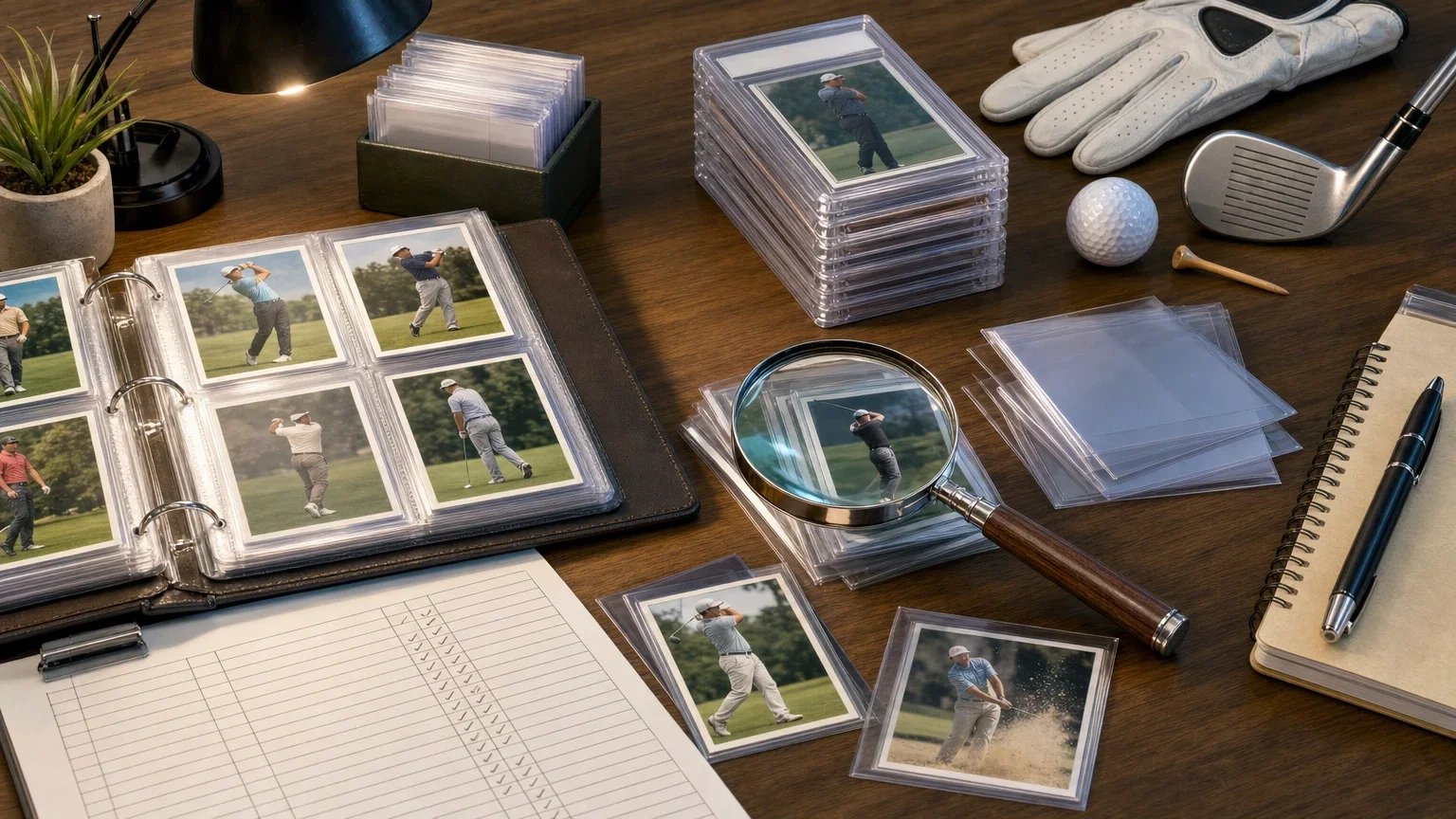
Golf card collecting gets easier when you stop trying to collect everything at once. Modern golf releases are structured around base sets, subsets, inserts, parallels, autographs, memorabilia, and tech cards, so a focused plan can save both money and frustration.
The key is to choose a lane before you buy. That could mean a single product line, a short list of players, or a format-based goal such as completing a base set, collecting serial-numbered parallels, or building only authenticated autograph cards.
The current Upper Deck golf checklists show how varied the hobby can be in a single release, while PSA and Beckett make clear that grading, authentication, and certification are related but not identical decisions. A good collection plan respects those differences instead of blurring them together.
What kind of golf collection are you actually trying to build?
The first decision is not which card to buy. It is what the collection is supposed to be. In golf, that matters because modern products can support very different goals at the same time: complete base sets, subset runs, player PCs, serial-numbered parallels, or premium hit collections. Upper Deck’s 2026 golf products show that range clearly, with one release built around a 140-card structure and another centered on a smaller 90-card base set with multiple hit types.
A collector who wants a visible shelf display may prefer a base or subset project. A collector who wants scarcity may prefer numbered parallels. Someone who enjoys centerpiece cards may lean into autographs or memorabilia. None of those approaches is wrong, but each requires a different budget, different patience, and a different definition of “complete.”
A practical way to narrow the field is to ask what would make the collection feel finished after a year. If the answer is “a full base run,” that is a set-building project. If the answer is “five favorite autograph cards,” that is a player-focused premium project. If the answer is “every card from one subset,” that is a hybrid of both.
- Pick one primary lane before buying anything.
- Treat base, parallels, autos, and mem cards as separate projects.
- Define “complete” in a way you can realistically reach.
- Choose the lane that matches your budget and patience, not just your excitement.
Why does the product checklist matter so much in golf?
Golf card releases can look simple on the surface and still be complicated underneath. The 2026 Upper Deck Golf checklist shows how a product can be divided into named subsets such as Vets/Legends, Season Highlights, Debut Dates, Young Guns, and Retrospective Young Guns. That means a collector is not just chasing a base card; in practice, the product is built around multiple mini-sets inside the main set.
That structure changes buying decisions. If you only want cards of a few golfers, a checklist tells you whether they appear as base subjects, in a subset, or perhaps not at all. If you are trying to finish a full run, the checklist also tells you which names are likely to be the bottlenecks and which names are likely to be common enough to buy cheaply as singles.
The same idea applies to premium products. Upper Deck’s 2026 Artifacts Golf page emphasizes numbered content, autograph and memorabilia elements, and multiple insert styles. A checklist is the difference between “I like this product” and “I know what I’m trying to pull from it.”
- Use the checklist to define your target, not just to admire the player names.
- Identify which cards are base, which are subsets, and which are inserts.
- Expect some golfers to be easier to complete than others.
- Read the checklist before deciding whether to rip or buy singles.
Which collecting format is best for a starter golf collection?
For most new collectors, base-set or subset collecting is the easiest place to begin. It teaches the structure of the product, keeps costs more manageable, and gives the collection a clear finish line. The 2026 Upper Deck Golf release is especially useful for this kind of plan because its 140-card structure includes several named subsets, so a starter collection can be simple without being boring.
Parallel chasing is more demanding. Upper Deck’s 2026 Artifacts Golf page leans into serial-numbered content, which changes the collecting experience from completion to scarcity hunting. That can be exciting, but it also makes progress slower and usually less predictable. The same is true, often more so, for autograph and memorabilia collecting, where the checklist is smaller and the average cost per card is usually higher.
For a first golf collection, a good rule is to start broad and then narrow. A base or subset run teaches you which players and designs you enjoy most. Once you know that, you can decide whether to upgrade the project into a parallel chase or a premium hit collection.
- Best starter lane: base or subset collecting.
- Best scarcity lane: serial-numbered parallels.
- Best centerpiece lane: autograph or memorabilia cards.
- Start broad first if you do not yet know your preferred style.
How should you choose players without turning the project into a wishlist?
A focused player list works best when it serves a purpose. The current checklists show a mix of established stars, legends, and newer names, including players such as Tiger Woods, Annika Sorenstam, Viktor Hovland, Lilia Vu, Rose Zhang, and John Daly II in the 2026 Upper Deck Golf checklist excerpt. That mix is useful because it gives collectors multiple ways to build a theme without needing every famous golfer in every product.
One sensible approach is to choose players by category. An icon-driven collection might center on historic names that appear across multiple products. A current-tour collection might focus on active golfers in the latest release cycle. A personal-favorite collection might ignore the market entirely and simply target a handful of golfers whose cards you actually want to own. Each approach is valid if it stays limited.
The mistake is mixing categories without a rule. If you try to collect “the best golfers, my favorites, and all rookies” at once, the project expands too quickly. A better plan is to decide whether the player list is meant to express history, present-day fandom, or checklist completion.
- Choose players by collecting purpose, not just reputation.
- Use one of three clear scopes: icons, current players, or personal favorites.
- Let the product checklist decide who is realistically collectible in that release.
- Avoid building a list so broad that it has no finish line.
Should you collect raw cards, graded cards, or authenticated items?
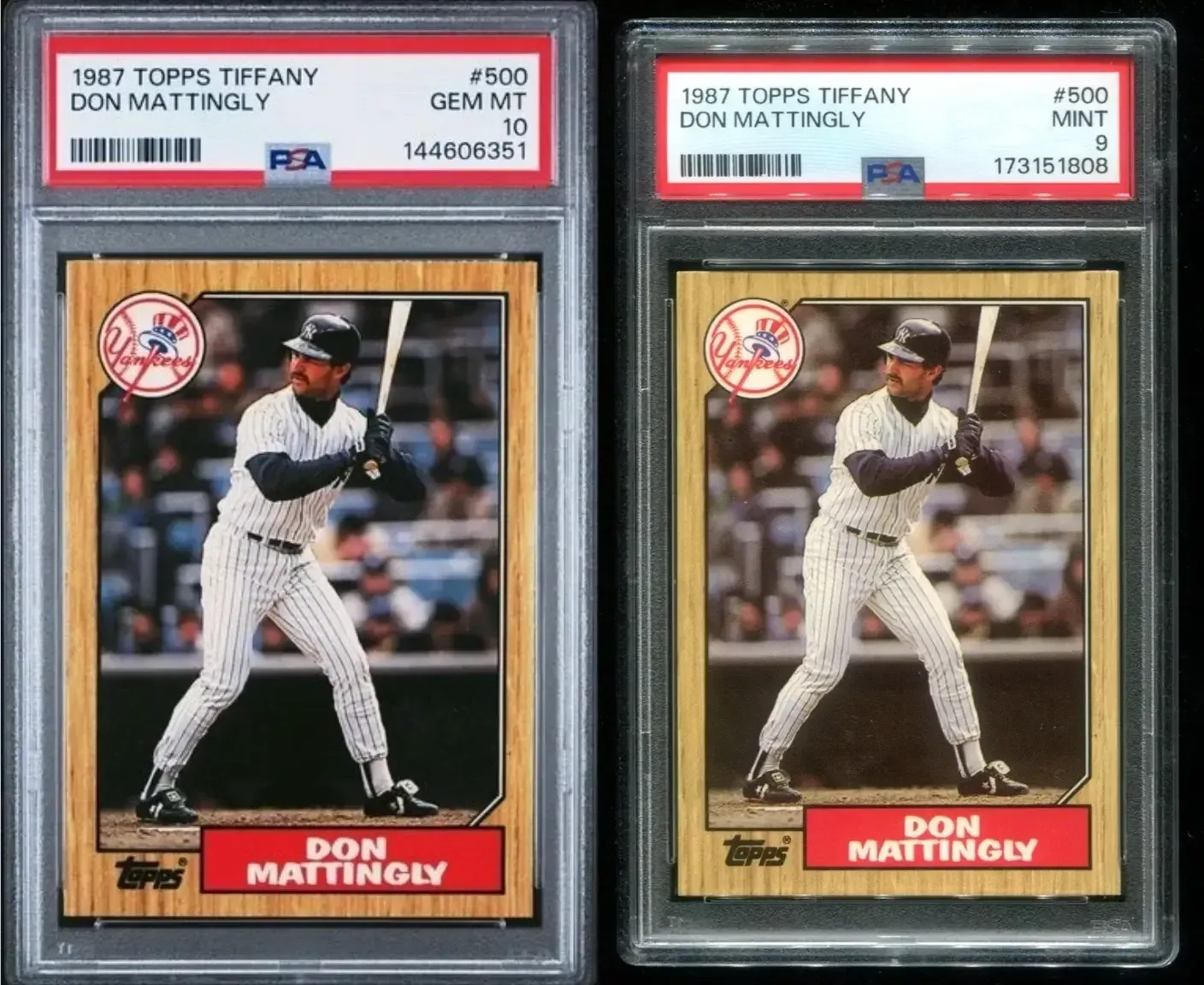
This is one of the most important decisions in any golf collection. PSA explains that authentication is the process of verifying originality or genuineness, while grading is a separate judgment that assigns a numeric condition score. Beckett’s grading language similarly treats card condition assessment as a distinct process. That means a card can be genuine without being high-grade, and a graded card can be legitimate without being perfect.
For collectors, the right choice depends on the goal. If the main goal is display or completeness, raw cards may be enough. If the goal is condition certainty or registry-style collecting, numeric grading may matter more. If the goal is simply to confirm that an autograph or item is genuine, authenticity alone may be the more practical target.
It helps to decide this early, because condition standards affect everything else. They influence the singles you chase, the prices you are willing to pay, and even how much tolerance you have for edge wear, centering, or surface flaws.
- Authentication and grading are not the same thing.
- Raw, authenticated, and graded cards are three different collecting outcomes.
- Choose your condition standard before you buy too deeply.
- Your standard should match how you plan to store, display, or resell the cards.
How much should you trust certification lookup tools?
Certification lookup is useful, but it is not a perfect shield. PSA states that checking a certification number does not eliminate risk, and it warns that counterfeiters may use real certification numbers from public sources. PSA also notes that its database is for confirming data about authenticated items with a particular certification number, not for validating every marketplace listing around that number.
That distinction matters because many collectors assume a matching lookup settles the question. It does not. A valid certification can still be misused, copied, or presented in a misleading listing. The practical response is to use the lookup as one check among several, not as the entire decision.
A careful buyer looks at the slab, the label format, the certification data, the seller, and the listing context. The certification is important, but the surrounding evidence matters too. That is especially true when buying premium golf cards online, where the difference between genuine and questionable can be subtle to the untrained eye.
- Use certification lookup as a check, not a conclusion.
- A valid number does not automatically make every listing trustworthy.
- Compare the slab and label to known grading-service formatting.
- Buy from sources you trust when the card is expensive or uncommon.
What does a smart budget plan look like for golf cards?
The best budget plan is the one tied to a specific target. If you want a base or subset run, you can usually spread spending across many lower-cost cards. If you want a handful of autograph or memorabilia cards, the budget will likely concentrate on fewer, pricier purchases. The product structure itself points you toward that difference, since current golf releases can include a mix of base, parallels, autos, mem cards, and tech inserts.
That means a collector should decide where to spend aggressively and where to save. A sensible strategy is to use singles for the most important names and only rip boxes when the checklist offers enough variety to make the process enjoyable, not merely expensive. There is no guarantee that ripping will solve a collecting need more efficiently than buying singles, and the product structure suggests it often will not.
Budgeting also works better when you set a ceiling for each lane. For example, you might decide that your base-set budget is separate from your premium-hit budget. That keeps a short-term chase from eating the money meant for your longer-term project.
- Set separate budgets for base cards and premium hits.
- Use singles for priority cards when the checklist is spread out.
- Treat ripping as entertainment, not as a guaranteed path to completion.
- Cap spending per lane so one chase does not derail the whole collection.
How do print runs and numbering affect your collecting plan?
Scarcity sounds straightforward until a product gets specific about what is and is not numbered. Beckett’s coverage of 2026 Artifacts Golf notes that cards without serial numbers do not have announced print runs. That is an important boundary: if a card is not numbered, you should not assume a hidden scarcity level unless the manufacturer actually states one.
For collectors, that means numbering should influence the plan but not overrule the checklist. A serial-numbered card is easier to frame as scarce, but an unnumbered card can still be important within a set, especially if it belongs to a key player or a desirable subset. The checklist tells you what the card is; numbering only tells you part of the story about quantity.
This is why format-first planning works so well. A collector who wants numbered content can target a product like Artifacts. A collector who wants a broader team or player mix may prefer a larger set structure. The point is not that one is better than the other; it is that each demands a different kind of attention.
- Do not invent a print run when the card is unnumbered.
- Use numbering as one factor, not the only factor.
- A numbered card can still be less important than a key base or subset card.
- Choose products whose scarcity style matches your goals.
When should you buy singles instead of chasing boxes?
Singles make the most sense when your target is specific and your tolerance for randomness is low. If you only want one player, one subset, or one particular parallel color, buying the exact card is usually cleaner than hoping a box delivers it. The current golf checklists support that logic because they show products with multiple card types and mixed hit structures, which naturally increases uncertainty.
Box ripping still has a place, especially if you enjoy the experience itself. It can make sense for collectors who want variety, who like prospecting through a checklist, or who are building a broad starter pile before narrowing down. But the more precise your goal becomes, the more singles usually fit the job.
A good compromise is to rip a little and buy a lot. Open enough product to learn the set, then use the checklist to identify the cards you actually care about. That approach keeps the collecting process fun without letting randomness control the final shape of the collection.
- Buy singles when the target is narrow.
- Rip boxes when you value the experience and variety.
- Use boxes to learn the set, then finish with singles.
- The more exact your goal, the more efficient singles usually become.
What is a practical starter plan for the next 30 days?
A simple 30-day plan keeps the project from becoming abstract. Start by choosing one product family and one collecting lane. Then build a short target list of players or subsets, set a condition standard, and decide how much you are willing to spend before you buy anything. The goal is not to own a lot of cards immediately; it is to define the collection well enough that each purchase has a job.
After that, build your checklist in layers. First, identify the cards you want most. Next, note which ones are realistically available as singles. Then decide whether any boxes are worth opening for fun or for a wider base of cards. If you are considering graded or authenticated items, add certification verification to your purchase routine from the start.
If you want an example of a balanced starter path, it would look like this: one product line, one group of players, one format, one condition rule, and one spending limit. That sounds basic, but it is exactly what prevents a golf collection from turning into a pile of unrelated cards.
- Choose one product line.
- Choose one player scope.
- Choose one format: base, parallels, autos, or graded.
- Choose one condition standard.
- Choose one monthly budget.
- Use the checklist before buying any premium card.
Frequently Asked Questions
What is the easiest way to start a golf card collection?
The easiest start is usually a base-set or subset project from one product line. It keeps the collection organized, teaches the checklist structure, and gives you a clear finish line.
Is a serial-numbered card always scarcer than an unnumbered one?
Generally, serial numbering is a strong scarcity signal, but you should not assume an unnumbered card has a hidden print run. If the manufacturer does not announce a print run, treat scarcity conservatively.
Should I collect graded golf cards or raw cards?
It depends on your goal. Grading is about condition, while authentication is about genuineness. Raw cards may be enough for a display or starter collection, while graded or authenticated items may better fit condition-focused or premium collections.
Are certification lookup tools enough to prove a card is real?
No. They are useful, but PSA specifically warns that lookup does not eliminate risk and that real certification numbers can be misused in counterfeit contexts.
When does it make sense to buy singles instead of boxes?
Singles make the most sense when your target is narrow, such as one player, one subset, or one parallel. Boxes are better when you want variety or enjoy the rip itself, not when you need one exact card.
Written with AI assistance. Featured image: AI-generated editorial illustration.


Comments
0You must be signed in to comment.
Sign In